 blog
blog
Alternatives to Standard Wrapped V-Belts
Table of Contents
- Why Consider Alternatives to Standard Wrapped V-Belts
- Cogged vs Wrapped V-Belts: Construction and Performance
- Raw-Edge vs Wrapped V-Belts: Durability and Load Capacity
- Banded V-Belts: Multiple Belts for Heavy-Duty Applications
- How to Identify V-Belt Size and Compatibility
- Total Cost of Ownership: Purchase Price vs Operating Efficiency
- Installation, Tensioning, and Troubleshooting
- Frequently Asked Questions
Last Updated: October 5, 2026
Why Consider Alternatives to Standard Wrapped V-Belts
When your facility relies on wrapped V-belts, it's easy to assume they're the only option. They're familiar, widely available, and they work, but that familiarity can mask real inefficiencies when your application demands better heat dissipation, higher load capacity, or longer service life.
Alternatives to standard wrapped v-belts have evolved significantly. Cogged belts reduce heat buildup, raw-edge belts handle extreme loads, and banded configurations multiply capacity, each addressing pain points wrapped belts struggle with. At V-Belt Nation, we help maintenance teams and procurement specialists match the right belt type to their operating conditions.
This guide covers the major alternatives to standard wrapped v-belts, how they perform under different conditions, and how to decide which one fits your application.
Cogged vs Wrapped V-Belts: Construction and Performance
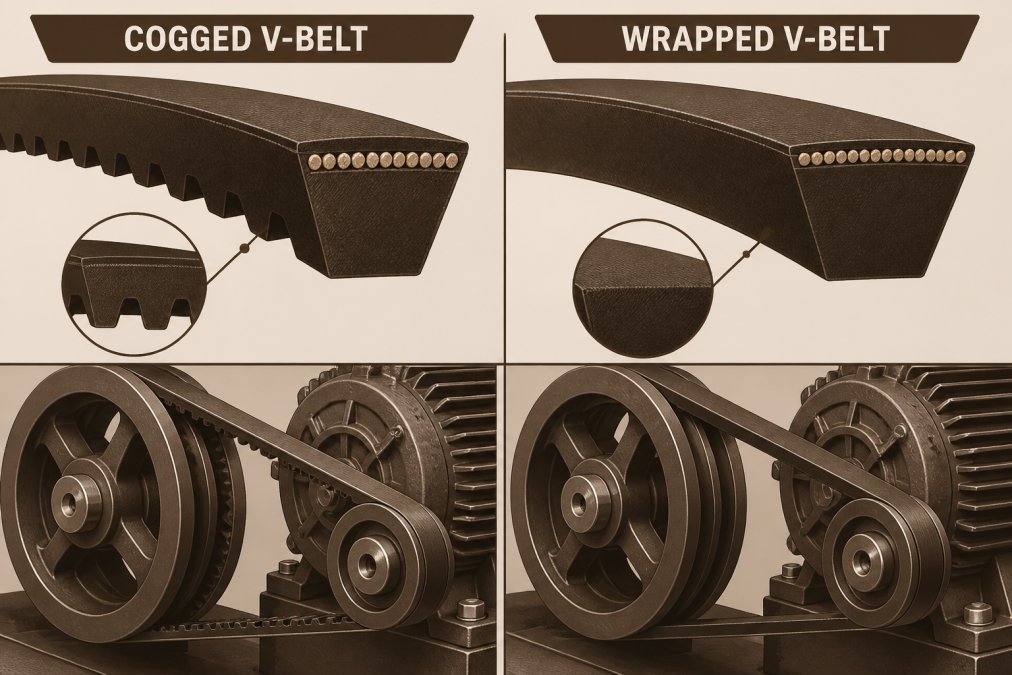
The fundamental difference between cogged and wrapped V-belts comes down to the belt's underside. A wrapped V-belt has a smooth, solid bottom. A cogged V-belt has evenly spaced teeth, or cogs, cut into that same surface. This single design change triggers a cascade of performance differences that matter in real-world operations.
How Cogging Improves Flexibility and Heat Dissipation
Cogged belts bend more easily around smaller-diameter sheaves. The teeth let the belt flex without fighting the rigid structure of a wrapped design, reducing bending resistance and cutting heat generation dramatically. Cogged belts stay cooler because they conform to the sheave groove without that internal resistance.
Heat dissipation is the real advantage. Wrapped belts generate more friction during each revolution's bending cycle, and over hours this compounds.
For applications with tight pulley spacing or small-diameter sheaves, cogged belts are often the only practical choice. They'll fit and perform where a wrapped belt would slip or overheat.
When Cogged Belts Outperform Wrapped Options
Cogged belts shine in high-speed applications, compact drive systems, and hot environments. HVAC cooling towers often run cogged belts because the duty cycle is continuous and the heat load inherent.
Cogged belts also work better when drive ratios are extreme. A high-ratio drive, where the input pulley is much smaller than the output, requires the belt to bend sharply at the input. Wrapped belts resist this geometry. Cogged belts accept it.
The trade-off is that cogged belts typically cost more than wrapped alternatives and may not be necessary for low-speed, low-heat applications. For a simple fan drive or a light-duty application, the added expense of cogging isn't justified.
Raw-Edge vs Wrapped V-Belts: Durability and Load Capacity
Raw-edge V-belts take a different design approach. Instead of wrapping the belt's sides with a protective fabric cover, raw-edge belts expose the cut edges of the reinforcement material directly to the sheave groove, changing how force transfers and how the belt behaves under load.
Raw-Edge Construction and Power Transmission Efficiency
A raw-edge belt transfers power through direct contact between the reinforcement cord and the sheave groove walls, with no fabric layer between them.
Raw-edge belts also handle shock loads better. If a drive experiences sudden load spikes, the raw-edge belt's direct cord engagement absorbs the impact more effectively than a wrapped belt's layered construction. This makes raw-edge belts the choice for intermittent-duty applications and machinery that starts under load.
The downside is that raw-edge belts wear faster in abrasive environments. Dust and debris can attack the exposed cord edges. In clean, controlled settings, like indoor machinery or sealed drive systems, this isn't a problem. In dusty facilities or outdoor applications, wrapped belts hold up better.
Service Life and Wear Resistance Comparison
Raw-edge belts typically deliver longer service life in ideal applications because direct cord engagement means less flexing and less internal heat generation than wrapped belts carrying the same load. That advantage disappears in contaminated environments, where dust and moisture degrade the exposed cord faster than a wrapped belt's protected edges.
Wrapped belts offer consistent performance across varied conditions because the fabric cover protects the reinforcement from environmental damage. They're the safer choice when conditions are unpredictable or the facility can't maintain clean drive enclosures.
For a facility that can commit to keeping its drives clean and dry, raw-edge belts offer superior longevity. For general-purpose applications where conditions vary, wrapped belts remain the more reliable standard.
Banded V-Belts: Multiple Belts for Heavy-Duty Applications
Banded V-belts handle massive loads by bonding multiple V-belt sections together as a single unit. Instead of one thick belt that's difficult to manufacture and prone to uneven load distribution, banding uses two, three, or more standard-profile belts glued side-by-side.
Increased Load Capacity and Force Distribution
The advantage is mathematical: two belts share the load more evenly than one oversized belt could, and a banded belt flexes more uniformly across its width, reducing edge stress and extending life.
Banded belts also reduce slippage under peak loads. Because the bonded sections act as a unified structure, the total grip on the sheave groove increases proportionally.
The downside is that banded belts are more expensive to purchase and replace. They also require precise alignment across all sections. Misalignment causes one section to carry more load than the others, which defeats the purpose of banding and accelerates wear on that section.
When Banding Is Worth the Extra Cost
Banding makes economic sense when the alternative is replacing the entire drive system, sheaves, shafts, and all. If a single wrapped belt is undersized, upgrading to a banded configuration costs far less than mechanical redesign, and it works well for retrofits where existing sheave sizes can't change.
Heavy-duty industrial applications, cement mills, lumber processing, large HVAC systems, often rely on banded belts because the continuous duty cycle and high loads justify the added expense. For light-duty or intermittent applications, banding is rarely necessary.
How to Identify V-Belt Size and Compatibility
Choosing the right alternative to standard wrapped v-belts means nothing if you can't identify what you currently have or match it to a replacement. V-belt sizing follows strict standards, and reading the markings correctly is essential.
Reading Belt Markings and Cross-Section Codes
Every V-belt carries a size code printed or molded into it, telling you the cross-section profile and pitch length. The cross-section, A, B, C, D, or E, refers to the width and depth of the V-groove.
The pitch length is the effective length of the belt measured at the centerline of the V-groove. A belt marked "A-38" is an A-section belt with a pitch length of 38 inches. This number is critical because sheaves are matched to specific pitch lengths.
Many belts also carry a brand identifier and sometimes a date code. Older belts may show only cross-section and length; newer ones often note reinforcement type, polyester, aramid, or another cord material.
Checking Sheave Groove Compatibility
The sheave groove must match the belt's cross-section profile. An A-section belt won't seat properly in a B-section groove, it rests too high (causing slippage) or too low (causing edge stress and accelerated wear). Checking compatibility requires visual inspection and, ideally, a groove gauge.
If you're considering switching to a cogged or raw-edge alternative, verify that your existing sheaves can accept the new belt type. Some sheaves are designed specifically for wrapped belts and may not grip a cogged or raw-edge belt effectively. In many cases, a sheave change is necessary, a cost that must factor into your decision.
V-Belt Nation carries many cross-sections and sizes, and our team can help verify compatibility before you order.
Total Cost of Ownership: Purchase Price vs Operating Efficiency
The cheapest belt at purchase often costs the most over its lifetime. Total cost of ownership means weighing initial expense, replacement frequency, downtime risk, and operating efficiency together.
Initial Cost, Replacement Intervals, and Downtime Risk
Wrapped V-belts typically cost less upfront than cogged or raw-edge alternatives, but that advantage disappears if the wrapped belt fails prematurely where a different design would last longer.
Downtime cost is often the hidden factor that tips the decision. If a belt failure stops production for four hours, the lost output may exceed the belt's purchase price by tenfold.
Raw-edge and cogged belts cost more initially but often deliver lower total cost of ownership in their ideal applications.
The key is matching the belt type to the actual duty cycle. An oversized, expensive belt in a light-duty application wastes money. The right belt in the right application saves it.
Installation, Tensioning, and Troubleshooting
Getting the belt onto the sheaves is just the beginning. Proper tension and alignment determine whether you'll get the belt's rated service life or watch it fail prematurely.
Proper Alignment and Tension for Each Belt Type
Belt tension is critical and varies by type. Cogged belts can run slightly looser because the cogs add grip, while raw-edge belts often need higher tension for direct cord engagement.
Alignment matters equally. Sheaves must be parallel and in the same plane. Misalignment causes the belt to track to one side, which creates edge stress and accelerates wear. A belt that's properly tensioned but misaligned will fail faster than a slightly loose, perfectly aligned belt.
Installation best practices vary by belt type. Cogged belts should be installed with the cogs facing the sheave groove, never wrap them backward. Raw-edge belts need careful handling to avoid damaging the exposed cord edges during installation.
Diagnosing Slippage, Squealing, and Premature Wear
A squealing belt usually means insufficient tension or misalignment, the belt is slipping on the sheave and creating friction noise.
Slippage is subtler: drive speed drops under load, or driven equipment runs slower than expected. It happens when tension is too low, the sheave groove is glazed from years of belt contact, or the belt is worn.
Premature wear, a belt failing well before its expected life, points to wrong belt selection, misalignment, or conditions exceeding the belt's rating. If wrapped belts fail quickly, consider cogged or raw-edge alternatives built for higher heat or shock loads.
Choosing the right alternative to standard wrapped v-belts starts with understanding your application's real demands: the speed, load, temperature, and duty cycle.
Frequently Asked Questions
What are the main alternatives to standard wrapped V-belts?
The primary alternatives to standard wrapped V-belts are cogged V-belts, raw-edge V-belts, and banded V-belts. Cogged belts feature transverse grooves that improve flexibility and heat dissipation, making them ideal for compact drives. Raw-edge belts use a narrow, unbound edge to increase power transmission efficiency and load capacity. Banded V-belts combine two or more belts into a single unit, distributing force across multiple strands for heavy-duty applications. Each type addresses different operating conditions and efficiency requirements.
Are raw-edge V-belts better than wrapped V-belts?
Raw-edge V-belts offer higher power transmission efficiency and greater load capacity compared to wrapped V-belts, but they are not universally better. Raw-edge belts excel in applications requiring maximum power transfer and durability, particularly on drives with adequate space. Wrapped V-belts remain the standard choice for many applications because they are cost-effective, work on a wider range of sheave sizes, and handle variable operating conditions well. The best choice depends on your specific application, duty cycle, and performance requirements.
How do I identify the correct V-belt size for my machinery?
V-belt size is identified using a cross-section code (like A, B, C, or D) and the belt's length. The cross-section code is stamped on the belt itself and indicates the width and height of the belt profile. Measure the belt length from outside edge to outside edge around the pulleys, or check your equipment's manual for the exact specifications. Verify that your sheave grooves match the belt's cross-section, a cogged belt requires different grooves than a wrapped belt. If uncertain, contact V-Belt Nation's support team with your equipment details for personalized sizing assistance.
When should I use a banded V-belt instead of a single V-belt?
Banded V-belts are ideal for heavy-duty applications requiring increased load capacity, improved force distribution, and reduced slippage. Use banded belts when a single wrapped or raw-edge belt cannot handle the power requirements, when you need to minimize vibration on high-speed drives, or when space constraints prevent using larger-diameter sheaves. Banded belts cost more initially but reduce downtime risk and replacement frequency in demanding industrial settings. Evaluate your application's duty cycle and power demands, if a single belt shows signs of slipping or excessive wear, banding is often the solution.