 listicle
Best Cogged Belts for HVAC: Top 5 Picks for 2026
Table of Contents
- Quick Comparison: Best Cogged Belts for HVAC
- V-Belt Nation: Best Overall for Cogged Belts
- Gates Industrial V-Belts: Top Choice for Heavy-Duty HVAC
- Bestorq X5 Cogged V-Belts: Ideal for Variable Load Systems
- Browning V-Belts: Best for High-Temperature Mechanical Rooms
- Timken Industrial Belts: Best for Large-Scale Air Handling
- Cogged vs Wrapped V-Belt for HVAC: Which Performs Better?
- HVAC Belt Replacement Best Practices
- Frequently Asked Questions
Last Updated: September 16, 2026
Quick Comparison: Best Cogged Belts for HVAC
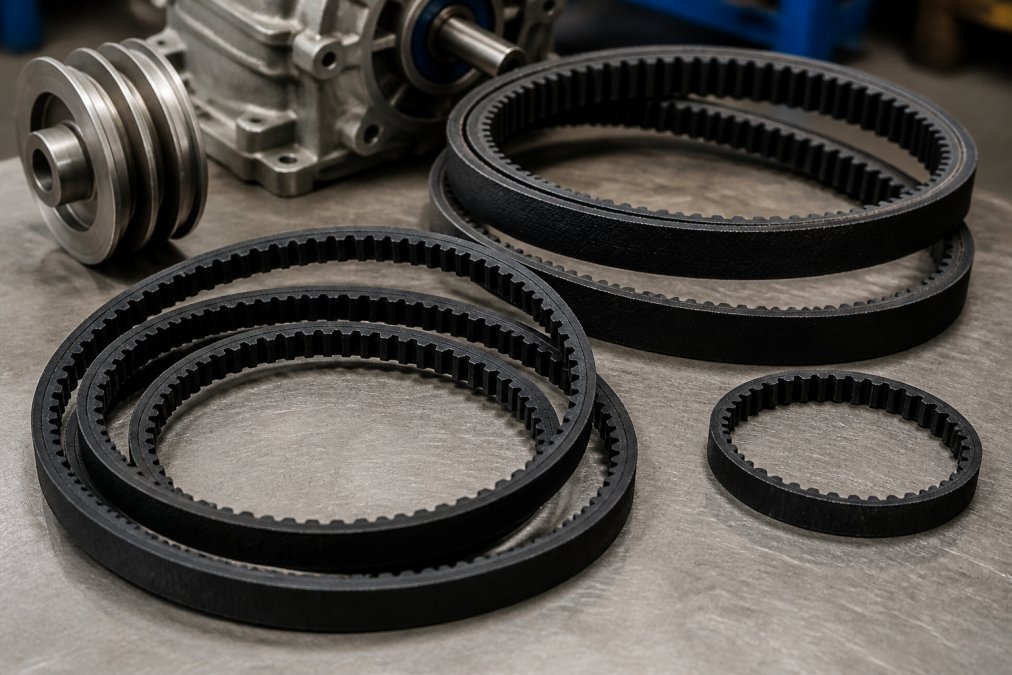
Ask any HVAC technician what fails first on a rooftop unit in July, and you'll hear the same answer: the belt. A cogged V-belt is a power transmission belt with notched teeth molded into its underside, letting it bend around small pulleys without cracking. This guide from V-Belt Nation compares the best cogged belts for HVAC service, from heavy-duty blowers to variable-load air handlers.
Quick Picks:
- Best Overall: V-Belt Nation, widest section coverage, price matching, personalized sizing help
- Best Heavy-Duty: Gates Industrial V-Belts, static conductive, heat and oil resistant
- Best for Variable Load: Bestorq X5 Cogged V-Belts, raw edge construction for cycling equipment
- Best for Hot Mechanical Rooms: Browning V-Belts, high-strength tensile cords, minimal stretch
- Best for Large Air Handlers: Timken Industrial Belts, notched design for small pulleys
| Brand | Best For | Standout Feature | Pricing |
|---|---|---|---|
| V-Belt Nation | Most maintenance teams | Price Match Guarantee, free shipping over $175 | On request |
| Gates Industrial | Heavy-duty blowers | Static conductive properties | Contact for pricing |
| Bestorq X5 | Variable load systems | Raw edge cogged construction | Contact for pricing |
| Browning | High-temp mechanical rooms | High-strength tensile cords | Contact for pricing |
| Timken Industrial | Large air handling units | Precision-molded cogs | Contact for pricing |
V-Belt Nation: Best Overall for Cogged Belts
V-Belt Nation earns the top spot because it solves the problem that actually stops a repair: getting the right belt, in the right section, before the building overheats. Its catalog spans classic and wedge belts plus specialized cogged, banded, and lawn and garden options, so a technician chasing an odd cross-section isn't stuck calling three distributors.
Pros:
- Price Match Guarantee on stocked belts
- Free ground shipping on U.S. orders over $175
- Extensive inventory of V-belt types and sections
- Personalized support for hard-to-find sizes
Cons:
- Online-only, so no counter pickup for same-hour emergencies
Gates Industrial V-Belts: Top Choice for Heavy-Duty HVAC
Gates is the name most senior techs reach for when a blower runs loaded all season. Its industrial V-belts use precision-engineered cogged geometry and high-grade rubber compounds built for heat and oil resistance, exactly what a mechanical room throws at a drive system.
Pros:
- Precision-engineered cogged design improves flexibility
- Heat and oil resistant compounds
- Static conductive for industrial safety
Cons:
- Higher upfront cost than wrapped alternatives
Bestorq X5 Cogged V-Belts: Ideal for Variable Load Systems
Equipment that cycles on and off all day punishes a belt differently than a constant-load blower. Bestorq's X5 line is built for that pattern, with raw edge cogged construction that dissipates heat and holds grip as the load swings. It's manufactured domestically, shortening the supply chain when you need a replacement fast.
Pros:
- Raw edge construction for efficient heat dissipation
- Designed for smaller diameter pulleys
- Consistent performance under variable load
Cons:
- Requires careful sizing verification
Browning V-Belts: Best for High-Temperature Mechanical Rooms
Rooftop mechanical rooms in summer are brutal on rubber. Browning engineers its cogged belts for exactly that environment, using high-strength tensile cords that resist stretch and cogged geometry that keeps power transmission steady as temperatures climb.
Pros:
- Excellent durability in high-heat environments
- Reduces sheave wear through improved grip
- High-strength tensile cords minimize stretch
Cons:
- Premium pricing versus standard non-cogged belts
Timken Industrial Belts: Best for Large-Scale Air Handling
Large air handling units need a belt that stays efficient across long runs and big blowers. Timken's notched design delivers flexibility on small pulleys, while oil and heat resistant cover materials protect the belt in dirty mechanical spaces.
Pros:
- High efficiency ratings
- Longer service life than standard wrapped belts
- Oil and heat resistant cover
Cons:
- Availability varies by region
Cogged vs Wrapped V-Belt for HVAC: Which Performs Better?
For most HVAC drives, a cogged belt wins. But "cogged is better" is what every supplier page says, and it doesn't help a maintenance manager justify the switch to purchasing or decide whether a specific drive needs one. Here's the mechanism-level breakdown, plus the cost math most guides skip.
Why the notches actually matter
A wrapped V-belt is a solid rubber cross-section with a fabric jacket. When it bends around a sheave, the underside compresses and the top stretches. On a small pulley, say a 3-inch sheave on a packaged rooftop blower, that compression has nowhere to go, so the belt cracks and heat builds up inside the rubber.
- Reduces the bend radius the belt can tolerate. A cogged belt can run on sheaves that would destroy a wrapped belt of the same section.
- Exposes more surface area to airflow. The raw edge and notches let heat escape instead of soaking into the tensile cord.
- Increases grip on the sheave. The cogged profile bites the groove more aggressively, which reduces slip under load.
The efficiency math, framed for a facility manager
Belt-drive efficiency gains from cogged construction are typically small, most practitioners cite low single-digit percentage improvements over a wrapped belt on the same drive. That sounds trivial until you multiply it across a building.
When a wrapped belt is still the right call
Cogged isn't universal. A wrapped belt makes sense when:
- The drive runs on large pulleys where bend radius isn't a constraint.
- The load is constant and the belt isn't cycling.
- Upfront cost is the dominant factor and the drive is low-consequence.
- The environment is clean and temperate, so heat buildup isn't accelerated.
If none of those apply, which is the case on most rooftop and air-handler drives, cogged is the better default.
| Factor | Cogged V-Belt | Wrapped V-Belt |
|---|---|---|
| Flexibility on small pulleys | High | Limited |
| Heat dissipation | Better (raw edge + notches) | Lower (jacketed) |
| Slip resistance | Higher | Moderate |
| Upfront cost | Higher | Lower |
| Service life on small-pulley drives | Longer | Shorter |
| Best for | HVAC blowers, variable load, tight sheaves | Constant-load, large pulleys, low-consequence drives |
HVAC Belt Replacement Best Practices
Replacement is where most premature failures are born. A belt that's correctly sized but wrongly tensioned will squeal, slip, and fail early regardless of brand. This section covers the full sequence, including the safety protocol most guides skip.
Lockout/tagout before you touch anything
A rooftop unit or air handler can start on a schedule, a thermostat call, or a building automation signal while your hands are inside the drive. Before removing a guard or loosening a motor mount:
- Shut the unit down at the disconnect, not just at the thermostat.
- Apply your lock and tag to the disconnect per your facility's energy control procedure.
- Verify zero energy, attempt a start at the controller and confirm nothing moves.
- Discharge any stored energy (capacitors on VFD-driven units, residual fan rotation).
- Keep the key or lock combination in your possession until the belt is reinstalled and the guard is back on.
The replacement sequence
- Lock out and tag out the unit (see above).
- Inspect sheave grooves for wear, burrs, and glazing. A glazed groove will destroy a new belt.
- Check pulley alignment with a straightedge across both sheaves. Misalignment is a top cause of premature failure.
- Measure the old belt's cross-section and pitch length, not just its outside length.
- Match the replacement to the correct section code.
- Set tension using a gauge, not the thumb-press method.
- Recheck tension after the first run-in period, typically after the unit has run under load for a short while.
- Record the install date, belt size, and tension reading for the next maintenance interval.
Tensioning: the step most techs get wrong
Belt tension is not a feel. It's a measurement. Two tools do the job:
- Tension gauge (deflection or sonic). A deflection gauge measures how much the belt flexes under a known force at the midpoint of the span. A sonic gauge reads the belt's natural frequency and converts it to tension, faster and more repeatable on long spans.
- Straightedge and ruler. For a quick deflection check, lay a straightedge across the two sheaves and measure how far the belt deflects at the midpoint when you push it.
Measuring the old belt
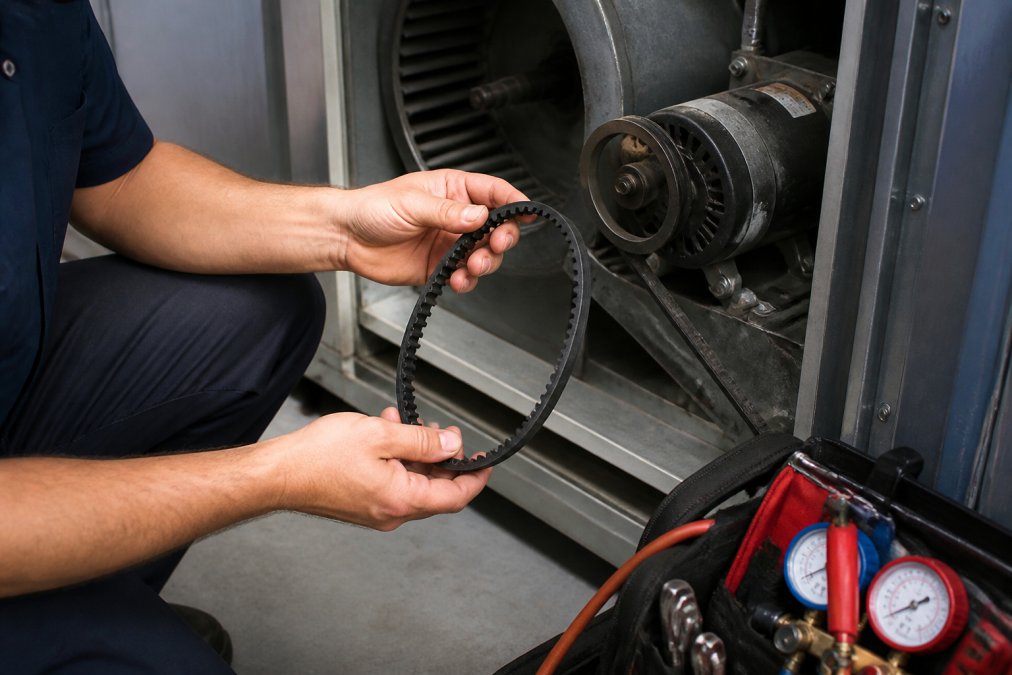
Wrap a cloth tape around the belt's outside circumference and note the cross-section letter stamped on it. If the stamp is gone, measure top width and depth with calipers and match against a section chart. Always confirm pitch length, not just outside length, ordering by outside length is the most common reason a replacement belt fails within weeks.
Reading the failure before you replace the belt
A failed belt is evidence. Before you toss it, look at how it failed:
- Cracked underside, small pulley or worn sheave. Consider a cogged belt or sheave replacement.
- Glazed, shiny sides, chronic slip from loose tension or oil contamination.
- Frayed edges, misalignment or a burr in the groove.
- Chunked or missing cogs, heat damage or age; check the environment and the drive's duty cycle.
- Belt bottoming out in the groove, worn sheave; the belt is riding on its base instead of its sides.
Frequently Asked Questions
What are the primary benefits of using cogged belts in HVAC systems?
Cogged belts offer better flexibility, heat dissipation, and energy efficiency compared to wrapped belts. The notched design reduces bending stress on small pulleys, allowing the belt to run cooler and last longer. This leads to lower energy consumption and less downtime for HVAC blowers and air handlers.
How do cogged belts compare to standard wrapped V-belts for blower motors?
Cogged belts outperform wrapped belts on small pulleys in flexibility and heat resistance. They grip better, reducing slip and wear. For HVAC blower motors that cycle frequently, cogged belts maintain tension and efficiency longer.
When should you replace an HVAC cogged belt?
Replace cogged belts if you notice cracking, glazing, fraying, or a squealing noise. Check tension regularly and look for signs of wear.
Do cogged belts run cooler than standard V-belts?
Yes, the cogged design increases airflow around the belt, dissipating heat more effectively. This reduces internal temperature, extending belt life.
Are cogged belts compatible with standard HVAC pulleys?
Cogged belts are compatible with standard V-belt pulleys, but they are optimized for smaller diameter sheaves. Ensure the pulley groove matches the belt cross-section (e.g., A, B, or 5V). For best performance, verify alignment and tension after installation.
Downtime is the real cost of a belt failure, not the belt itself. V-Belt Nation stocks classic, wedge, cogged, banded, and lawn and garden belts so you can match the exact section your equipment needs, backed by a Price Match Guarantee, free ground shipping on U.S. orders over $175, and a support team that will help you find a specific size. Get started with V-Belt Nation and keep your drives running through the season.