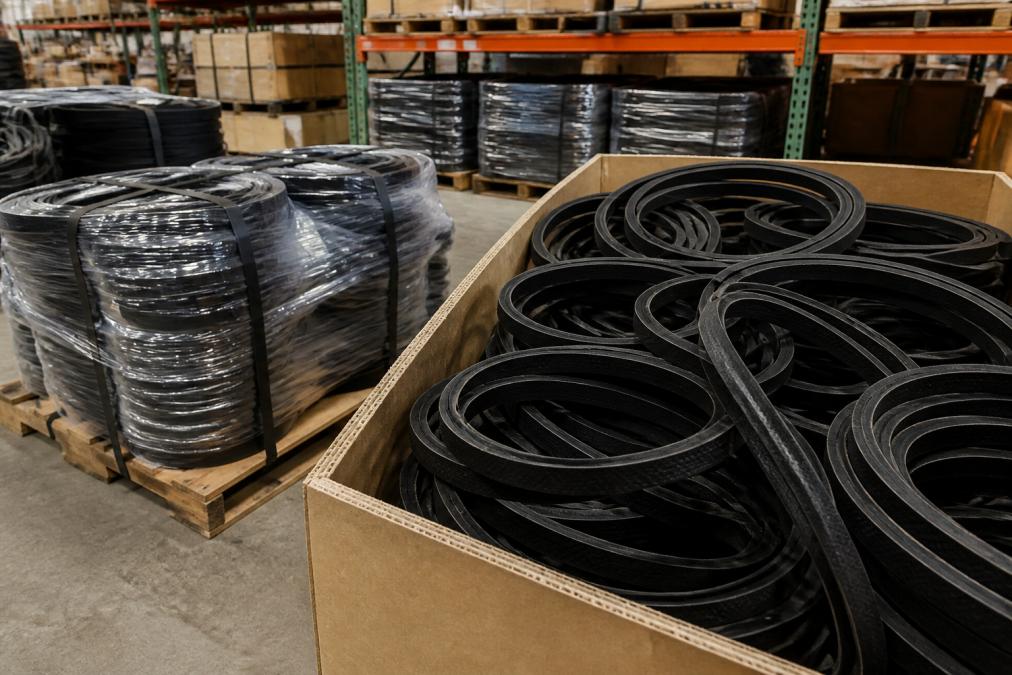
 ultimate-guide
Bulk V-Belt Orders for HVAC: 2026 Buyer's Guide
Table of Contents
- Why Bulk V-Belt Orders for HVAC Beat One-Off Purchases
- Matching Belt Profiles to HVAC Equipment: A, B, 3V, 5V, and Cogged Options
- How to Measure HVAC V-Belts Before You Order in Bulk
- HVAC V-Belt Cross Reference: Matching OEM Numbers to Aftermarket Belts
- Matched Sets, Tolerances, and the Standards That Keep Drives Running
- Troubleshooting Premature Belt Failure in HVAC Systems
- V-Belt Storage and Shelf Life: Protecting Your Bulk Inventory
- Frequently Asked Questions
Last Updated: September 23, 2026
Why Bulk V-Belt Orders for HVAC Beat One-Off Purchases
A rooftop unit goes down on a Friday afternoon, and the belt that failed is one nobody stocked. That scenario, repeated across a portfolio of buildings, is why bulk v-belt orders for HVAC have become standard practice for facility teams. The logic is straightforward: belts are consumables, drives fail on their own schedule, and the cost of a stalled air handler dwarfs the cost of the belt itself.
This guide from V-Belt Nation covers how to order the right belts in the right quantities, match profiles to equipment, and avoid the inventory traps that turn a smart purchase into dead shelf stock.
The real argument here is simple. Buying one belt at a time feels efficient because it minimizes inventory. In practice, it maximizes downtime risk. A spare belt sitting on a shelf costs almost nothing. A production line or a cooling tower waiting three days for a replacement costs a great deal more.
Cost Per Belt vs. Cost Per Breakdown
The purchase price of a V-belt is the smallest number in the equation. The larger numbers are labor, expedited freight, and lost operating time. When a drive fails during peak cooling season, the emergency purchase premium and the overtime to install it both land on the maintenance budget.
Bulk ordering changes the math by shifting spend from reactive to planned.
Just-in-Time vs. Bulk: A Cost-Benefit Breakdown
Just-in-time purchasing works when lead times are short and demand is predictable. HVAC belt demand is neither. Belts fail based on runtime hours, load, and alignment, not on a schedule you can forecast.
| Approach | Strength | Weakness | Best For |
|---|---|---|---|
| Just-in-time | Minimal inventory cost | Exposed to lead-time delays | Rarely used belt sizes |
| Bulk ordering | Belts on hand when drives fail | Ties up shelf space | Common profiles across many units |
| Hybrid | Fast movers in bulk, slow movers on demand | Requires tracking usage | Most facility portfolios |
Matching Belt Profiles to HVAC Equipment: A, B, 3V, 5V, and Cogged Options
Every HVAC drive is built around a specific belt cross-section, and using the wrong profile shortens belt life and damages sheaves. The common profiles in air handling units and rooftop units are A, B, 3V, and 5V, with AX and BX cogged versions of the classic A and B sections.
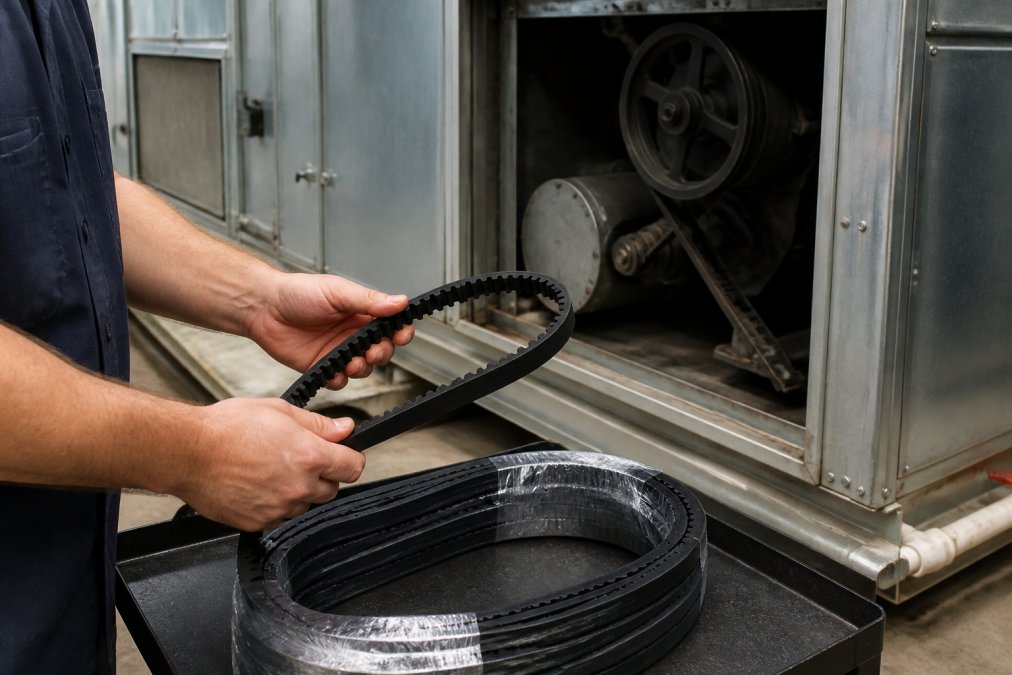
Wrapped vs. Cogged V-Belts for Air Handling Units
Wrapped belts have a fabric cover over the tensile cords. They run quietly and resist oil and heat reasonably well, which suits many constant-speed fans.
Sizing by Horsepower and Sheave Groove
Belt selection starts with the drive's horsepower rating and the sheave groove profile. A 5V belt on a 3V sheave will not seat correctly, and a belt that sits too high or too low in the groove will slip under load.
How to Measure HVAC V-Belts Before You Order in Bulk
Measuring an HVAC V-belt correctly means capturing four values: cross-section, top width, outside diameter or pitch length, and the number of ribs on banded belts. Guessing any one of these leads to a return and another delay.
- Cross-section: A, B, 3V, 5V, or cogged equivalent
- Top width: measured across the flat top of the belt
- Pitch length: the effective length around the drive
- Rib count: for banded or multiple-groove setups
HVAC V-Belt Cross Reference: Matching OEM Numbers to Aftermarket Belts
An HVAC V-belt cross reference maps a manufacturer's part number to an equivalent aftermarket belt by profile and length. OEM numbers are useful, but they are not the only path to the right belt, and treating them as gospel is where most procurement errors start.
Why Belt Labeling Is Not Standardized Across Manufacturers
There is no single industry-wide numbering convention that every belt maker follows. The Rubber Manufacturers Association (RMA) and the Mechanical Power Transmission Association (MPTA) publish dimensional standards for V-belt cross-sections, top width, pitch width, and included angle, but they do not mandate a universal part-numbering scheme. That means two belts from two different manufacturers can both be "B-section, 60-inch" and still carry completely different catalog numbers.
- Classical wrapped sections (A, B, C, D, E) are usually followed by the outside length in inches. An "A60" is typically an A-section belt with a 60-inch outside length.
- Narrow wedge sections (3V, 5V, 8V) are usually followed by the outside length in inches as well, but some makers use pitch length instead. A "5V1000" is nominally a 5V belt at 100 inches, but confirm whether the number refers to outside or pitch length before you order.
- Cogged versions often add an "X" to the section letter, AX, BX, CX, but not every manufacturer uses the X convention. Some use a suffix, some use a completely different prefix.
- Banded belts add a rib count, usually as a prefix or suffix (for example, "3/B75" or "B75-3" for a three-rib B-section banded belt).
Building a Master Cross Reference Sheet
A master cross reference sheet is the single highest-return document a facility team can maintain for belt procurement. It converts a twenty-minute scramble at 2 a.m. into a thirty-second lookup, and it prevents the most common bulk-ordering mistake: buying a case of belts that fit one unit but not the ten others on the same site.
Build it with these columns:
| Column | What Goes In It |
|---|---|
| Asset ID | The unit tag or equipment number (RTU-3, AHU-12, CT-1) |
| Drive location | Rooftop, mechanical room, cooling tower deck |
| OEM part number | Exactly as printed on the unit nameplate or OEM manual |
| Belt profile | A, B, AX, BX, 3V, 5V, or banded equivalent |
| Pitch length | Measured or looked up from sheave geometry |
| Rib count | For banded or multiple-groove drives |
| Aftermarket equivalent | The number your supplier stocks |
| Quantity on hand | Updated after every pull from stock |
| Last replaced | Date the belt was last changed |
When the Cross Reference Is Unclear
If the OEM number does not decode cleanly and no cross reference table matches it, do not guess. Measure the sheave groove profile with a belt gauge or calipers, measure the drive center distance, and calculate the pitch length from the sheave diameters. Then confirm the profile and length against the supplier's catalog before committing to a bulk order.
Matched Sets, Tolerances, and the Standards That Keep Drives Running
Matched sets matter on any drive with two or more belts. Belts in a set must be the same length within a tight tolerance, or the shorter belt carries more load and fails first.
Troubleshooting Premature Belt Failure in HVAC Systems
Premature belt failure almost always points to a problem outside the belt. Belts rarely fail because they were badly made. They fail because something in the drive is wrong.
Slipping, Squealing, and Vibration: What Each Symptom Tells You
Each symptom points to a specific cause, which makes diagnosis faster.
| Symptom | Likely Cause | Fix |
|---|---|---|
| Squealing on startup | Loose tension or glazed belt | Re-tension or replace belt |
| Slipping under load | Worn sheave or wrong profile | Inspect sheaves, confirm profile |
| Vibration | Misalignment or unmatched set | Align sheaves, use matched set |
| Edge wear | Sheave misalignment | Realign the drive |
V-Belt Storage and Shelf Life: Protecting Your Bulk Inventory
V-belts have a shelf life, and how you store them decides how long that is. Rubber compounds degrade over time, and heat, sunlight, and ozone speed that up.
- Keep belts out of direct sunlight and away from heat sources
- Avoid contact with oil, solvents, and ozone-generating equipment
- Rotate stock so older belts get used first
- Inspect stored belts for cracking or glazing before installation
Frequently Asked Questions
What are the benefits of buying HVAC V-belts in bulk?
Bulk v-belt orders for HVAC reduce per-belt cost, cut emergency shipping fees, and keep critical spares on hand so a snapped belt does not stall an air handler for days. Ordering in matched sets also means every belt in a drive has the same length tolerance, which limits uneven loading. The trade-off is storage space and shelf life, so rotate stock oldest-first and keep belts in a cool, dark place away from ozone sources.
How do you determine the correct size for HVAC replacement V-belts?
Use the belt's printed part number first, then verify with a cross reference. If the number is worn off, measure the sheave groove and pulley diameter. Always check the sheave groove and pulley diameter before ordering a bulk quantity.
What is the difference between wrapped and cogged V-belts for HVAC systems?
Wrapped belts have a fabric cover that resists oil, heat, and abrasion, making them a good fit for dusty rooftop units and older drives. Cogged belts have a raw-edge, notched design that bends around small pulleys with less heat buildup and higher power transmission efficiency. For cooling tower fans and tight-sheave AHU drives, cogged belts often last longer. Both are available in matched sets for bulk orders.
How should bulk V-belts be stored to prevent degradation?
Store belts in a cool, dry area away from direct sunlight, electric motors, and ozone-generating equipment. Keep them in original packaging or on a shelf with a gentle curve, never hanging on a nail or folded. Rotate stock and inspect belts for cracking or glazing before installing. Avoid storing near solvents or oil.