 listicle
Buy Heavy Duty Industrial Belts: 2026 Guide
Table of Contents
- Types of Heavy Duty Industrial Belts to Know Before You Buy
- Industrial V-Belt Sizing Guide: Cross-Section, Pitch, and Profile
- Heavy Duty Belt Maintenance Best Practices
- Industrial Belt Failure Signs You Should Not Ignore
- Installation Best Practices for Industrial Belts
- Energy Efficiency and Load-Bearing Capacity: What the Specs Actually Mean
- Where to Buy Heavy Duty Industrial Belts: What to Look for in a Supplier
- Frequently Asked Questions
Last Updated: September 2, 2026
Choosing the wrong industrial belt costs you unplanned downtime, damaged machinery, and unbudgeted maintenance calls. At V-Belt Nation, we work with maintenance managers, procurement specialists, OEM engineers, and HVAC technicians who need the right industrial belts the first time. This guide covers belt types, sizing, failure signs, installation, and what to look for in a supplier worth trusting.
Types of Heavy Duty Industrial Belts to Know Before You Buy
Industrial belts are the backbone of power transmission in manufacturing, HVAC, agriculture, and OEM equipment. Understanding which belt type fits your application is the single most important decision you'll make.
Classic and Wedge V-Belts
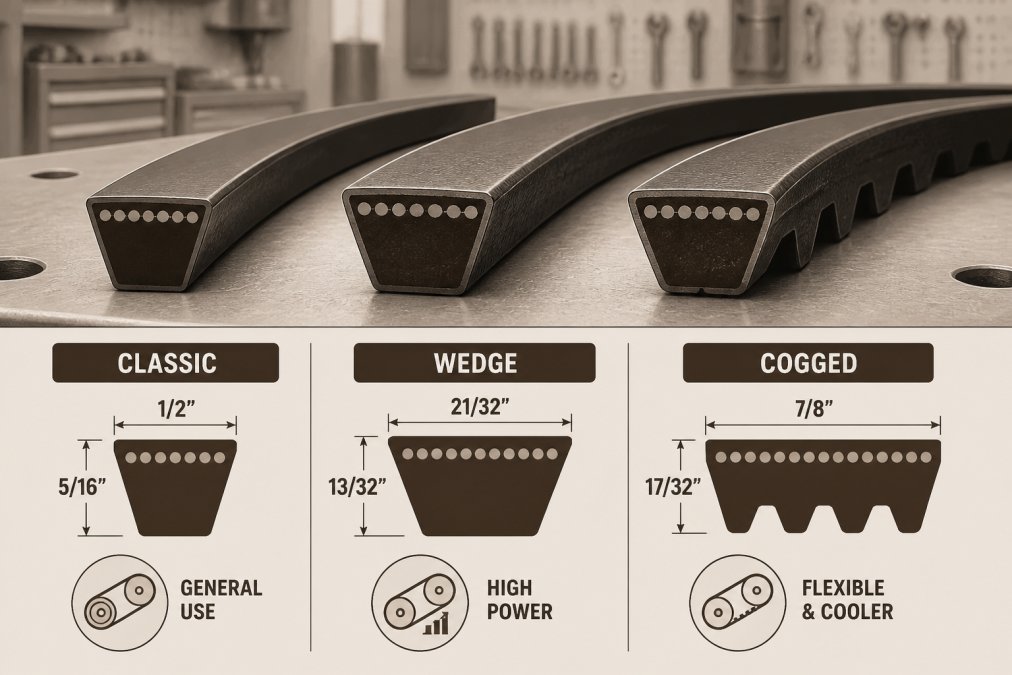
Classic V-belts feature a trapezoidal cross-section that wedges into sheaves and pulleys to transfer torque. Standardized sections (A, B, C, D, E) are interchangeable across most machinery.
Wedge V-belts (3V, 5V, 8V series) carry significantly more load per unit width than classic belts. Their narrower profile allows tighter center distances and smaller sheave diameters, making them ideal for high-horsepower drives where space is constrained.
Cogged and Banded Belts
Cogged V-belts have transverse notches molded into the inner surface that reduce bending resistance, lower heat buildup, and improve efficiency on smaller-diameter sheaves. Cogged sections (AX, BX, CX, 3VX, 5VX, 8VX) are direct replacements for smooth-belt equivalents and outperform them in high-temperature or high-cycle applications.
Banded belts bond multiple V-belts together with a reinforced tie band, eliminating belt whipping, distributing load evenly, and reducing vibration in high-horsepower drives. V-Belt Nation offers Classic Banded (A, B, C, D), Aramid/Kevlar Wedge Banded (3VK, 5VK, 8VK), and Cogged Banded varieties.
Synchronous and Timing Belts
Synchronous belts use a toothed profile that meshes with matching sprockets for exact shaft synchronization with zero slip and no re-tensioning required after break-in. Synchronous drives require precise pulley alignment and are less forgiving of installation errors than V-belt drives.
| Belt Type | Cross-Section/Profile | Best Application | Key Advantage |
|---|---|---|---|
| Classic V-Belt | A, B, C, D, E | General industrial drives | Wide availability, low cost |
| Wedge V-Belt | 3V, 5V, 8V | High-horsepower, tight spaces | Higher load per unit width |
| Cogged V-Belt | AX, BX, 3VX, 5VX | High-temp, small sheaves | Lower heat, better flex |
| Banded V-Belt | Multiple ribs bonded | High-vibration, multi-belt drives | Eliminates belt whip |
| Synchronous/Timing | Trapezoidal, curvilinear | Exact synchronization needed | Zero slip, no re-tensioning |
Industrial V-Belt Sizing Guide: Cross-Section, Pitch, and Profile
Most ordering mistakes happen at the sizing stage. An industrial V-belt sizing guide requires three measurements: cross-section, pitch length, and outside circumference.
Cross-section defines the belt's width and depth profile. The letter or number designation (A, B, 3V, 5V) tells you the shape. Mixing cross-sections on the same drive is not an option.
Pitch length is measured along the belt's neutral axis inside the tensile cord layer. Outside circumference is what you measure with a tape measure. The two differ by a fixed amount per cross-section, so conversion is straightforward once you know your section.
For banded and synchronous belts, pitch refers to the distance between tooth centers in inches or millimeters. Common pitches include MXL, XL, L, H, and XH for inch-series timing belts.
A practical approach to sizing a replacement belt:
- Note the existing belt's part number if legible
- If the number is gone, measure outside circumference and cross-section width
- Convert outside circumference to pitch length using the section offset table
- Confirm sheave groove angle matches the belt profile (standard V-belts use 38-40 degree groove angles)
- For metric belts, cross-reference the metric designation to the equivalent inch-series section
According to ANSI/RMA belt standards documentation, V-belt dimensions and tolerances follow standardized specifications that ensure interchangeability across manufacturers.
Heavy Duty Belt Maintenance Best Practices
Reactive maintenance on industrial belts is expensive. Planned replacement on a scheduled interval costs a fraction of an emergency shutdown.
Belt Tensioning and Pulley Alignment
Incorrect tension is the leading cause of premature belt failure. Under-tensioned belts slip and glaze the sheave surface. Over-tensioned belts overload shaft bearings and accelerate tensile cord fatigue.
Proper tensioning requires measuring deflection force at the midpoint of the longest span. Correct values vary by cross-section, span length, and design horsepower and are available in manufacturer engineering data. Tensioning by feel alone almost always results in failure.
Pulley alignment is equally critical. Angular misalignment causes uneven load distribution and accelerates edge wear. Parallel misalignment shifts the belt laterally and increases the risk of the belt riding out of the groove. Both conditions are detectable with a straightedge or laser alignment tool before they cause damage.
Maintenance Intervals and Replacement Cycles
Most heavy-duty industrial belts require an initial re-tensioning after the first 24-48 hours of operation. Tensile cords seat during break-in, and tension drops measurably in this period.
After break-in, a practical maintenance interval schedule looks like this:
| Inspection Type | Frequency | What to Check |
|---|---|---|
| Visual inspection | Weekly | Cracking, fraying, glazing, misalignment |
| Tension check | Monthly | Deflection force at midspan |
| Full drive inspection | Quarterly | Sheave wear, bearing condition, alignment |
| Planned replacement | Per manufacturer cycle | Tensile cord fatigue, cumulative wear |
Replacement cycles depend on operating conditions: temperature range, shock loading, contamination exposure, and hours per day. Tracking hours and conditions per drive gives a more accurate replacement trigger than calendar time alone.
Industrial Belt Failure Signs You Should Not Ignore
Early failure detection saves money. The signs below are visible and audible long before a belt breaks, if someone is looking.
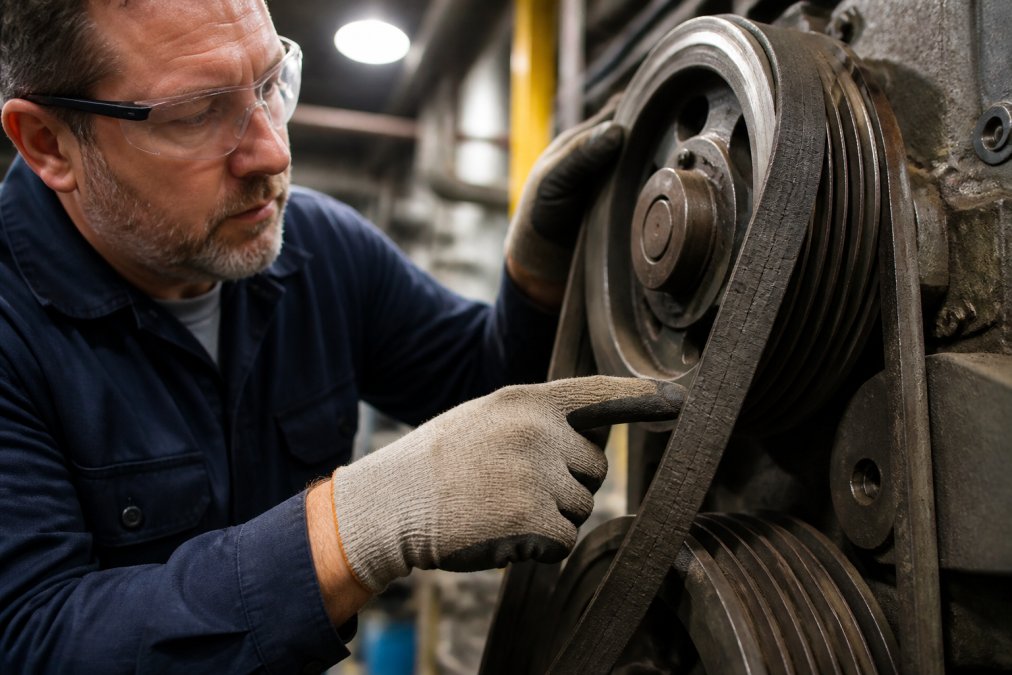
Cracking and checking on the belt surface indicate rubber compound degradation from heat, ozone exposure, or age. Surface cracks reaching the tensile cord layer are a replacement trigger.
Glazing, a shiny, hardened appearance on the belt's contact faces, results from slipping. Once a belt glazes, it loses friction-resistant properties and continues to slip even after re-tensioning.
Fraying or cord exposure on the belt edges points to misalignment. The belt is riding against the sheave flange rather than seating properly in the groove.
Squealing or chirping during startup or under load is almost always a tension or alignment issue.
Visible cord separation or belt chunking is a catastrophic failure precursor. If you see chunks missing from the belt body or cord bundles separating, shut the drive down.
According to OSHA general industry machinery and machine guarding standards, exposed drive belts and pulleys must be properly guarded, and inspections should be part of a documented preventive maintenance program.
Installation Best Practices for Industrial Belts
A correctly specified belt installed incorrectly will still fail prematurely. Installation is where a significant percentage of warranty claims originate.
Never force a belt over sheave flanges. Reduce center distance until the belt can be placed in the groove without stress. Prying a belt over a sheave with a screwdriver damages the tensile cord immediately.
Check sheave condition before installing a new belt. Worn sheave grooves cause the belt to bottom out rather than wedge, eliminating the friction-based drive.
Set initial tension correctly, then re-check after 24-48 hours. Break-in tension loss is predictable and must be corrected.
For synchronous belt drives, verify that sprocket tooth profiles match the belt tooth profile. Mixing trapezoidal belt profiles with curvilinear sprockets causes accelerated tooth wear.
Energy Efficiency and Load-Bearing Capacity: What the Specs Actually Mean
The specs on an industrial belt data sheet are purchasing decision data.
Load-bearing capacity is expressed as a power rating per belt at a given speed and sheave diameter. Wedge belts carry higher ratings per unit width than classic belts, which is why a drive redesigned from classic to wedge sections can use fewer belts for the same horsepower. Aramid cord belts carry higher tensile strength than standard polyester or fiberglass cord, making them the right choice for shock-load applications.
Mechanical efficiency for a properly installed V-belt drive runs in the range of 93-98%, according to U.S. Department of Energy motor systems resource guide. Synchronous belt drives operate at the higher end because they eliminate slip losses entirely.
Temperature range affects rubber compound selection. Standard neoprene compounds handle most industrial environments. EPDM synthetic rubber offers better heat resistance and ozone resistance for high-temperature applications. Oil-resistant compounds are specified for drives exposed to hydraulic fluid or lubricant contamination.
Don't select a belt on price alone. A belt rated for a higher temperature range or higher tensile strength costs more upfront and lasts significantly longer in demanding conditions.
Where to Buy Heavy Duty Industrial Belts: What to Look for in a Supplier
Price is one variable. Availability, technical support, and order reliability often matter more in a production environment.
Inventory depth is the first filter. A supplier with a broad selection across V-belt types and sections can fill a non-standard metric belt order or specialty cogged belt without multi-week lead times.
Technical support separates commodity distributors from genuine power transmission partners. If you're troubleshooting a slipping drive or cross-referencing an obsolete OEM part number, you need a support team that knows belts.
Certifications matter for OEM and regulated applications. ISO 9001 certification means belt dimensions and quality control meet documented standards. V-Belt Nation offers ISO-certified V-belts, which matters for OEM customers who need documented quality assurance.
V-Belt Nation offers free ground shipping on all orders over $175, a Price Match Guarantee, and personalized support to help identify the correct belt when the part number isn't clear. Test your current supplier: can they fill your next non-standard order on time, at a competitive price, with someone available to answer a technical question?
As documented in ISO 9001 quality management systems overview, ISO certification provides a framework for consistent product quality and traceability, criteria that matter when belt failures have downstream consequences.
| Supplier Criteria | Why It Matters | What to Ask |
|---|---|---|
| Inventory breadth | Avoids backorders on non-standard sizes | "Do you stock metric and non-standard sections?" |
| ISO 9001 certification | Documents quality control for OEM compliance | "Can you provide cert documentation?" |
| Technical support | Identifies correct belt when part number is unclear | "Who handles cross-reference requests?" |
| Shipping terms | Reduces per-order cost on regular replenishment | "What's the free shipping threshold?" |
| Price match policy | Ensures competitive pricing without switching suppliers | "Do you match documented competitor quotes?" |
Unplanned downtime from belt failure is one of the most preventable costs in a maintenance budget. The right belt selection, correct installation, and a documented inspection schedule eliminate the majority of drive failures before they happen. If your current supplier can't provide the inventory depth, technical support, or pricing terms your operation requires, V-Belt Nation's extensive selection of industrial belts, Price Match Guarantee, and free ground shipping on orders over $175 are worth a direct comparison. Shop Now at vbeltnation.com and let our support team help you find exactly what your drive system needs.
Frequently Asked Questions
Q: What are the different types of heavy duty industrial belts?
A: The main types are classic V-belts, wedge V-belts, cogged (molded notch) belts, banded belts, and synchronous timing belts. Classic V-belts suit general power transmission across sheaves and pulleys. Wedge belts handle higher torque in a narrower profile. Cogged belts flex more easily and run cooler. Banded belts join multiple V-belts with a tie band for high-horsepower, high-vibration drives. Synchronous belts provide exact shaft synchronization with no slippage, making them ideal for precision industrial automation applications.
Q: How do I determine the correct size for an industrial V-belt?
A: Start with the belt's cross-section designation (A, B, C, D for classical; 3V, 5V, 8V for wedge), then measure the pitch length or outside circumference. Check the sheave groove profile to confirm compatibility. For replacement belts, the part number stamped on the old belt is the fastest reference. If that's worn off, measure the top width, depth, and outside length, then match to the standard cross-section table. Contact V-Belt Nation's support team if you're sizing a non-standard or metric belt.
Q: What is the difference between wrapped and cogged industrial belts?
A: Wrapped V-belts have a fabric cover over the rubber body, which protects against contamination and extends wear resistance in dirty environments. Cogged belts, also called molded notch belts, have transverse grooves cut into the inner surface. Those notches increase flexibility, reduce heat buildup, and improve mechanical efficiency. Cogged belts are often a better choice for smaller-diameter sheaves and high-cycle drives like HVAC cooling towers and agricultural equipment.
Q: How often should heavy duty industrial belts be replaced?
A: Replacement cycles depend on load, temperature range, belt tensioning accuracy, and whether the drive is properly aligned. The practical rule is to inspect belts every 500 to 1,000 operating hours and replace the full belt set, not just the worn belt, to avoid uneven load distribution. Tracking maintenance intervals reduces unplanned operational downtime significantly.
Q: Are there specific industrial belts for high-temperature environments?
A: Yes. Belts made from EPDM synthetic rubber compounds or those with aramid cord tensile members handle elevated temperatures better than standard neoprene constructions. For drives near heat sources or in enclosed housings where ambient temps regularly exceed 140°F, specify a belt rated for that temperature range. Oil-resistant and static-dissipating (static conductivity) ratings are also worth confirming for environments with flammable vapors or chemical exposure. V-Belt Nation's support team can help match the right compound to your operating conditions.