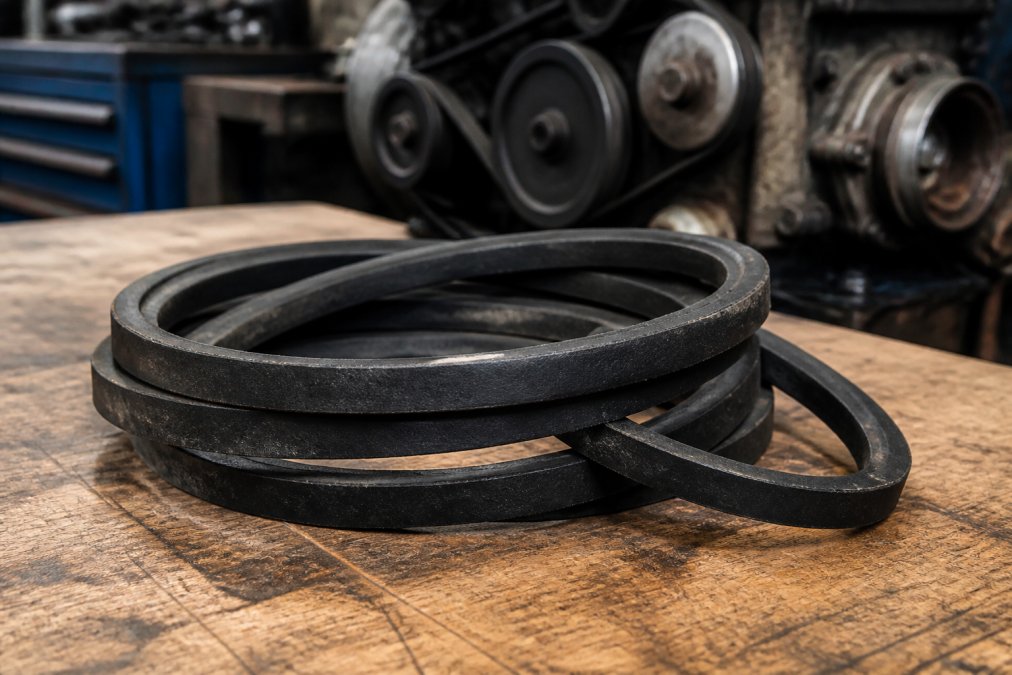
 comparison
Are Cheaper V-Belts Reliable? A 2026 Review
Table of Contents
- Are Cheaper V-Belts Reliable? The Honest Answer
- Quick Comparison: Budget vs Premium V-Belts
- V-Belt Failure Symptoms: What Cheap Belts Do Differently
- V-Belt Maintenance Best Practices That Extend Any Belt's Life
- How to Choose the Right V-Belt for Your Application
- When Cheap Belts Make Sense: Cost Savings and TCO Analysis
- Verdict: Are Cheaper V-Belts Reliable Enough for Your Equipment?
- Frequently Asked Questions
Last Updated: September 21, 2026
Are Cheaper V-Belts Reliable? The Honest Answer
Cheaper V-belts are reliable for many light-duty and home equipment applications, but they carry real trade-offs in heat resistance, tensile strength, and lifespan. Whether a budget belt holds up comes down to how hard you run it, not the price tag alone. Below: the engineering differences, failure patterns to watch for, and how to calculate whether saving money upfront pays off.
Quick Comparison: Budget vs Premium V-Belts
| Factor | Budget V-Belt | Premium V-Belt |
|---|---|---|
| Price | Lowest upfront | Higher upfront |
| Material | Standard rubber compound | Heat and oil-resistant compound |
| Reinforcement | Polyester cord | Kevlar or aramid cord |
| Lifespan | Shorter in high-heat use | Longer under load |
| Best For | Light-duty, home equipment | Industrial, continuous-duty drives |
Price vs. Quality Correlation
Price tracks quality closely in V-belts, and the gap shows up in the rubber compound and the cord inside it. A standard polyester cord stretches under sustained heat and load; a Kevlar-reinforced belt resists that stretch, holding length and tension far longer, which explains most of the price gap. Price is not a perfect signal, though: a cheap belt from a reputable supplier can outperform a mid-priced belt of unknown origin.
Durability and Lifespan Expectations
Durability scales with how hard you run the drive. Budget belts perform acceptably in light-duty cycles but fail early on heavy-duty drives, a belt that lasts years on a lawn mower may last a fraction of that on a cooling tower fan running around the clock. Match the belt to the duty cycle, not to the budget line.
V-Belt Failure Symptoms: What Cheap Belts Do Differently
Cheap belts rarely fail without warning. Their symptoms appear earlier and more aggressively than on premium belts, and catching them early is the difference between a scheduled swap and an unplanned shutdown.
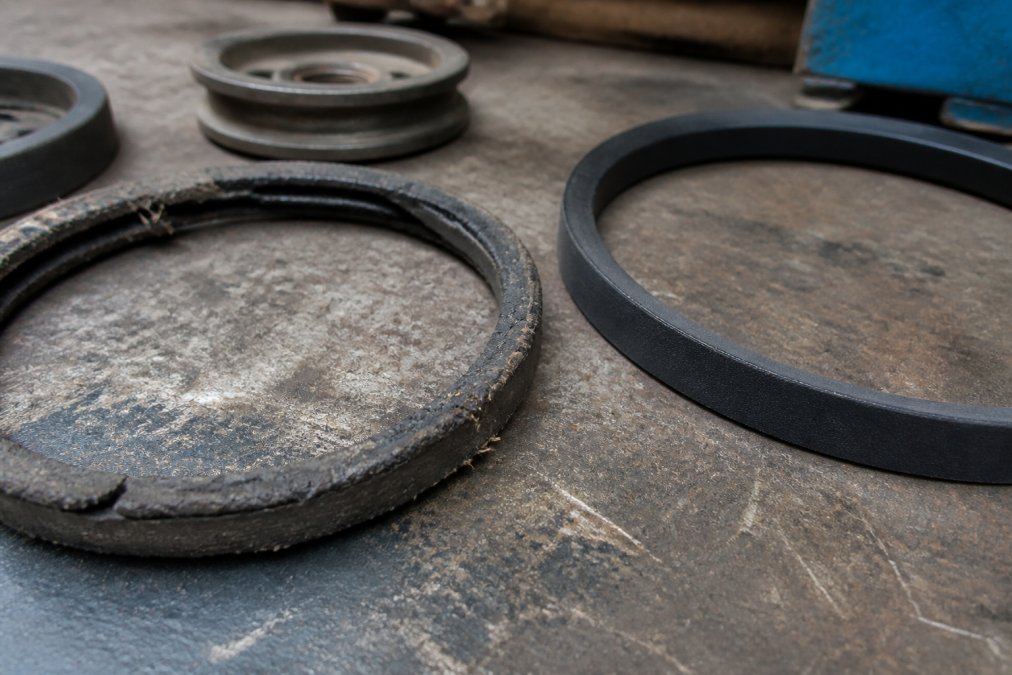
Common Failure Modes of Cheap Belts
The most common failure mode in budget belts is glazing, where heat and slippage harden and polish the surface. A glazed belt loses grip, squeals under load, and transfers less torque.
Other frequent failures include:
- Cord stretch: polyester cords elongate, forcing constant re-tensioning until adjustment runs out
- Cracking: low-grade rubber dries out and splits at the flex points
- Edge fraying: the belt sheds material at the sides from poor pulley alignment
- Heat hardening: the compound stiffens, reducing flexibility around small pulleys
Why Cheap Belts Fail: A Technical Breakdown
The more useful question is why the failure happens, because the mechanism tells you whether a budget belt is a calculated risk or a guaranteed callback.
Signs of Belt Wear and Degradation
Knowing the V-belt failure symptoms lets you replace a belt before it takes down a machine. Watch for:
- Squealing or chirping at startup or under load
- Visible cracks, glazing, or a shiny surface
- Frayed or missing material along the edges
- Belt sitting low in the pulley groove
- Excessive slack that returns after re-tensioning
- A belt that is noticeably hotter than the pulley it runs on after shutdown
V-Belt Maintenance Best Practices That Extend Any Belt's Life
Good V-belt maintenance best practices add life to any belt, budget or premium. Check tension at every service interval: too loose slips and glazes, too tight overloads bearings and cords. Verify pulley alignment with a straightedge, since misalignment is the quiet killer of belt life. Keep belts clean and oil-free, and store spares away from heat and sunlight.
How to Choose the Right V-Belt for Your Application
Choosing the right belt starts with the drive, not the catalog. Match rated capacity, profile, and material to the load, speed, and environment.
- Identify the drive type: light-duty, heavy-duty, or continuous industrial
- Confirm the belt profile and section (classic, wedge, or cogged)
- Check the horsepower rating against your actual load
- Match the material to the environment (heat, oil, dust)
- Verify pulley groove condition and alignment
- Choose OEM or aftermarket based on criticality
Application-Specific Requirements: Light vs. Heavy Duty
Light-duty applications tolerate budget belts well. Lawn mowers, garage door openers, and small ventilation fans run short cycles at modest loads. A standard belt handles these fine.
Reinforcement Materials: Kevlar vs. Standard Polyester
The cord decides how well a belt holds tension. Standard polyester stretches under heat and sustained load, so budget belts need frequent re-tensioning; Kevlar-reinforced belts resist stretch, holding length and grip far longer.
When Cheap Belts Make Sense: Cost Savings and TCO Analysis
Cheap belts make sense when failure is cheap and replacement is quick. They stop making sense when downtime, labor, and secondary damage enter the equation.
Total Cost of Ownership Calculator
Here is a total cost of ownership framework you can run with your own numbers.
The formula:
How to fill in each term:
- Belt price, the invoice price of one belt; on multi-belt drives, multiply by the number in the matched set, since you replace the set, not the single failed belt.
- Labor per swap, fully loaded labor cost (wage plus benefits plus overhead) times hours, including lockout/tagout, guard removal, tensioning, and alignment. An accessible drive might take under an hour; a guarded, elevated, or cramped one can take several.
- Replacements per year, how many times you expect to change the belt annually. This term separates budget from premium: if a budget belt lasts six months and a premium belt two years, the budget belt is replaced four times as often.
- Downtime hours per failure, production hours lost to an unexpected failure, not the hours to change it. A scheduled swap during a planned outage costs nothing in lost production; a mid-shift failure costs the full line rate for the repair.
- Downtime cost per hour, your best estimate of margin lost per hour down. Without a number, use the line's revenue rate as a ceiling and idle labor cost as a floor.
- Failures per year, how many replacements are unplanned. This term most often flips the decision, since unplanned failures carry downtime cost and planned ones do not.
Worked comparison (plug in your own figures):
| Term | Budget belt | Premium belt |
|---|---|---|
| Belt price (per set) | Lower | Higher |
| Labor per swap | Same | Same |
| Replacements per year | More | Fewer |
| Unplanned failures per year | More | Fewer |
| Downtime cost per failure | Same | Same |
| Annual TCO | Often higher once downtime is included | Often lower on critical drives |
A quick sensitivity check. Before you commit, ask:
- If the belt fails at 2 a.m. on a Saturday, what does that cost?
- Can the drive be run at reduced load until the next scheduled outage, or does it stop the line?
- Is the belt reachable without scaffolding, a lift, or a second person?
When to Choose OEM vs. Aftermarket
Choose OEM when the equipment is under warranty, the drive is critical, or the manufacturer specifies exact tolerances. Choose aftermarket for a hard-to-source metric size, an overpriced OEM part on a light-duty job, or faster delivery.
How to Tell a Good Cheap Belt From a Bad One
Price alone will not tell you. What will:
- A stated cord material. If the sleeve or listing names the tensile cord (polyester, aramid/Kevlar), the maker is telling you something. If it says nothing, assume the cheapest cord.
- A stated compound rating. Look for oil-resistant and heat-resistant callouts. A belt sold only by size is a commodity belt.
- A recognizable standard on the label. A belt citing a published dimensional or performance standard is more accountable than one that does not.
- A matched-set option. On multi-belt drives, buy belts sold as a matched set; mixing lots throws off load sharing.
- A real return policy. A supplier who stands behind the belt is a supplier who expects it to last.
Verdict: Are Cheaper V-Belts Reliable Enough for Your Equipment?
Cheaper V-belts are reliable enough for light-duty and home equipment, and a false economy on critical, continuous-duty drives. The deciding factor is the cost of failure, not the price of the belt.
Frequently Asked Questions
How long do V-belts typically last?
Belt lifespan depends on the application and belt quality. A standard rubber V-belt in a light-duty HVAC system may last 2 to 3 years, while a heavy-duty Kevlar-reinforced belt in continuous industrial service can run 5 years or more with proper maintenance. Heat, pulley misalignment, and overload conditions shorten life regardless of brand. Check belts at every maintenance interval for cracking, glazing, or stretch.
What are the risks of using low-cost V-belts in heavy machinery?
Budget belts in heavy-duty applications can fail prematurely due to lower tensile strength and heat resistance. Common risks include belt slippage, sudden breakage that halts production, and damage to pulleys from uneven wear. If downtime costs thousands per hour, the savings from a cheap belt rarely justify the risk. Match belt grade to the load and duty cycle.
How does belt material affect V-belt longevity?
The rubber compound and reinforcement cords determine how a belt handles heat, oil, and shock loads. Standard belts use polyester or rayon tensile cords and basic rubber. Premium belts use Kevlar or aramid reinforcement with heat-resistant compounds. Kevlar reinforced belts resist stretching and handle higher torque, which extends service life in demanding drives. For light loads, standard material is sufficient.
Where is the best place to buy V-belts?
Industrial suppliers, agricultural stores, and online retailers all carry V-belts. For hard-to-find metric sizes or specific profiles, look for a supplier with extensive inventory and knowledgeable support. V-Belt Nation offers a comprehensive selection of V-belts, including classic, wedge, cogged, and banded options. Always verify the belt section and length before ordering.
Are cheaper V-belts reliable for lawn mowers and home equipment?
For lawn mowers and garage door openers, a quality aftermarket belt is often reliable and costs far less than dealer OEM parts. These belts handle shock loads from mower decks well. The key is matching the belt profile and length to your equipment. Avoid no-name belts with no reinforcement, as they stretch quickly and slip under load.
Cheaper belts can work, but only when the application is forgiving. For everything that matters, V-Belt Nation stocks the reinforced, heat-resistant belts that keep machinery running, backed by a Price Match Guarantee, free ground shipping on U.S. orders over $175, and personalized support to find your exact size. Get started with V-Belt Nation and keep your drives running without the guesswork.