 how-to
How to Stop V-Belt Squealing: A Fix-It Guide
Table of Contents
- Why V-Belt Squealing Happens: Diagnose Before You Fix
- Signs of a Worn V-Belt You Should Never Ignore
- V-Belt Tensioning Guide: Getting the Tension Right
- How to Check Pulley Alignment on Your Drive System
- Belt Dressing: What Works and What Makes Things Worse
- Step-by-Step: How to Stop V-Belt Squealing for Good
- When to Replace Instead of Repair
- Frequently Asked Questions
Last Updated: September 1, 2026
Why V-Belt Squealing Happens: Diagnose Before You Fix
A squealing v-belt is one of the most common and most misdiagnosed problems in drive system maintenance. Technicians often reach for belt dressing before identifying the actual cause, which masks the symptom and accelerates failure.
V-belt squealing is the high-pitched noise produced when a belt loses traction against a pulley groove. The root cause is almost always one of four things: incorrect belt tension, pulley misalignment, belt wear, or a seized accessory component. Getting the diagnosis right before you touch a wrench saves time, money, and the belt itself.
Squealing vs. Chirping vs. Slipping: What the Sound Tells You
The sound your belt makes is diagnostic data.
- Squealing (continuous, high-pitched): typically indicates a loose belt, glazed belt surface, or belt-to-pulley slippage under load
- Chirping (intermittent, rhythmic): usually tied to pulley misalignment or a localized flat spot on the belt
- Slipping (low rumble or intermittent loss of power): points to severe under-tension or a worn pulley groove
Chirping that disappears after warm-up often signals misalignment. Squealing that worsens under load almost always means insufficient belt tension or glazing.
Quick Visual Inspection Guide
Before measuring anything, a visual pass takes less than two minutes and rules out obvious failures.
- Look for shiny, hardened surfaces on the belt's contact faces (glazing)
- Check for cracks running across the belt's width (transverse cracking) or along the edges
- Inspect the pulley grooves for wear, rust, or debris buildup
- Look for belt tracking: a belt riding high in the groove signals misalignment
- Check for oil or coolant contamination on the belt or pulleys
Any one of these findings changes your repair path.
Signs of a Worn V-Belt You Should Never Ignore
Worn belts rarely fail without warning. The problem is that warning signs are easy to dismiss as "normal wear" until the belt snaps.
Glazing, Cracking, and Rubber Degradation
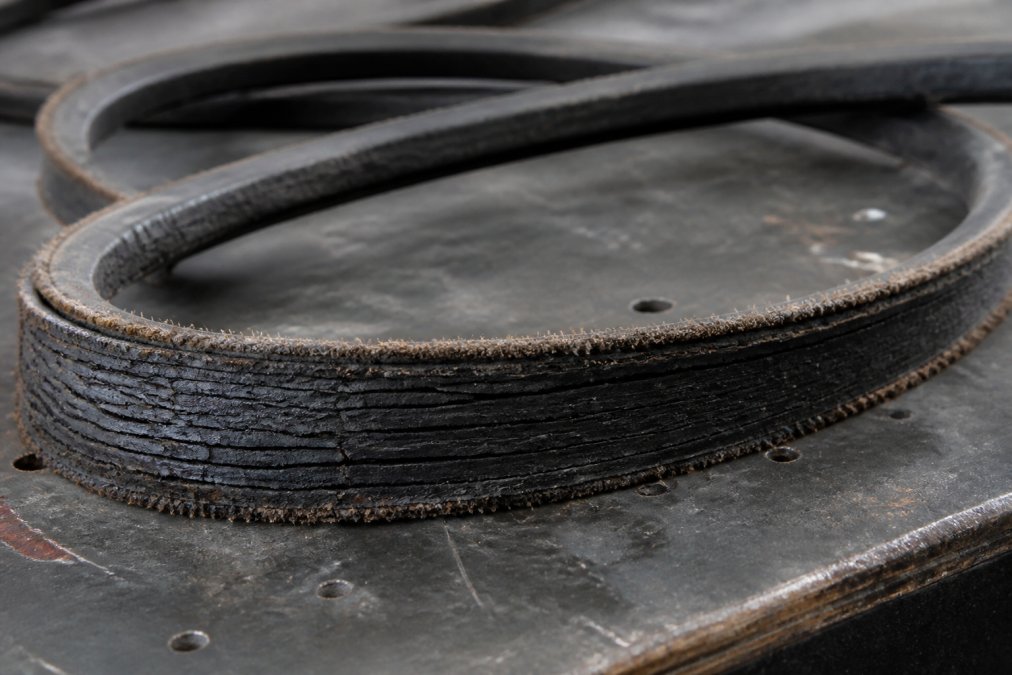
Glazing is the hardening and smoothing of the belt's contact surface caused by heat buildup from slippage. A glazed belt looks shiny where it should look matte. Once glazed, the belt loses its grip coefficient and will continue to slip regardless of tension. Glazing is not reversible; the belt needs replacement.
Transverse cracking runs across the belt's width and indicates rubber degradation from age, heat cycling, or ozone exposure. According to the Rubber Manufacturers Association belt maintenance guidelines, transverse cracks deeper than 1/32 inch require immediate replacement. Edge cord separation indicates the belt has been running misaligned.
Rubber degradation also manifests as belt swelling, which occurs when oil or solvent contamination causes the rubber to absorb fluid and lose structural integrity. A swollen belt will not seat properly in the pulley groove.
Long-Term Damage Risks from a Neglected Belt
A slipping belt generates heat that transfers directly to pulley grooves, accelerating groove wear and reducing grip capacity for any future belt. Running a worn belt long enough to damage pulleys turns a $30 belt replacement into a $300+ pulley replacement.
Bearing failure is the second risk. A misaligned or over-tensioned belt creates side-loading on shaft bearings in your alternator, water pump, and power steering pump. Many bearing failures trace back to prolonged belt problems, not bearing defects.
V-Belt Tensioning Guide: Getting the Tension Right
Under-tension is the single most common cause of v-belt squealing. Over-tension is the most common cause of premature bearing failure. Getting belt tension right is the foundation of a properly functioning drive system.
How to Measure Belt Deflection
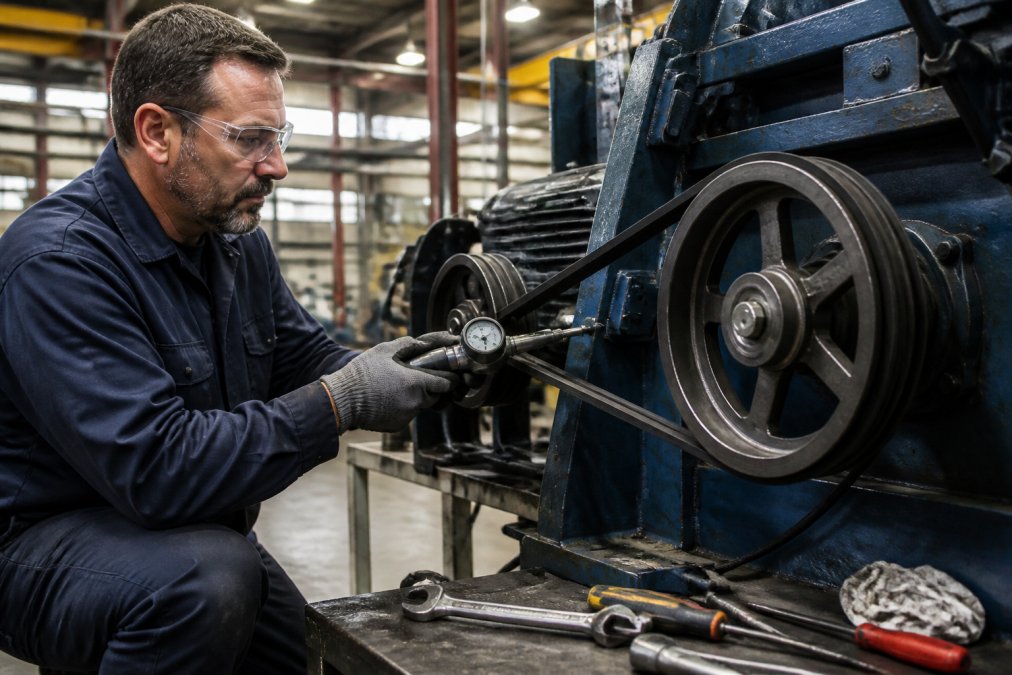
The deflection method is the standard field technique for checking belt tension without specialized tooling.
- Find the midpoint of the longest unsupported belt span between two pulleys
- Apply a perpendicular force of approximately 1 pound (4.4 N) to the belt at that midpoint
- Measure the deflection distance
- The target deflection is typically 1/64 inch per inch of belt span, so a 32-inch span should deflect roughly 1/2 inch
As documented in Gates Power Transmission belt installation guide, specific deflection targets vary by belt cross-section and drive design. Always consult the manufacturer's specification for your exact belt profile.
A belt tension gauge gives more precise results and is worth the investment for facilities running multiple drive systems.
Tensioner Pulley and Idler Pulley Inspection
Automatic tensioners maintain belt tension until they fail. A worn tensioner pulley bearing produces a chirping or rattling noise easy to confuse with belt noise. Check tensioner spring tension by manually deflecting the tensioner arm. It should resist movement firmly and return smoothly. A tensioner that moves too easily has lost spring force.
Inspect the idler pulley the same way. Idler pulleys often seize gradually, creating a flat spot that produces rhythmic chirping at belt speed.
Replace tensioner and idler pulleys whenever you replace the belt on a high-hour drive system. The labor cost is already paid.
How to Check Pulley Alignment on Your Drive System
Misalignment is the second most common cause of belt noise and premature wear. A properly tensioned belt on misaligned pulleys will still squeal, chirp, and wear out prematurely.
Straightedge and Laser Alignment Methods
Straightedge alignment is the baseline method for v-belt drives. Place a straightedge across the faces of both pulleys. All four contact points should touch simultaneously. Any gap indicates angular or parallel misalignment.
For drives where pulleys are far apart or obscured, a laser alignment tool provides more reliable results. The American National Standards Institute ANSI/ASABE belt drive standards recommends maximum angular misalignment of 0.5 degrees for standard v-belt drives.
| Misalignment Type | What You See | Fix |
|---|---|---|
| Angular misalignment | Belt rides high on one side of pulley | Adjust shaft angle or pulley position |
| Parallel (offset) misalignment | Belt tracks to one edge of groove | Reposition pulley axially on shaft |
| Pulley groove wear | Belt sits too deep in groove | Replace pulley |
Belt Dressing: What Works and What Makes Things Worse
Belt dressing is a spray applied to restore grip and reduce squealing. Most commercial belt dressings work by softening the belt's contact surface to increase friction. This can quiet squealing for days or weeks, but the underlying cause, insufficient tension, glazing, or misalignment, remains unchanged. The belt continues to slip and generate heat, and dressing residue builds up in pulley grooves, eventually making the grip problem worse.
Do not use brake fluid as belt dressing. It degrades rubber compounds and accelerates belt failure.
Belt dressing makes sense only as a short-term measure to get through a shift while a replacement belt is sourced. For silicone-based or EPDM compound belts, avoid petroleum-based dressings entirely; they cause swelling and degradation.
Step-by-Step: How to Stop V-Belt Squealing for Good
Work through this sequence in order. Skipping steps leads to replacing belts that didn't need replacing or missing seized bearings that destroy new belts within a week.
- Safety first. Lock out / tag out the drive system per OSHA 29 CFR 1910.147 before touching any components.
- Identify the noise type. Squealing, chirping, or slipping each points to a different root cause.
- Inspect the belt visually. Check for glazing, cracking, edge wear, and contamination. If found, proceed to step 8.
- Check belt tension. Use the deflection method or a tension gauge.
- Adjust tension if needed. On fixed-center drives, adjust the motor or driven machine position. On spring-loaded tensioners, check spring force.
- Check pulley alignment. Use a straightedge across both pulley faces. Correct any misalignment before proceeding.
- Inspect tensioner and idler pulleys. Spin each by hand with the system de-energized. Any roughness or grinding means replacement.
- Check accessory components. Manually rotate the alternator, water pump, and power steering pump pulleys. Resistance or grinding indicates bearing failure.
- Replace the belt if needed. If the belt shows glazing, cracking, or has been running on a misaligned or contaminated drive, replace it.
- Re-inspect after 24 hours of operation. New belts seat into pulley grooves and lose initial tension. Check and re-tension after the first day of use.
When to Replace Instead of Repair
Some belt problems cannot be fixed through adjustment. Replace the belt immediately when you find:
- Glazing on the contact faces, grip cannot be restored once the surface hardens
- Transverse cracks across the belt width
- Edge cord separation or fraying along the belt edges
- Oil or solvent contamination, contaminated belts swell and lose grip
- Belt age exceeding the manufacturer's service interval, rubber degrades with heat cycling regardless of appearance
- Belt riding high in the pulley groove, indicating the belt cross-section has worn down
The Power Transmission Distributors Association belt maintenance resources recommends proactive belt replacement on a scheduled basis for critical drive systems rather than waiting for failure symptoms. For high-duty-cycle applications, unplanned downtime from belt failure costs far more than a scheduled replacement.
| Condition | Action | Urgency |
|---|---|---|
| Glazed contact surface | Replace belt | Immediate |
| Transverse cracking | Replace belt | Immediate |
| Under-tension, no wear | Re-tension and monitor | This shift |
| Pulley misalignment | Realign, inspect belt | This shift |
| Tensioner bearing rough | Replace tensioner | Scheduled |
| Accessory bearing seized | Replace component and belt | Immediate |
| Belt age at service interval | Replace proactively | Scheduled |
How to stop v-belt squealing permanently comes down to one principle: fix the cause, not the symptom. Tension, alignment, and component condition determine whether a belt runs quietly for years or fails within weeks.
V-Belt Nation carries an extensive inventory of industrial V-belts across all major cross-sections and profiles, with free ground shipping on all U.S. orders over $175 and a Price Match Guarantee. If you're sourcing a replacement belt or building out a preventative maintenance stock, our team can help you find the exact specification you need.
Shop Now at V-Belt Nation and get the right belt the first time.
Frequently Asked Questions
Can I spray WD-40 on a V-belt to stop squeaking?
No. WD-40 is a petroleum-based product that degrades rubber compounds. Spraying it on a V-belt will temporarily reduce squealing but accelerates glazing and rubber degradation, shortening belt life significantly. It also increases the risk of belt slippage under load. The correct fix is to identify the root cause, improper tension, pulley misalignment, or a worn belt, and address that directly rather than masking the noise with a spray.
Is a squealing V-belt a sign of imminent failure?
Not always, but it is a warning you should act on immediately. V-belt squealing often signals low belt tension, pulley misalignment, or early-stage glazing, all of which are fixable before failure occurs. Left unaddressed, these conditions accelerate rubber degradation and can lead to complete belt failure, which risks component seizure on driven accessories like water pumps, alternators, or power steering pumps. Treat any persistent squeal as a maintenance alert, not a minor annoyance.
How do I check the tension on a V-belt?
The standard method is belt deflection testing. Apply firm thumb pressure to the belt midspan between two pulleys. A properly tensioned V-belt should deflect approximately 1/64 inch per inch of span length. For a 16-inch span, that means roughly 1/4 inch of deflection. Too much deflection means the belt is loose and prone to slipping and squealing. Too little means over-tensioning, which stresses bearings. A belt tension gauge gives a more precise reading and is recommended for industrial and HVAC applications.
What are the most common causes of V-belt squealing on industrial equipment?
The four most common causes are: insufficient belt tension allowing slippage against pulley grooves, pulley misalignment that forces the belt to run at an angle, glazed or worn belt surfaces that have lost grip, and contamination from oil or coolant. On industrial accessory drive systems, a seized bearing in the alternator, water pump, or idler pulley can also cause the belt to drag and squeal. Correct diagnosis before replacement prevents the same problem from recurring on a new belt.