 how-to
Identifying Non-Standard Metric V-Belt Sizes
Table of Contents
- Why Non-Standard Metric V-Belt Sizes Matter
- V-Belt Measurement Tools You'll Need
- How to Measure a Broken V-Belt Step by Step
- Understanding Belt Profiles and Cross-Sections
- Metric vs. Imperial V-Belt Conversion
- Analyzing Wear Patterns to Identify Root Causes
- Finding Exact Replacements for Legacy Equipment
- Conclusion
- Frequently Asked Questions
Last Updated: September 4, 2026
Why Non-Standard Metric V-Belt Sizes Matter
Identifying non-standard metric v-belt sizes is frustrating: a machine goes down, the belt snaps, and the markings are worn off or unreadable. Standard metric sizes are easy to source, but oddball profiles from legacy European or Japanese equipment leave you with only the physical geometry to work from.
This guide walks through measuring a broken belt, decoding its profile, and finding a replacement that fits without extended downtime.
The stakes are higher than just buying the wrong part. A belt that is close but not exact will wear prematurely, slip under load, and eventually fail again. Getting the measurement right the first time keeps your machinery running and your maintenance budget intact.
V-Belt Measurement Tools You'll Need
Gather the right equipment before measuring: a tape measure for circumference and a digital caliper for width and depth.
Essential equipment for accurate sizing
Use a steel tape or dedicated belt measuring tool for circumference and a digital caliper for top width and depth. Lay the belt on a flat surface with good lighting and record all measurements in millimeters.
How to Measure a Broken V-Belt Step by Step
Measuring a broken belt requires a different approach: since it has no continuous loop, you must butt the cut ends together. How you position and support the belt directly affects measurement accuracy.
Measuring outside circumference and pitch length
Butt the cut ends together on a flat surface to measure outside circumference. This measurement is only valid if the belt is laid flat without tension or compression. Sagging shortens the reading; stretching lengthens it. Both errors lead to wrong-sized replacements.
Best practice: Lay the belt on a flat, rigid surface, butt the cut ends together without forcing them, and use a steel tape laid flat against the belt. Record the measurement in millimeters.
The pitch length, which is the measurement used for sizing, is typically shorter than the outside circumference by a fixed amount that depends on the belt profile. For classical and narrow V-belts, the difference between outside circumference and pitch length is standardized and published in the Rubber Manufacturers Association belt sizing tables. A common approach is to subtract a set value per inch of belt width, but the exact offset varies by profile.
When you are dealing with metric belts, the datum length is often the critical number, and it sits between the inside and outside circumference. ISO 4184 specifies the datum line location for each metric profile (10mm, 13mm, 17mm, 22mm, etc.). If you do not know the profile yet, measure the outside circumference and record it; you will use it to calculate pitch length once you identify the profile.
Why belt tension during measurement matters
Measure the belt in its resting state on a flat surface with no applied force. Measuring under tension introduces 1-3 percent error, resulting in a replacement that is too long and will slip.
Temperature also affects belt length. Rubber V-belts expand approximately 0.1-0.2 percent per 10°F. A belt measured at 60°F and installed on a 140°F drive will be effectively 1-2 percent longer, causing slack and slip.
Measurement protocol: Allow the belt to acclimate to room temperature (68-72°F) for 2 hours. Lay it on a flat surface, butt the cut ends together gently, and measure with a steel tape laid flat. Record the measurement, ambient temperature, and any visible deformation.
Determining top width and belt profile
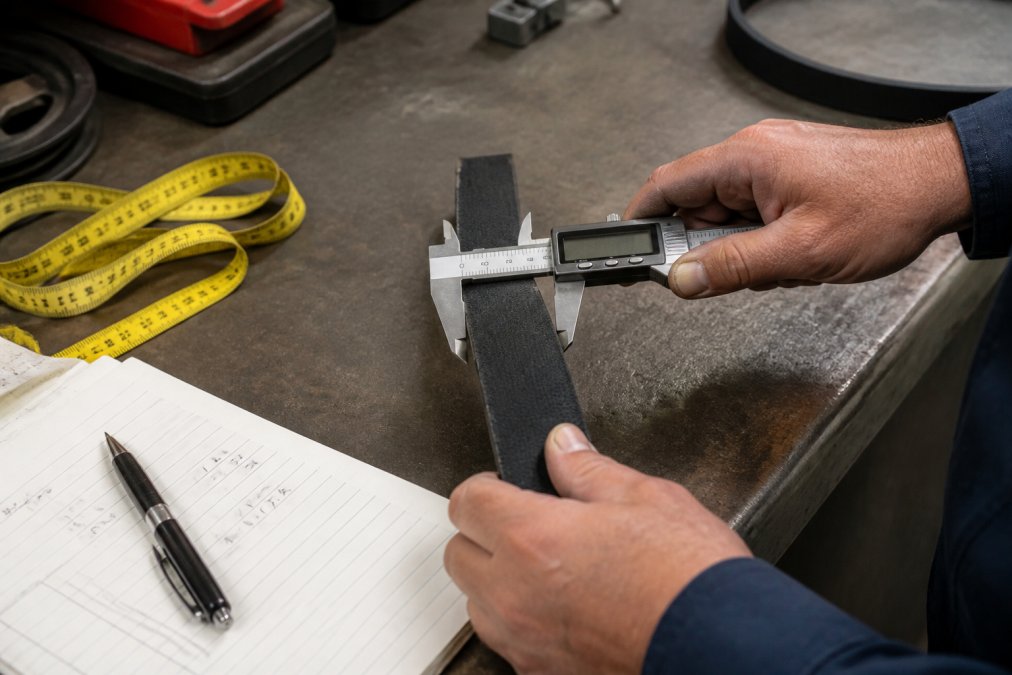
Measure top width and depth with a digital caliper. A 10mm top width suggests metric 10, 13mm suggests metric 13 or narrow 3V, and 17mm suggests metric 17 or classical B-section. The combination of top width and depth is unique to each profile family and is the foundation of accurate identification.
Converting outside circumference to pitch length
Calculate pitch length using: Pitch length = Outside circumference − Profile offset. For example, 1,500mm − 12mm = 1,488mm, which rounds to 1,490mm (a standard metric 17 size). If the calculated pitch length does not round to a standard size, the belt is likely non-standard or custom; photograph the belt and measurements and send them to a supplier with cross-reference databases.
Understanding Belt Profiles and Cross-Sections
Classical vs. narrow vs. metric profiles
Classical V-belts use letter designations (A, B, C, D) in inches; narrow V-belts use 3V, 5V, 8V designations. Metric profiles use millimeters and follow ISO 4184 standards. A metric 17 belt looks similar to a classical B-section but has different groove angles and length measurements. Mixing profiles causes slippage and premature wear.
| Profile Family | Top Width Range | Common Designations | Measurement Standard |
|---|---|---|---|
| Classical | 13mm - 32mm | A, B, C, D | Inches (nominal) |
| Narrow | 9mm - 25mm | 3V, 5V, 8V | Inches (nominal) |
| Metric | 10mm - 50mm | 10, 13, 17, 22 | Millimeters (ISO) |
Metric vs. Imperial V-Belt Conversion
Converting between metric and imperial V-belt sizes requires understanding the dimensional differences and the relationship between pitch length and outside circumference. A direct 1:1 conversion does not exist because the two standards use different datum lines and groove angles.
Understanding the pitch length vs. outside circumference relationship
The pitch length is the theoretical length at the belt's neutral axis, the point where the belt neither stretches nor compresses under load. The outside circumference is the total perimeter of the belt measured around its outer edge. The difference between these two measurements depends on the belt profile and is governed by the belt's cross-sectional geometry.
For classical V-belts (A, B, C, D profiles), the offset between outside circumference and pitch length is approximately 1.3 inches for A-section belts, 1.6 inches for B-section, 2.0 inches for C-section, and 2.5 inches for D-section. These offsets are standardized in the Rubber Manufacturers Association standards for classical V-belts.
Metric belts follow ISO 4184 standards and use a different datum system. A metric belt's pitch length is typically 10-15 millimeters shorter than its outside circumference, depending on whether it is a 10mm, 13mm, 17mm, or 22mm profile. The exact offset is built into the belt's cross-section angle and cannot be estimated by eye.
Conversion formula: from imperial to metric
Convert imperial to metric using: Pitch length in millimeters = Pitch length in inches × 25.4. For a 75-inch B-section belt: 75 × 25.4 = 1,905mm. Round to the nearest standard size (1,900mm or 1,910mm in 5-10mm increments). Always round down; a slightly shorter belt can be tensioned to compensate, but a longer belt cannot be tightened without damage.
Conversion formula: from metric to imperial
To convert metric to imperial: Pitch length in inches = Pitch length in millimeters ÷ 25.4. For 1,500mm: 1,500 ÷ 25.4 = 59.06 inches. However, groove angles must match. A metric belt with a 40-degree angle will not seat correctly in a classical sheave (typically 38 degrees), causing the belt to ride high and slip.
Why profile matching matters more than length
The most common mistake is assuming a 17mm metric belt is interchangeable with a B-section imperial belt because the top width is close (B-section is nominally 17/32 inch, or 13.5mm). The groove angle and the depth differ, which means the belt will not seat correctly in the sheave. Belt slip and squealing are the immediate symptoms, followed by rapid sidewall wear and premature failure.
Before converting, measure the pulley groove angle using a protractor or angle gauge. Most V-belts use a 38-40 degree groove angle, but metric belts on European equipment sometimes use 36 degrees or 42 degrees. If the angle does not match, the belt will ride incorrectly regardless of the length. The ISO 4184 standards for metric V-belt dimensions define the groove profiles and datum lengths that govern proper fit.
Practical conversion checklist
- Measure pitch length or outside circumference in the original unit.
- Convert using the formula above.
- Round to the nearest standard size (5-10mm increments for metric; 1-inch for imperial).
- Verify the pulley groove angle matches the belt profile.
- Confirm the belt profile family is compatible with the sheave design.
- If the groove angle or profile does not match, consult a supplier for a compatible alternative.
The pitch line, where the belt transmits power, sits inside the belt body. Wrong length measurements by even a few millimeters cause tension problems that shorten belt life and increase slip losses.
Analyzing Wear Patterns to Identify Root Causes
A worn belt tells you more than just its size. The wear pattern reveals whether the belt was sized correctly in the first place.
Check the sidewalls of the belt. Shiny, polished sidewalls indicate belt slip, which means the tension was too low or the load was too high. Uneven wear on one side points to a misaligned pulley system. Cracks at the bottom of the V suggest the belt was running too hot or was bent around too small a pulley.
These observations matter when you are identifying non-standard metric v-belt sizes because they tell you whether the replacement should be the same profile or whether the drive system itself needs correction. Installing a correctly sized belt on a misaligned drive just produces another premature failure. According to power transmission maintenance guidance from the US Department of Energy, proper belt tension and alignment are critical factors in extending the service life of mechanical drive systems.
Finding Exact Replacements for Legacy Equipment
Legacy equipment presents the hardest identification challenge. Old machines often use belt profiles that were common in their country of origin but rare elsewhere, and the original documentation is long gone.
Start by measuring everything you can: top width, depth, outside circumference, and groove angle. Then compare those numbers against the standards for classical, narrow, and metric profiles. If the measurements do not match any current standard, you are likely dealing with an obsolete profile that requires a custom cross-reference.
This is where working with a supplier that carries a broad inventory matters. At V-Belt Nation, the support team handles these exact scenarios daily, matching obscure profiles to compatible replacements from an extensive inventory of classical, wedge, cogged, and banded belts. The Rubber Manufacturers Association belt identification guide provides a useful starting point for understanding profile designations, but it does not cover every legacy metric size.
A reliable approach is to photograph the belt alongside your measurement notes and send both to a specialist. Clear photos of the cross-section and the full length, combined with precise caliper readings, give an experienced supplier what they need to find a match. Many customers assume a non-standard metric size means weeks of waiting, but a supplier with deep stock and cross-reference experience can often ship the right belt quickly.
Conclusion
Identifying non-standard metric v-belt sizes comes down to systematic measurement: top width, depth, outside circumference, and groove angle. Wear patterns reveal whether the drive system needs attention. When measurements point to an obscure profile, work with a supplier that understands legacy equipment and carries the full range of belt types. V-Belt Nation combines extensive inventory with personalized support, competitive pricing, and a Price Match Guarantee. Free ground shipping on U.S. orders over $175 helps get your equipment back online quickly.
Frequently Asked Questions
What do the numbers and letters on a metric V-belt mean?
Metric V-belt markings typically show the belt profile (such as SPZ, SPA, SPB), the pitch length in millimeters, and sometimes the top width. For example, 'SPA 1250' indicates a narrow profile belt with a pitch length of 1250 mm. The profile determines the pulley groove angle and cross-section dimensions. If markings are worn or missing, you'll need to measure the outside circumference, top width, and belt depth to identify the correct replacement.
Can I replace a metric V-belt with a standard U.S. size?
Direct replacement is not recommended without careful verification. Metric and classical U.S. belts have different pulley groove angles and cross-sectional dimensions. A metric belt on a U.S. pulley groove will slip or wear prematurely due to poor seating. However, you can cross-reference the pitch length and profile to find an equivalent U.S. classical belt size, provided the pulley grooves match the new belt's angle of wrap specifications. Always verify pulley groove angles before switching standards.
How do I find a non-standard metric V-belt that's no longer in production?
Start by measuring the pitch length, top width, belt depth, and pulley groove angle. Document any wear patterns or tensioning issues. Cross-reference these dimensions against ISO standards for metric V-belts to identify the closest standard size. If the original is truly non-standard, you may need a custom-length belt or a functionally equivalent alternative. V-Belt Nation's support team can help match legacy equipment specifications to available inventory or arrange special orders for rare sizes.
What's the difference between pitch length and outside circumference?
Pitch length is the effective length measured along the belt's neutral axis (the datum line), while outside circumference is the total length measured along the belt's outer edge. The difference depends on the belt's depth and cross-section. For accurate identification, measure both values. Pitch length is typically what manufacturers use in belt designation, but outside circumference is often easier to measure on an installed or broken belt. Converting between the two requires knowing the belt's profile and depth.