 listicle
Industrial V-Belts Cheaper Than OEM: Top Picks for 2026
Table of Contents
- Why Aftermarket Industrial V-Belts Match OEM Durability
- Quick Comparison: Top Industrial V-Belt Suppliers
- V-Belt Nation: Price Match Guarantee and Free Shipping
- VBeltSupply: Budget-Friendly Cross-Referenced Belts
- Tractor Supply Huskee: Kevlar-Reinforced Belts for Lawn and Garden
- TranBelt: Industrial-Grade Quality at Accessible Prices
- Continental, Gates, Bando, Timken, and Dayco: Premium OEM Alternatives
- How to Use an Industrial V-Belt Cross Reference
- Frequently Asked Questions
Last Updated: September 13, 2026
Why Aftermarket Industrial V-Belts Match OEM Durability
Aftermarket industrial V-belts often match OEM durability because they are built to the same published cross-section and length standards. The difference is branding and distribution cost, not engineering. This guide from V-Belt Nation answers the question thousands of maintenance managers ask: where can I buy high-quality industrial V-belts that are cheaper than OEM brands but just as durable?
Here is the core tension most buyers miss. OEM dealers rarely manufacture belts. They buy from the same large plants that supply the aftermarket, then add a markup for dealer network overhead. When you buy a replacement through a dealer channel, you often pay for logistics and branding rather than better rubber.
That is why an industrial V-belt cross reference is the single most useful tool in this category. It lets you match a dealer part number to a standardized profile, then source that profile from any qualified supplier.
Quick Comparison: Top Industrial V-Belt Suppliers
The best supplier depends on your application, but the evaluation criteria should not. Before you compare names, compare what each channel can actually document: profile coverage, cord material, RMA or ISO conformance, static-conductivity rating, and whether the supplier will put dimensional tolerances in writing. A supplier that cannot answer those five questions is a price play, not a durability play.
| Supplier | Best For | Standout Feature | Verification Strength | Pricing Model |
|---|---|---|---|---|
| V-Belt Nation | Most industrial buyers | Price Match Guarantee, free ground shipping over $175 | Cross-reference support and dimensional confirmation on request | Contact for pricing |
| VBeltSupply | Cost reduction programs | Online part-number cross-referencing | Self-serve lookup; buyer must verify profile | Contact for pricing |
| Tractor Supply (Huskee) | Lawn and garden | Kevlar-reinforced, in-store pickup | Retail packaging with printed profile and length | From $24.00 per unit |
| TranBelt | General industrial | Classic and wedge profile range | Quote-based; request material spec sheet | Contact for pricing |
| Continental | Heavy-duty plants | Wrapped construction, heat and oil resistance | Published technical data and RMA-conformant dimensions | Contact for pricing |
| Gates | Critical machinery | Deep technical documentation | Full engineering data, installation specs, and drive-design tools | Contact for pricing |
| Bando USA | Precision drives | High-strength tensile cords | Published cord and compound specifications | Contact for pricing |
| Timken | Heavy loads | Robust construction for high-stress drives | Application engineering support | Contact for pricing |
| Dayco | Mixed fleets | Broad profile compatibility | Cross-reference catalog and OEM interchange data | Contact for pricing |
How to read this table like a buyer, not a shopper
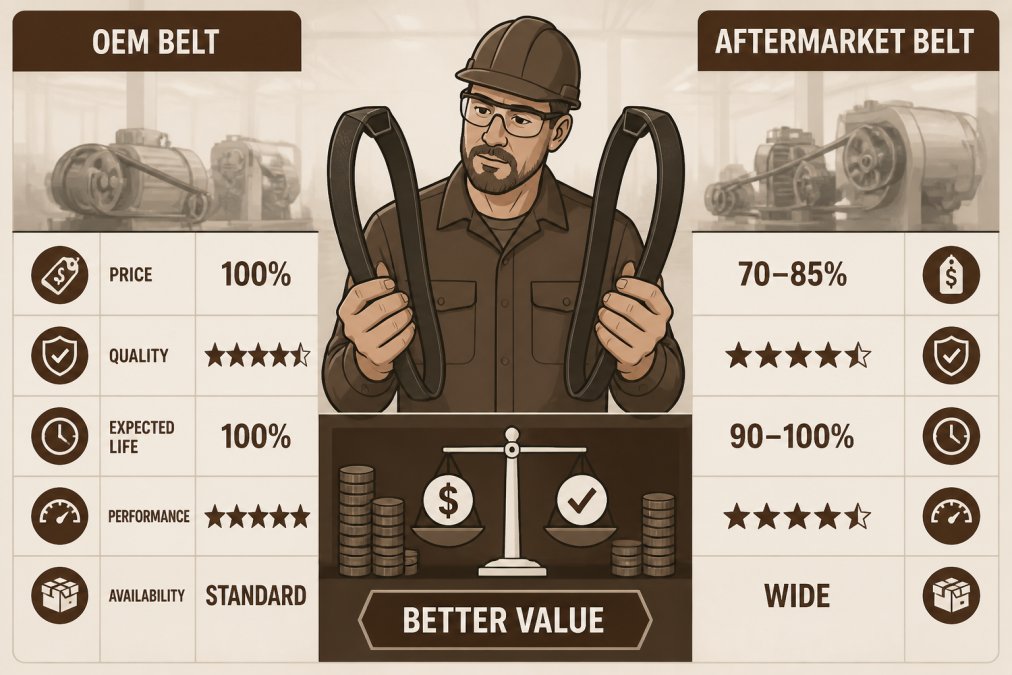
Three columns matter more than the rest. Verification strength tells you whether the supplier will hand you the dimensional and material data you need to confirm equivalence before you install. Standout feature tells you what problem the supplier is actually built to solve, urgency, cost, or engineering depth. Pricing model tells you how much friction sits between you and a quote.
A common pattern among maintenance teams is to shortlist two suppliers: one premium channel for critical drives where downtime cost dwarfs belt cost, and one value channel for the long tail of conveyors, fans, and compressors where a documented RMA-conformant belt is functionally identical to the dealer part. That split captures most of the savings without exposing the plant to a single point of failure.
Where the price gap actually comes from
The gap between a dealer belt and a qualified aftermarket belt is mostly distribution overhead, not manufacturing cost. Dealer networks carry regional warehouses, counter staff, and brand marketing. Direct and semi-direct suppliers strip some of that out. What they do not strip out, and should not, is the cord, the compound, and the wrap. If a supplier's price is dramatically below the market, the savings usually come from one of those three, which is exactly where durability lives.
That is why the counterfeit-detection guidance later in this article matters as much as the supplier list itself. The cheapest belt on the page is rarely the best value once you factor in a mid-shift failure.
V-Belt Nation: Price Match Guarantee and Free Shipping
V-Belt Nation offers a Price Match Guarantee and free ground shipping on all U.S. orders over $175, addressing common concerns about switching suppliers and hidden costs.
The catalog covers classic and wedge belts plus specialized cogged, banded, and lawn and garden options. That range matters because a single facility often runs several belt types across conveyors, compressors, and ventilation fans.
Personalized help finding a specific belt can be crucial when your part number is non-standard.
VBeltSupply: Budget-Friendly Cross-Referenced Belts
Tractor Supply Huskee: Kevlar-Reinforced Belts for Lawn and Garden
TranBelt: Industrial-Grade Quality at Accessible Prices
Continental, Gates, Bando, Timken, and Dayco: Premium OEM Alternatives
How to Use an Industrial V-Belt Cross Reference
An industrial V-belt cross reference converts a dealer part number into a standardized profile you can buy anywhere. The step most guides skip is verification: confirming that the aftermarket belt you found is dimensionally and materially equivalent to the OEM part, not just close enough to fit. That verification step is what separates a durable replacement from a premature failure.
The cross-reference workflow
- Record the printed part number from the old belt, including any suffix that indicates cord type or construction
- Measure top width and thickness with calipers to identify the cross-section (A, B, C, D, 3V, 5V, 8V, etc.)
- Measure outside circumference with a flexible tape, and note whether the catalog lists outside circumference or pitch length
- Match profile and length against a published cross-reference chart from the supplier
- Verify the replacement meets RMA or ISO dimensional standards for that profile
- Confirm cord material (polyester, aramid/Kevlar, or steel) matches or exceeds the OEM spec
- Confirm the belt is static conductive if the drive runs in a hazardous area
- Request the supplier's dimensional tolerance sheet before committing to a bulk order
Compatibility verification checklist
Most cross-reference failures are not wrong profiles, they are unverified substitutions. Run this checklist before you install an aftermarket belt on any drive where downtime matters:
- Cross-section match. Top width and thickness must fall within the published tolerance band for the profile. A belt that is 1/32 inch narrow may seat deeper in the groove and slip under load.
- Length designation match. Confirm whether the OEM number encodes outside circumference, pitch length, or effective length. Mixing these up is the single most common cross-reference error.
- Cord material match. If the OEM belt uses aramid cord for shock loads, a polyester-cord aftermarket belt is not equivalent even if the dimensions match.
- Wrap and construction match. A wrapped belt and a raw-edge cogged belt behave differently in the same drive. Match the construction type, not just the profile.
- Static conductivity. Drives in dusty or hazardous environments require a static-conductive belt (osha.gov). This is a safety item, not a preference.
- Matched-set compatibility. On banded or multi-belt drives, verify the replacement is sold as a matched set or from a single production batch.
How to spot a counterfeit V-belt
As buyers move toward cheaper channels, counterfeit and substandard belts become a real risk. Counterfeit belts usually show inconsistent print quality, uneven cord spacing visible at the cut end, and a rubber compound that feels slick or overly glossy compared to a genuine belt (gates.com). Packaging may have spelling errors, mismatched logos, or missing lot numbers. Premium-brand belts sold far below normal market pricing are the highest-risk listings.
Buy from authorized distributors or suppliers who will provide material documentation on request. If a supplier cannot tell you where the belt was manufactured or what cord it uses, treat the listing as unverified.
How do I measure V-belt length?
Measure the outside circumference by wrapping a flexible tape around the belt's outer face, then match that number to the profile's length designation. For cogged and wrapped belts, confirm whether the catalog lists outside circumference or pitch length, because the two differ. When in doubt, measure both and compare against the supplier's published dimensions for the part number you are considering.
Best practices for V-belt installation matter as much as the belt you choose. Align the sheaves, tension to the manufacturer's deflection spec, and re-check tension after the first shift. Most premature failures trace back to misalignment and over-tensioning, not defective rubber (gates.com).
Frequently Asked Questions
How do aftermarket industrial V-belts compare to OEM brands in industrial applications?
Aftermarket belts from reputable suppliers often meet or exceed OEM specifications for tensile strength, heat resistance, and oil resistance. Many are manufactured in the same ISO-certified facilities that produce OEM-branded belts. The key difference is branding and distribution markup, not quality. Look for belts with aramid cord reinforcement, wrapped or cogged construction, and documented ISO/RMA ratings to ensure durability matches OEM performance.
What should I look for when buying industrial V-belts online?
Check for aramid or Kevlar cord reinforcement, wrapped or cogged construction, and static conductivity for safety. Verify the belt profile matches your sheave cross-section dimensions. Confirm the supplier offers a cross reference tool so you can match OEM part numbers. Ask for ISO or RMA certification documentation. Reputable sellers like V-Belt Nation provide personalized support to help you find the exact belt for your machinery.
How can I identify the correct V-belt size for my machinery?
Measure the outside circumference with a flexible tape around the belt path, or use a belt length gauge. For worn belts, measure the pitch length at the cord line. Cross-reference the OEM part number using an industrial V-belt cross reference chart. If the belt is missing, check the machine manual or measure the sheave groove width to determine the correct profile (A, B, C, D, or 3V, 5V, 8V).
Are generic V-belts as durable as name-brand OEM belts?
Generic belts from quality-focused suppliers can match OEM durability when they use the same rubber compounds, cord materials, and manufacturing standards. The difference often comes down to quality control consistency. Belts with Kevlar reinforced aramid cord and ISO-certified production typically deliver comparable service life. Avoid unbranded belts with no material specifications or certification, as these often fail prematurely due to inferior rubber compound or cord construction.
Do industrial V-belts have industry-standard ratings for durability?
Yes. The Rubber Manufacturers Association (RMA) and ISO set standards for V-belt dimensions, tensile strength, and performance testing. RMA IP-20 and IP-22 cover classical and narrow V-belts. ISO 4184 specifies dimensions for classical V-belts. Belts meeting these standards undergo durability testing for heat resistance, oil resistance, and static conductivity. Always ask suppliers for documentation confirming their belts meet RMA or ISO ratings.
Matching OEM durability at a lower cost comes down to verification, not luck. Confirm the profile, check the standards, and buy from a supplier who can cross-reference your part number and stand behind the result. V-Belt Nation stocks a broad inventory of classic, wedge, cogged, banded, and lawn and garden belts, backs orders with a Price Match Guarantee, and ships free on U.S. ground orders over $175. Get started with V-Belt Nation and keep your machinery running without paying dealer markup.