 ultimate-guide
Metric V-Belt Size Conversion Chart: 2026 Guide
Table of Contents
- Why Metric V-Belt Conversion Matters for Your Equipment
- How to Measure V-Belt Length Accurately
- Metric V-Belt Size Conversion Chart: Length and Cross-Section
- V-Belt Cross Reference Guide: Matching Part Numbers Across Standards
- Fractional vs Metric V-Belt Sizing: Key Differences
- Installation Best Practices and Wear Analysis
- Conclusion
- Frequently Asked Questions
Last Updated: September 10, 2026
Why Metric V-Belt Conversion Matters for Your Equipment
A metric v-belt size conversion chart is a reference tool that translates belt dimensions between metric and inch standards so you can match a replacement belt to your drive system without guessing. At V-Belt Nation, we field calls every week from maintenance managers holding a worn belt with a metric part number and a machine spec sheet listing an inch size. That mismatch stops production lines.
The problem is real: belts are sized under two competing systems. European and Asian equipment typically uses SPZ, SPA, SPB, and SPC profiles measured in millimeters (iso.org). Older American machinery uses 3L, 4L, 5L, A, B, C, and D sections measured in inches. Get the conversion wrong by even a few millimeters and the belt either slips under load or refuses to seat in the pulley groove.
Below, we'll show you exactly how to measure, convert, and cross-reference any V-belt, plus the failure signs that tell you the wrong belt was installed months ago.
How to Measure V-Belt Length Accurately
Accurate measurement starts with the right method for the belt type. A wrapped belt measures differently than a cogged belt, and an inside length is not the same as an outside circumference. Most ordering errors trace back to measuring the wrong dimension.
Tools You Need for Measuring
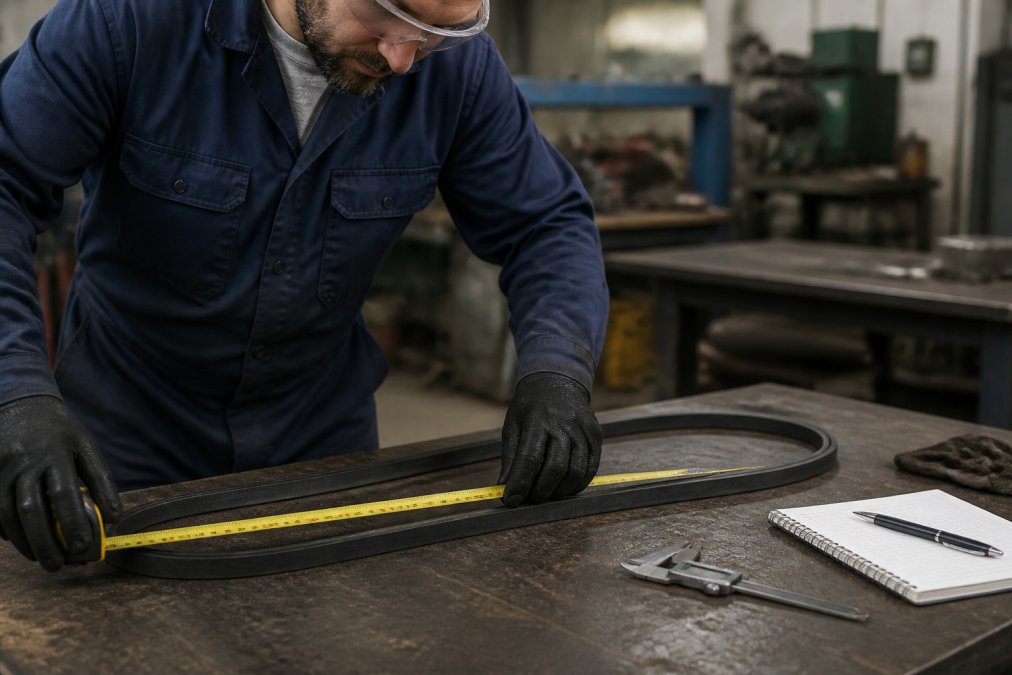
- Flexible tape measure (cloth or thin steel, at least 60 inches long)
- Vernier calipers for top width and height
- A flat workbench surface
- Marker and notebook for recording dimensions
- The old belt, if available, for direct comparison
Step-by-Step Measurement Procedure
- Lay the belt flat on the workbench without twisting it.
- Measure the top width across the widest point of the cross-section with calipers.
- Measure the height from the top surface to the bottom of the belt.
- Run the tape around the outside circumference for an outside-length belt.
- For an inside-length belt, measure around the inner face instead.
- Record the effective length, which is the pitch line running through the belt's neutral axis.
- Compare your numbers against the profile chart before ordering.
Metric V-Belt Size Conversion Chart: Length and Cross-Section
The conversion itself is straightforward once you know which dimension you are converting. Metric belt lengths are given in millimeters, while inch-series belts use a nominal length in inches, and the two do not map one-to-one across every profile.
Metric to Inch Length Conversion Table
| Metric Length (mm) | Approximate Inch Length | Common Belt Designation |
|---|---|---|
| 635 mm | 25 in | A25 / 4L250 |
| 762 mm | 30 in | A30 / 4L300 |
| 889 mm | 35 in | A35 / 4L350 |
| 1016 mm | 40 in | B40 / 5L400 |
| 1270 mm | 50 in | B50 / 5L500 |
| 1524 mm | 60 in | B60 / 5L600 |
Cross-Section Profile Conversion (SPZ, SPA, SPB, SPC to 3V, 5V, 8V)
| Metric Profile | Inch Equivalent | Top Width | Typical Use |
|---|---|---|---|
| SPZ | 3V | 9.7 mm / 0.38 in | Light-duty, small pulleys |
| SPA | 5V (narrow) | 12.7 mm / 0.50 in | Medium HVAC drives |
| SPB | 5V | 16.3 mm / 0.64 in | Industrial pumps, fans |
| SPC | 8V | 22.0 mm / 0.87 in | Heavy-duty, high horsepower |
The conversion factor between these profiles is not a simple multiplier. SPZ and 3V are dimensionally close but not always interchangeable, because the belt angle and pulley groove geometry differ slightly between standards (gates.com). Always confirm the cross-section profile against the pulley before substituting.
V-Belt Cross Reference Guide: Matching Part Numbers Across Standards
A V-belt cross reference guide exists because no single numbering system covers every belt on the market. Manufacturers encode the section, length, and construction into the part number, and decoding that string is faster than measuring a worn belt.
Decoding Belt Part Numbers
A typical alphanumeric string breaks down into three parts: the cross-section profile (A, B, 3V, SPZ), the nominal length (in inches or millimeters), and a suffix indicating construction (cogged, wrapped, banded). Reading left to right tells you the section first, then the length.
Common Cross-Reference Examples
- 4L to A belt conversion: A 4L belt and an A belt share the same 0.5-inch top width, but 4L uses the inside length while A uses the outside length (gates.com). Add roughly 2 inches to the 4L number to find the A equivalent.
- 5L to B belt conversion: Same principle. A 5L belt has a 0.625-inch top width matching the B section. Convert by adding about 3 inches to the 5L length to reach the B outside length.
Fractional vs Metric V-Belt Sizing: Key Differences
Fractional and metric belts look similar on the shelf but follow different sizing logic, and mixing them causes premature wear. Fractional sizes describe the belt by its nominal cross-section letter and a length in inches. Metric sizes describe the belt by an SP code and a length in millimeters.
Fractional (Inch) Sizes: 3L, 4L, 5L, A, B, C, D
The 3L, 4L, and 5L series are fractional horsepower belts for light-duty drives like lawn equipment and small blowers. The A, B, C, and D sections are standard duty and heavy duty belts for industrial drives. All use inch-based nominal length figures.
Metric Sizes: SPZ, SPA, SPB, SPC, 3V, 5V, 8V
The SP series is the European metric standard, while 3V, 5V, and 8V are the narrow-profile inch equivalents common on American industrial equipment. Note that 3V, 5V, and 8V are technically inch profiles despite often being grouped with metric belts in catalogs, which is where a lot of confusion starts.
Installation Best Practices and Wear Analysis
Correct installation prevents most of the failures that send belts back for replacement. Tension and alignment matter more than belt quality, and a premium belt installed badly will fail faster than a standard belt installed correctly.
Proper Tensioning and Alignment
Set belt tension using a tension gauge or the deflection method: press the belt at the midpoint of the longest span and check that it deflects roughly the thickness of the belt per inch of span. Align pulleys with a straightedge across both faces. Misalignment of even a few degrees wears the sidewalls unevenly.
Spotting Wear and Failure Signs
- Glazed, shiny sidewalls: indicates slipping from loose tension
- Cracked or missing cogs: heat damage or age
- Uneven sidewall wear: pulley misalignment
- Frayed edges: pulley groove damage or wrong profile
- Stretched length: normal fatigue, replace the belt
Conclusion
Getting the right belt comes down to measuring correctly, converting between metric and inch standards, and installing with proper tension. At V-Belt Nation, we stock classic, wedge, cogged, banded, and lawn and garden belts across both sizing systems, with a price match guarantee, free ground shipping on orders over $175, and a support team that will help you match a part number to your drive. Shop now and get the belt that fits the first time.
Frequently Asked Questions
What are the metric sizes of V-belts?
Metric V-belts use profile designations like SPZ, SPA, SPB, and SPC, plus 3V, 5V, and 8V for wedge belts. Lengths are given in millimeters, such as 1000 mm or 1250 mm. The profile determines top width and height, while the number shows the effective length. When converting to US sizes, SPZ roughly matches 3V, SPA matches A, SPB matches 5V or B, and SPC matches 8V or C. Always verify with a cross-reference chart because exact dimensions vary by manufacturer.
How do I convert a metric V-belt length to inches?
Divide the millimeter length by 25.4 to get inches. For example, a 1000 mm belt equals about 39.37 inches, and a 1250 mm belt equals about 49.21 inches. Note that metric belts are often labeled by effective length (the pitch circumference), while US fractional belts may use outside circumference or inside length. This difference can shift the number by an inch or more, so always match the measurement type before converting.
Are metric and fractional V-belts interchangeable?
Not always. A metric SPZ belt and a US 3V belt share similar cross-sections, but the length and angle can differ slightly. If the pulley groove angle and diameter match, a cross-referenced belt may fit, but mismatched profiles cause slipping, rapid wear, or premature failure. Use a V-belt cross reference guide to confirm the profile and length, and check with your supplier if you are unsure. For critical drives, stick with the original specification.
How do I know my V-belt size?
Check the belt label first. It usually shows the profile (like A, B, 5V, or SPA) and the length. If the label is worn, measure the top width and thickness with calipers, then measure the outside circumference with a flexible tape. Match those numbers against a metric v-belt size conversion chart to find the equivalent. For cogged or banded belts, note the number of ribs or bands as well.
What do the numbers on a V-belt label actually mean?
A typical label like "A1000" or "SPA1250" breaks down into two parts: the letter code is the cross-section profile (A, B, SPA, etc.), and the number is the length. For metric belts, the number is in millimeters. For US fractional belts, the number may indicate length in inches or a code that needs a cross-reference. Some labels also include a standard (like ISO or DIN) and a manufacturer prefix. Always read the full label before ordering a replacement.
What is the difference between SPA, SPB, and SPC belt profiles?
SPA, SPB, and SPC are metric wedge belt profiles defined by ISO standards. SPA has a top width of 13 mm and is used for lighter drives. SPB is 17 mm wide and handles medium to heavy loads. SPC is 22 mm wide and is built for high-power industrial drives like crushers and large fans. Each profile has a specific height and groove angle, so they are not interchangeable without verifying pulley compatibility. Match the profile to the pulley groove for proper fit.