 ultimate-guide
V-Belt Cross Reference Guide 2026: Sizes Made Simple
Table of Contents
- Why a V-Belt Cross Reference Guide Matters in 2026
- V-Belt Profile Types Explained: Classical vs. Narrow Wedge
- How to Identify Belt Size: A Step-by-Step Method
- Using a V-Belt Measurement Chart for Accurate Cross-Referencing
- Decoding V-Belt Part Numbers for Interchange
- Common Cross-Reference Mistakes and How to Avoid Them
- Conclusion: Your Next Steps for a Reliable Replacement
- Frequently Asked Questions
Last Updated: September 5, 2026
Why a V-Belt Cross Reference Guide Matters in 2026
A v-belt cross reference matches a worn belt to an equivalent replacement from another manufacturer. It matters more than ever because modern supply chains and OEM part numbers rarely align with what your local distributor stocks. The wrong cross-reference leads to slippage, overheating, and premature failure. Before ordering, understand the belt profile, measurement system, and how part numbers translate across brands.
V-Belt Profile Types Explained: Classical vs. Narrow Wedge
V-belts are categorized by cross-section geometry, which dictates how they seat in the sheave groove. The two dominant families are classical V-belts and narrow wedge belts, and confusing them is the most common cross-reference error. Selecting the right profile is also about the synthetic materials and cord construction that determine survival in high-heat, high-torque, or chemically aggressive environments.
Classical V-belts (designations A, B, C, D) feature a traditional cross-section with a 40-degree belt angle. Widely used in HVAC fans, agricultural equipment, and general industrial machinery, their standardized top width and depth make them easy to measure and replace. They typically have a wrapped cover that protects tensile cords but generates more internal heat at high speeds.
Narrow wedge belts (designations 3V, 5V, 8V, and SPZ, SPA, SPB, SPC) are deeper and narrower relative to their width, transmitting more power in a smaller drive package. A classical A belt and a narrow 5V belt may both be roughly 1/2 inch wide at the top, but their depths and pitch lengths differ, so they are not interchangeable.
| Belt Profile | Common Designations | Top Width Range | Typical Application |
|---|---|---|---|
| Classical V-belt | A, B, C, D | 1/2" to 1-1/4" | HVAC, agricultural, general industrial |
| Narrow Wedge | 3V, 5V, 8V | 3/8" to 1" | High-horsepower compact drives |
| Fractional Horsepower | 2L, 3L, 4L, 5L | 1/4" to 1/2" | Lawn mowers, garage door openers |
| Cogged / Raw Edge | AX, BX, 5VX | Varies by base profile | High-torque, small-diameter sheaves |
Material Science: Not All Belts Are Built the Same
Modern belts use wrapped or raw-edge construction with different cord materials and static conductive or oil and heat resistant compounds (gates.com). A cross-reference must account for these factors, not just dimensions, because a belt with the right size but wrong construction will fail early.
Here is what separates the three dominant elastomer compounds you will encounter:
- Neoprene (Polychloroprene): The traditional workhorse with good oil and heat resistance up to approximately 180°F to 200°F. It is the baseline for most classical and narrow wedge belts and is almost always sufficient for standard HVAC or general industrial applications.
- EPDM (Ethylene Propylene Diene Monomer): Excels in extreme heat (up to 300°F) and resists ozone, water, and steam. Preferred for outdoor equipment, hot air handlers, and drives near electric motors, but it has poorer oil resistance than Neoprene, if exposed to petroleum-based lubricants, EPDM will swell and fail.
- Aramid Tensile Cords (e.g., Kevlar): Used in high-torque, shock-load applications such as rock crushers, wood chippers, and large agricultural implements. Aramid belts resist stretching and handle sudden load spikes that would snap a standard polyester cord, preventing downtime despite a higher cost.
Visual Failure Analysis: What the Belt Tells You
Before cross-referencing a failed belt, look at how it failed. The wear pattern tells you whether a simple replacement will solve the problem or whether you are about to repeat a mistake.
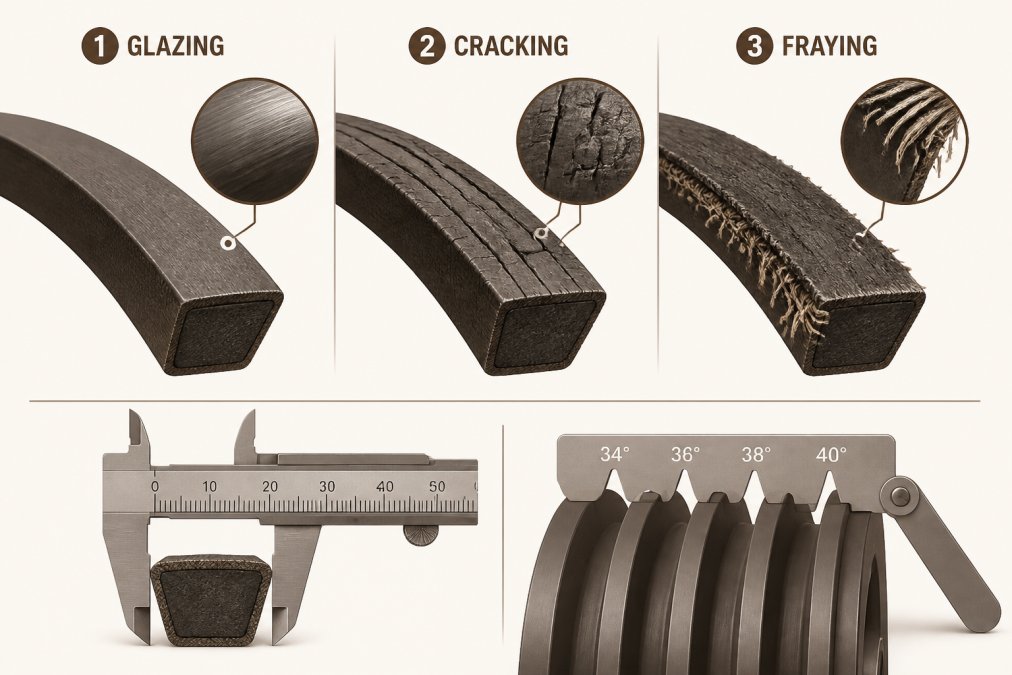
- Glazing (shiny, hardened bottom surface): Indicates slippage from a wrong profile, low tension, or worn sheave grooves. Replacing a glazed belt without fixing the tension or sheave issue will result in the same failure.
- Cracking at the base: Typically heat degradation from an undersized drive, excessive ambient temperature, or a compound mismatch (e.g., using Neoprene where EPDM is required).
- Fraying or cord exposure: This indicates physical abrasion or misalignment. The belt is rubbing against a guard, the sheaves are not aligned, or the groove is damaged. A cross-reference will not fix a misaligned drive.
Matching the Material to the Application
A practical cross-reference requires answering three questions before ordering:
- What is the ambient and operational temperature? If it exceeds 200°F, move from Neoprene to EPDM.
- Is the drive exposed to oil, grease, or solvents? If yes, EPDM is the wrong choice; stick with Neoprene or a specially formulated oil-resistant compound.
- Does the drive experience shock loads? If the application is a crusher, auger, or heavy reciprocating load, specify aramid cord construction.
How to Identify Belt Size: A Step-by-Step Method
Accurate cross-referencing starts with identifying belt size. You need three measurements: top width, depth, and outside circumference. Here is a common method.
Step 1: Measure the top width. Use a caliper across the widest part of the belt's top surface and record the measurement in inches. This tells you the belt profile family.
Step 2: Measure the belt depth. Stand the belt on its side and measure from the top surface to the bottom of the V. Classical and narrow wedge belts differ here, confirming the profile.
Step 3: Determine the outside circumference. Use a fabric tape measure around the outside of the belt without stretching it. This gives you the outside length.
Step 4: Identify the pitch length. The pitch length is the measurement at the belt's neutral axis, which most part numbers reference. For classical belts, it is approximately the outside circumference minus a fixed offset that varies by section. For narrow wedge belts, the effective length is typically stamped on the belt.
Step 5: Locate the part number. Many belts have a printed code on the outer cover. A belt stamped "B52" is a classical B-section belt with a 52-inch pitch length. A belt stamped "5V1000" is a narrow wedge belt with a 100.0-inch effective length.
Using a V-Belt Measurement Chart for Accurate Cross-Referencing
A v-belt measurement chart translates physical measurements into a standard industry designation. Once you know the profile and length, you can cross-reference across virtually any manufacturer. Pair the chart below with an interactive calculation tool to eliminate arithmetic errors.
The Two-Step Process: From Measurement to Designation
The chart works in two directions: if your belt is marked "A48," read across to find equivalent belts from other brands; if unmarked, use caliper and tape measurements to find the matching row. The process becomes error-prone with metric equivalents, unusual lengths, or multi-groove drives.
For classical belts, the length designation is the pitch length in inches, an A48 belt has a 48-inch pitch length, roughly a 49.3-inch outside circumference (mrosupply.com). For narrow wedge belts, the number after the profile letter indicates the effective length in tenths of an inch; a 5V1000 belt has a 100.0-inch effective length.
| If Your Belt Reads | Profile | Length Type | Cross-Reference Example |
|---|---|---|---|
| A48 | Classical A | 48" pitch | A48, 4L480, equivalent classical A |
| B52 | Classical B | 52" pitch | B52, 5L520, equivalent classical B |
| 5V1000 | Narrow 5V | 100.0" effective | 5V1000, equivalent narrow wedge |
| SPB2650 | Narrow SPB | 2650mm datum | SPB2650, equivalent metric wedge |
The 2026 Upgrade: Move From Static Chart to Interactive Calculator
The most common error is mixing measurement systems. Classical belts are measured in inches using pitch length; narrow wedge belts can be measured in inches (5V, 8V) or millimeters (SPZ, SPA, SPB, SPC) using datum length. A chart listing both systems side by side prevents this confusion, but a static chart still requires manual conversion.
Instead of relying on mental math or a printed table, use an interactive V-belt length calculator with this workflow:
- Input your measured outside circumference (from your fabric tape measure).
- Select the belt profile (e.g., Classical A, B, 5V, SPB).
- The tool automatically subtracts the correct offset to calculate the pitch length (for classical) or effective length (for narrow wedge).
- The tool flags the measurement system, inches vs. millimeters, so you never accidentally order a metric belt when you need an inch belt, or vice versa.
This approach is particularly valuable for fractional horsepower belts (2L, 3L, 4L, 5L) where the offset between outside and pitch length is proportionally larger and more easily miscalculated.
Why This Matters for Cross-Referencing
OEM replacement belts from European or Asian equipment frequently use metric wedge designations, so check the original part number before assuming a standard inch profile. A drive using an SPB2650 will not accept a B-section belt, even if top widths appear similar. The interactive tool forces you to confirm the profile family before returning a length.
Decoding V-Belt Part Numbers for Interchange
V-belt part number decoding separates a quick replacement from a week of downtime. Most part numbers follow a logical structure: profile letter, length number, and sometimes a construction suffix.
The profile letter identifies the cross-section: A, B, C, and D are classical; 3V, 5V, and 8V are narrow wedge; SPZ, SPA, SPB, and SPC are metric wedge. AX, BX, and 5VX indicate cogged versions that run cooler and handle smaller sheave diameters.
The length number follows the profile: pitch length in inches for classical belts, effective length in tenths of an inch for narrow wedge belts, and datum length in millimeters for metric wedge belts.
Construction suffixes add another layer: a "W" sometimes indicates a wrapped cover, and a cogged belt may carry an "X" suffix. Fractional horsepower belts use a different system, starting with a number indicating top width in thirty-seconds of an inch, a 4L480 belt is a 4/32-inch wide belt with a 48-inch pitch length.
Interchange between manufacturers follows published guides, but these assume the profile and length are correct. If replacing an OEM belt, look up the OEM part number in an interchange database to find the equivalent industry-standard designation.
Common Cross-Reference Mistakes and How to Avoid Them
Several recurring mistakes cause failed cross-references, all tracing back to skipping the physical identification step.
Mistake 1: Trusting the printed part number without measuring. Belts get relabeled, mismarked, or fitted incorrectly by a previous technician. Measure the belt and the sheave before ordering, a belt too long by even half an inch will slip; one too short will not fit over the sheaves.
Mistake 2: Confusing outside circumference with pitch length. The outside circumference is always longer than the pitch length. If you measure the outside and order a belt with that number as its pitch length, the replacement will be too long. Use the measurement chart to convert.
Mistake 3: Ignoring belt construction. A cogged belt and a wrapped belt with the same profile and length are not always interchangeable. Cogged belts run cooler and are required for small-diameter sheaves. If the original was cogged, replace it with a cogged belt.
Mistake 4: Assuming metric and inch belts are interchangeable. An SPB belt and a B-section belt have similar top widths but different belt angles and depths. They will not seat correctly in the same sheave. Check whether your equipment uses metric or inch designations before cross-referencing.
Mistake 5: Skipping sheave inspection. A worn or misaligned sheave will destroy any replacement belt quickly. Check sheave grooves for wear and verify shaft alignment before installing the new belt, slippage and squealing are often sheave problems, not belt problems.
| Mistake | Consequence | Prevention |
|---|---|---|
| Trusting printed part number | Wrong belt ordered | Measure top width and length |
| Confusing outside vs. pitch length | Belt too long or short | Use measurement chart conversion |
| Ignoring cogged vs. wrapped construction | Overheating, premature failure | Match original construction type |
| Mixing metric and inch profiles | Poor seating, slippage | Verify measurement system |
| Skipping sheave inspection | Rapid belt failure | Check grooves and alignment first |
Conclusion: Your Next Steps for a Reliable Replacement
A reliable v-belt cross reference comes down to disciplined measurement, accurate part number decoding, and matching construction type to the application. Measure the belt, measure the sheave, confirm the profile family, and only then look up the interchange.
When you need a replacement fast, work with a supplier that stocks the full range of belt profiles and can verify the cross-reference before shipping. V-Belt Nation carries classical, wedge, cogged, banded, and lawn and garden belts, with free ground shipping on U.S. orders over $175 and a price match guarantee. Our support team can help decode your part number and confirm compatibility before you order.
Get started with V-Belt Nation and get the right belt shipped the first time.
Frequently Asked Questions
What are the cross references for V-belts?
Cross-referencing a V-belt means finding an equivalent replacement from another manufacturer or product line. For example, a Gates A46 belt is often interchangeable with a Dayco A46 or a NAPA 4L460, as they follow the same classical V-belt sizing standards. To find the correct cross reference, you must match the profile (like A, B, or 3V) and the effective length. Always check a manufacturer's official interchange guide to confirm the replacement compatibility before installing a new belt.
How do I figure out what V-belt I need?
First, identify the belt profile by measuring the top width of the belt's cross-section. Common types include Classical A (1/2 inch), B (21/32 inch), and narrow wedge 3V, 5V, and 8V. Next, determine the required length using a flexible tape measure along the outside circumference, or use a dedicated V-belt measurement chart. Finally, check the part number printed on the old belt; it often contains the profile and length, such as 'B51' for a B-section belt that is 51 inches long.
Are V-belt sizes universal across different manufacturers?
Yes, standard V-belt sizes are generally universal across manufacturers because they adhere to industry standards. This means a belt with a 'A' profile from one brand should have the same top width and angle as an 'A' profile from another. However, variations exist in cord construction, material compounds, and features like cogged or banded designs. While the dimensions are interchangeable, always consider the belt's specific application, such as its need for oil and heat resistance, to ensure it matches OEM replacement quality.
What do the letter codes (A, B, C, 3L, 4L) mean on a V-belt?
The letter codes on a V-belt identify its cross-section profile. Classical V-belts are designated by letters A, B, C, and D, with A being the smallest (1/2 inch top width) and D the largest. Narrow wedge belts use numbers like 3V, 5V, and 8V. Fractional horsepower belts, often used in lawn and garden equipment, use codes like 2L, 3L, and 4L. The number following the letter indicates the belt's effective or outside length in inches, which is critical for proper fit.
Can I cross-reference a lawn and garden belt with an industrial belt?
You can cross-reference a lawn and garden belt with an industrial belt if the profile and length match, but you must evaluate the construction. Lawn and garden belts are often fractional horsepower (FHP) belts, designed for lighter loads and smaller pulleys. Industrial belts are built for heavier, continuous use with stronger cord construction. If your application involves significant power transmission or industrial machinery, choose a belt designed for that duty cycle to prevent belt slippage and premature wear.
Frequently Asked Questions
Q: What are the cross references for V-belts?
A: Cross-referencing a V-belt means finding an equivalent replacement from another manufacturer or product line. For example, a Gates A46 belt is often interchangeable with a Dayco A46 or a NAPA 4L460, as they follow the same classical V-belt sizing standards. To find the correct cross reference, you must match the profile (like A, B, or 3V) and the effective length. Always check a manufacturer's official interchange guide to confirm the replacement compatibility before installing a new belt.
Q: How do I figure out what V-belt I need?
A: First, identify the belt profile by measuring the top width of the belt's cross-section. Common types include Classical A (1/2 inch), B (21/32 inch), and narrow wedge 3V, 5V, and 8V. Next, determine the required length using a flexible tape measure along the outside circumference, or use a dedicated V-belt measurement chart. Finally, check the part number printed on the old belt; it often contains the profile and length, such as 'B51' for a B-section belt that is 51 inches long.
Q: Are V-belt sizes universal across different manufacturers?
A: Yes, standard V-belt sizes are generally universal across manufacturers because they adhere to industry standards. This means a belt with a 'A' profile from one brand should have the same top width and angle as an 'A' profile from another. However, variations exist in cord construction, material compounds, and features like cogged or banded designs. While the dimensions are interchangeable, always consider the belt's specific application, such as its need for oil and heat resistance, to ensure it matches OEM replacement quality.
Q: What do the letter codes (A, B, C, 3L, 4L) mean on a V-belt?
A: The letter codes on a V-belt identify its cross-section profile. Classical V-belts are designated by letters A, B, C, and D, with A being the smallest (1/2 inch top width) and D the largest. Narrow wedge belts use numbers like 3V, 5V, and 8V. Fractional horsepower belts, often used in lawn and garden equipment, use codes like 2L, 3L, and 4L. The number following the letter indicates the belt's effective or outside length in inches, which is critical for proper fit.
Q: Can I cross-reference a lawn and garden belt with an industrial belt?
A: You can cross-reference a lawn and garden belt with an industrial belt if the profile and length match, but you must evaluate the construction. Lawn and garden belts are often fractional horsepower (FHP) belts, designed for lighter loads and smaller pulleys. Industrial belts are built for heavier, continuous use with stronger cord construction. If your application involves significant power transmission or industrial machinery, choose a belt designed for that duty cycle to prevent belt slippage and premature wear.