 how-to
V-Belt Storage and Handling: A Step-by-Step Guide
Table of Contents
- Why Proper V-Belt Storage Matters
- Step 1: Prepare Your Storage Environment
- Step 2: Choose the Right Storage Equipment
- Step 3: Organize and Protect Your Inventory
- V-Belt Shelf Life Standards and Monitoring
- Signs of V-Belt Aging and Degradation
- V-Belt Tensioning Best Practices Before Installation
- Handling V-Belts During Installation
- Frequently Asked Questions
Last Updated: September 24, 2026
Why Proper V-Belt Storage Matters
Proper v-belt storage and handling directly affects belt lifespan and performance. Poorly stored belts fail prematurely, while correct storage extends life, reduces replacement costs, and prevents unexpected downtime.
Poor storage costs extend beyond wasted belts, production lines stop, HVAC systems fail, and equipment sits idle.
Rubber compounds degrade from heat, moisture, ozone, UV light, and chemicals, all preventable with proper storage.
Step 1: Prepare Your Storage Environment
Your storage environment is the foundation of belt preservation. This step covers four critical factors: temperature, humidity, light, and chemical exposure.
Control Temperature and Humidity
Temperature and relative humidity are the two most important environmental controls for v-belt storage and handling. Extreme heat accelerates degradation; excessive moisture causes swelling and loss of elasticity.
Store v-belts between 50°F and 85°F to keep rubber compounds stable. Avoid attics, uninsulated garages, and outdoor sheds that create damaging temperature fluctuations.
Maintain relative humidity between 45% and 65%. Below 45%, rubber becomes brittle; above 65%, belts absorb moisture and swell. Both shorten belt life.
A small climate-controlled storage cabinet pays for itself through extended belt life and reduced downtime.
Eliminate Light and UV Exposure
Ultraviolet radiation breaks down rubber compounds; even indirect sunlight causes damage.
Store v-belts in dark interior rooms without windows or in enclosed cabinets away from direct light.
If storing near windows or bright lights, cover belts with opaque material like dark plastic bins or cardboard boxes.
Keep belts at least 3 feet from fluorescent lights. LED lighting is safer as it produces minimal UV radiation.
Prevent Chemical Contamination
Chemicals damage rubber compounds. Even small spills nearby can contaminate stored belts.
Keep belts away from oils, fuels, solvents, cleaning chemicals, pesticides, and caustic cleaners. Store separately or use sealed plastic bins to prevent chemical vapor exposure.
Check regularly for spills; even small puddles damage belts through vapor exposure. Clean immediately and improve ventilation.
Step 2: Choose the Right Storage Equipment
How you hang belts matters as much as where you store them. Wrong methods cause deformation and permanent damage; right equipment keeps belts flat and unstressed.
Saddle Racks and Proper Hanging
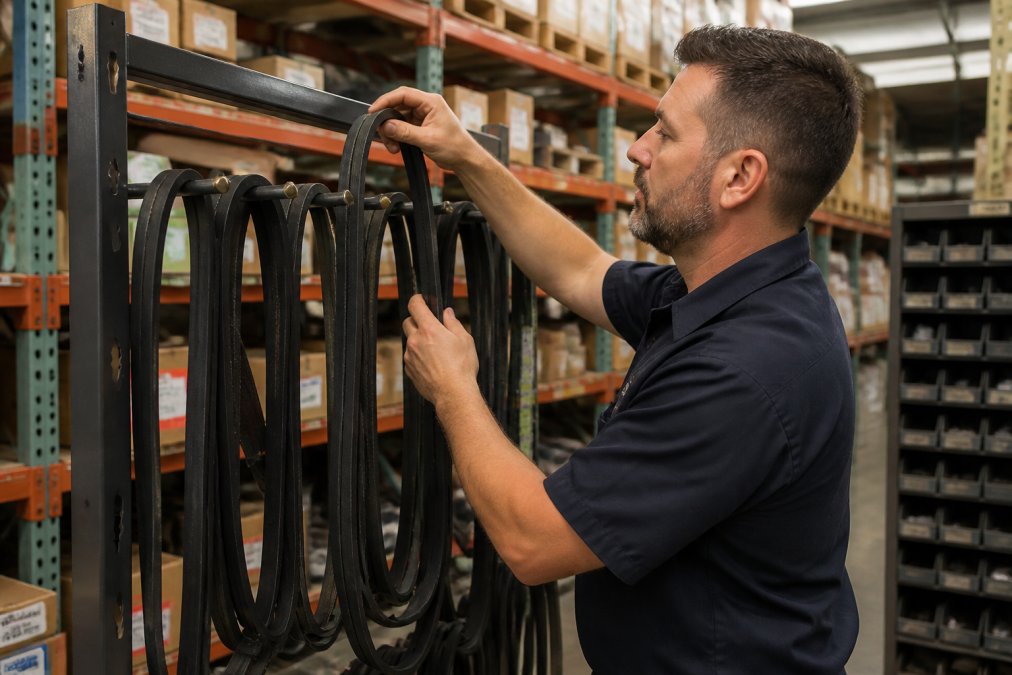
A saddle rack is the best storage method, supporting the belt without pinching or deforming it.
Match saddle diameter to belt width, too tight causes deformation; too loose provides poor support.
Space saddle racks 12 to 18 inches apart to prevent belts from touching, sticking, or transferring contaminants.
Mount racks at eye level on a wall or sturdy frame to prevent dust collection and accidental damage.
Label each saddle with the belt size and type. This simple step saves time during inventory rotation and prevents grabbing the wrong belt during installation.
Avoiding Belt Deformation
Deformation is permanent damage. Once a belt is creased, kinked, or flattened, it won't return to its original shape. A deformed belt performs poorly and fails early.
Never stack belts (causes compression), fold them (creases become permanent), or store near sharp edges, rough surfaces, or where objects might fall on them.
Step 3: Organize and Protect Your Inventory
Organization prevents waste and extends belt life. When you know what you have and where it is, you use older stock first. You also catch degraded belts before they reach the job site.
Dust and Debris Prevention
Dust and debris attract moisture and promote degradation. A dust-free environment extends belt life.
Use enclosed cabinets or bins with air circulation. For open racks, use breathable fabric covers; avoid plastic that traps moisture.
Sweep your storage area regularly. Dust on the floor can become airborne and settle on belts. Clean floors reduce dust accumulation.
Install air filters in your storage area if possible. A simple HEPA filter removes dust and particulates. This is especially important in shops with high dust levels from grinding, cutting, or sanding operations.
Inventory Rotation and FIFO Management
FIFO (First-In-First-Out) inventory rotation ensures older belts are used first. This practice prevents belts from aging in storage longer than necessary. It also catches degraded stock before it causes problems.
Label each belt with the date it was received. Use a permanent marker on the belt itself or on a label attached to the belt. Include the belt size, type, and any other relevant information.
Organize your storage so older belts are easily accessible. Place new stock behind or above older stock. When you need a belt, grab the oldest one first.
Track your inventory in a simple spreadsheet or notebook. Record the belt type, size, quantity, and date received. Update the list when you remove belts. A quick visual scan tells you what's in stock and how long it's been there.
Review your inventory every 90 days. Remove any belts that have been in storage for more than two years. Even properly stored belts degrade over time. Older stock should be inspected carefully before use.
V-Belt Shelf Life Standards and Monitoring
V-belts don't last forever, even in perfect storage. The rubber compound gradually hardens and loses elasticity. Shelf life depends on storage conditions and the specific belt type.
Under ideal storage conditions (50-85°F, 45-65% humidity, no light, no chemicals), most industrial v-belts have a shelf life of three to five years. Cogged belts and specialty belts may have shorter shelf lives. Check your belt documentation for specific shelf life information.
In poor storage conditions, shelf life drops dramatically. Belts stored in hot, humid, or bright environments may degrade within six months to a year. This is why storage environment matters so much.
Monitor your stored belts regularly. Even in good storage, belts age. A belt that's been in storage for two years needs inspection before use. A belt stored for four years should be tested or replaced regardless of appearance.
Keep records of when belts were received and when they were used. This history helps you identify which storage practices work best. Over time, you'll learn which belts last longest under your specific conditions.
Signs of V-Belt Aging and Degradation
A belt can look fine and still be degraded. The damage happens inside the rubber compound before visible signs appear. Learning to spot aging signs prevents installation failures.
Hardening is the most common sign of aging. A new belt feels slightly flexible. An aged belt feels stiff and rigid. Squeeze the belt gently. If it doesn't flex easily, it's degraded.
Cracking appears on the belt surface. Small cracks start at the edges or corners. As the belt ages, cracks spread. Deep cracks indicate the belt is near the end of its life.
Discoloration means the rubber compound has oxidized. A belt that was black is now gray or brown. Discoloration indicates age and degradation, even if the belt looks otherwise fine.
Loss of elasticity is harder to spot but critical. A degraded belt won't grip the sheave properly.
Visual Inspection Checklist
Use this checklist before installing any belt, especially older stock:
- Belt is flexible, not stiff or brittle
- No visible cracks on the top, sides, or bottom
- Color is uniform black (or original color for colored belts)
- Belt surface is clean and dry
- Belt returns to shape immediately after gentle stretching
- No soft spots or swelling
- No chemical odors indicating solvent or oil exposure
- Storage date is less than three years ago
- No visible dust, dirt, or debris on the belt
- Belt dimensions match specifications
V-Belt Tensioning Best Practices Before Installation
Proper tensioning is the final step before installation. A belt that's stored perfectly but installed wrong will fail. Correct tensioning extends belt life and prevents slipping.
Handling V-Belts During Installation
How you handle belts during installation affects their lifespan. Rough handling causes damage that shortens belt life or causes immediate failure.
Frequently Asked Questions
What is the typical shelf life of a V-belt?
Most industrial V-belts maintain their performance for 3 to 5 years when stored correctly in a climate-controlled environment. Shelf life depends on storage temperature, humidity, light exposure, and the rubber compound used. Synthetic rubber belts generally last longer than natural rubber. Check the manufacturer's specifications and inspect belts annually for signs of cracking or hardening, especially after year two.
How tight should a V-belt be when installed?
V-belt tension is critical for power transmission and belt longevity. The belt should deflect approximately 0.5 to 1 inch when moderate pressure is applied midway between sheaves. Use a belt tension gauge for precision, as over-tensioning causes premature wear and bearing damage, while under-tensioning leads to slippage and reduced load-bearing capacity. Always refer to your equipment manufacturer's specifications for exact tension requirements based on sheave diameter and belt profile.
What are the signs of V-belt aging and degradation?
Aged V-belts show cracking on the inner surface, hardening of the rubber compound, visible belt elongation, and loss of grip. Check for surface cracking, brittleness when flexed, discoloration, and glazing on the belt profile. If a belt has been stored improperly or exposed to ozone, ultraviolet radiation, or extreme heat, it may appear dried out. Any belt showing these signs should be replaced to prevent machinery failure and maintain safe power transmission.
Should V-belts be stored in their original packaging?
Yes, original packaging provides protection from dust, debris, and light exposure during storage. However, ensure the storage environment itself meets ideal conditions: 50-85°F ambient temperature and 35-65% relative humidity. If belts are removed from packaging, store them on a saddle rack in a dust-free environment away from direct sunlight, ozone-generating equipment, and chemical exposure. Keep inventory organized by size and type to enable FIFO rotation.