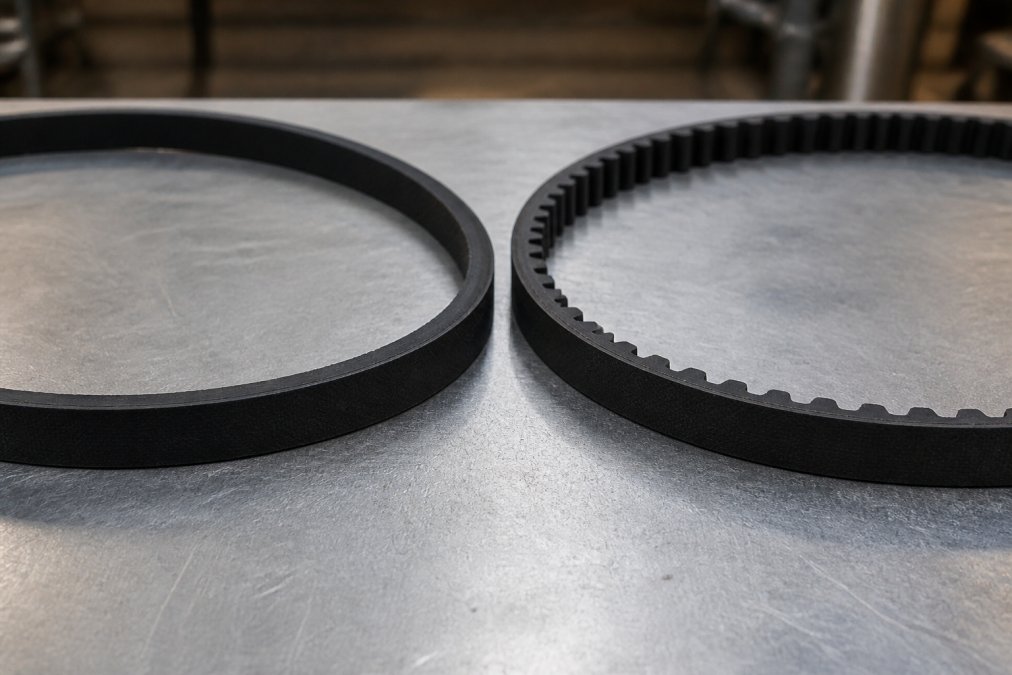
 comparison
V-Belt vs Cogged Belt Differences: A 2026 Guide
Table of Contents
- V-Belt vs Cogged Belt Differences: Quick Comparison
- What Is a Cogged Belt and How Does It Differ from a Standard V-Belt?
- Cogged Belt Advantages: Flexibility, Grip, and Efficiency
- V-Belt Heat Dissipation and Operational Temperature
- How to Identify Belt Size Before You Order a Replacement
- Compatibility, Retrofitting, and Failure Modes
- Conclusion
- Frequently Asked Questions
Last Updated: September 14, 2026
V-Belt vs Cogged Belt Differences: Quick Comparison
A cogged belt is a V-belt with molded notches cut into its underside; a standard wrapped V-belt has a smooth, fabric-covered base. That design change alters flexibility, heat dissipation, grip, and service life. This guide from V-Belt Nation breaks down the v-belt vs cogged belt differences so you pick the right belt the first time.
The short version: cogged belts bend more easily around small pulleys, run cooler, and grip better on raw-edge sidewalls. Standard wrapped belts cost less and tolerate dirty environments where a fabric cover protects the core. Neither is universally better, and the wrong choice shows up as slippage, squealing, or premature failure.
| Feature | Standard Wrapped V-Belt | Cogged (Raw-Edge) V-Belt |
|---|---|---|
| Underside | Smooth, fabric-wrapped | Molded cogs (notches) |
| Flexibility | Limited on small pulleys | High; bends around small diameters |
| Heat dissipation | Moderate | Better; cogs vent bending heat |
| Grip | Fabric cover, lower friction | Raw edge, higher friction coefficient |
| Typical use | General drives, dirty environments | Compact, high-speed, high-load drives |
| Cost | Lower upfront | Higher upfront |
| Service life | Shorter on tight bends | Longer on small-pulley drives |
What Is a Cogged Belt and How Does It Differ from a Standard V-Belt?
A cogged belt is a V-belt with a raw-edge construction and molded cogs on the underside that increase flexibility and reduce bending stress. A standard V-belt wraps its core in a fabric cover and relies on a smooth base to ride the pulley groove.
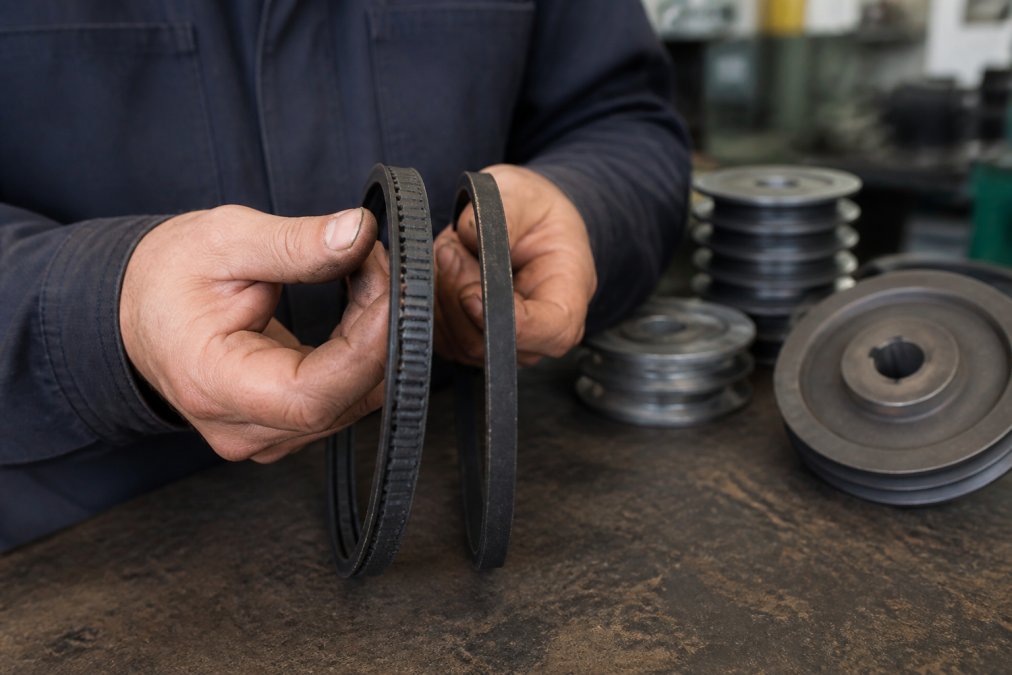
Both belts share the same v-belt profile, so they seat in the same groove. The cogged version removes material from the underside, letting the belt flex without building internal stress, which is why a cogged belt handles a small diameter pulley that would overheat and crack a wrapped belt.
The cogs also let the belt shed heat as it cycles around the drive: a wrapped belt traps heat in the fabric and rubber compound, while a cogged belt releases it through the open notches.
Cogged Belt Advantages: Flexibility, Grip, and Efficiency
The core cogged belt advantages come down to three things: it bends around smaller pulleys, grips the groove with more friction, and transmits power with less energy loss. The raw edge exposes the rubber compound directly to the pulley wall, raising the friction coefficient and cutting slippage.
Flexibility matters most on compact drives. Shrink pulley diameter and bending stress climbs fast; molded cogs absorb that stress, so the belt fatigues more slowly and holds its load capacity longer.
Grip is the second win. A raw-edge sidewall bites the groove harder than a fabric cover, meaning less slip under sudden torque loads. If your line squeals on startup, a cogged belt often fixes it.
Efficiency is the quiet benefit: less slip and less internal heat mean more motor power reaches the driven equipment, which adds up on a drive running around the clock.
V-Belt Heat Dissipation and Operational Temperature
Heat is the leading killer of V-belts, and cogged construction manages it better than a wrapped design (gates.com). Every bend around a pulley generates internal friction; a wrapped belt holds that heat against the core, while a cogged belt vents it through the notches.
Operational temperature drives service life: run a belt hot and the rubber compound hardens, cracks, and loses grip; run it cool and it keeps its flexibility far longer. That's why cogged belts often outlast wrapped belts on high-speed, small-pulley drives despite the higher upfront cost.
The practical takeaway: if a drive runs hot enough that you can't hold your hand on the belt guard, the belt is working too hard. Check pulley alignment, tension, and whether a cogged belt would run cooler.
How to Identify Belt Size Before You Order a Replacement
Identifying belt size correctly prevents most wrong-part orders, and it gets harder when you switch between a wrapped and a cogged belt. The two types share a cross-section family but not a part number. You need four things: the cross-section (profile), the outside length, the top width, and the construction (wrapped or cogged). Get the construction wrong and you'll order a belt that seats in the groove but doesn't match the drive's intended performance.
The code prefix tells you which belt you're holding
Classical V-belts use a letter for the cross-section, and the cogged version adds an X. A wrapped B-section belt is stamped B; the cogged version is stamped BX (gates.com). The pattern runs across the classical line: A becomes AX, B becomes BX, C becomes CX, D becomes DX. Narrow (wedge) profiles follow the same logic: 3V, 5V, and 8V are wrapped, while 3VX, 5VX, and 8VX are cogged.
That single letter is the difference between a belt that runs cool on a small pulley and one that overheats. If the old belt is stamped B and you want the cogged upgrade, order a BX, not another B. The length number stays in the same family, so a B75 and a BX75 share a nominal length even though the construction differs.
Measure the old belt before you trust the stamp
Stamps wear off, and a previous owner may have installed the wrong belt. Run this checklist before ordering:
- Read the code stamped on the old belt, note both the prefix (B vs BX) and the length number
- Measure the outside circumference with a cloth tape laid along the belt's back, following its full path
- Measure the top width across the widest part of the cross-section
- Confirm the profile against the pulley groove width, not against the old belt alone
- Decide whether the drive calls for a wrapped or cogged construction (small pulleys, high speed, and heat favor cogged)
- Check for a matched-set requirement if the drive runs multiple belts
If the stamped code is worn off, measure the pulley groove instead. Groove width points to the profile, and the drive layout gives you the length. A groove that measures for a B-section also accepts a BX, because the top width and groove angle are the same, the difference lives on the underside.
Length is measured differently on some cogged belts
One trap that catches buyers mid-retrofit: wrapped belts are commonly specified by outside length, while some cogged and narrow-profile belts use datum length, measured at the neutral axis inside the belt rather than around the outside. The two numbers are close but not identical, and ordering by the wrong one lands you a belt slightly too long or too short. When crossing from a wrapped belt to a cogged one, confirm which length convention the new part number uses.
When in doubt, send a photo of the old belt, the pulley, and the stamped code to your supplier. V-Belt Nation's support team helps customers match specific and non-standard sizes so a worn code doesn't turn into a week of downtime.
Compatibility, Retrofitting, and Failure Modes
A cogged belt and a wrapped belt of the same cross-section are interchangeable on the same pulley, so retrofitting is straightforward in most cases. The groove doesn't care whether the underside is smooth or notched, as long as the profile matches, but it does care about condition, alignment, and tension, and those are where retrofits go wrong.
Can you swap a standard belt for a cogged one without changing pulleys?
Most of the time, yes. If the pulley groove is sized for a B-section, a BX cogged belt seats correctly, because the top width and groove angle are identical, you're changing the underside, not the profile. The retrofit is a genuine upgrade when the drive has any of these characteristics:
- Small pulleys. A cogged belt bends around a smaller diameter without cracking, so a drive that was marginal on a wrapped belt becomes reliable.
- High speed. Faster belt travel means more bending cycles per hour and more heat. Cogs vent that heat.
- High starting torque. A raw edge grips harder, which reduces slip on startup.
- Compact layouts. When you can't fit a larger pulley, the cogged belt is often the only way to keep the drive within its envelope.
The swap isn't always a clean upgrade. In a gritty, dusty, or oily environment with an exposed belt, a wrapped belt's fabric cover shields the core in a way a raw edge cannot. If the pulley is already worn or grooved, any new belt, cogged or wrapped, will fail early, so inspect the groove first. On multi-belt drives, the whole set has to change together.
The retrofit checklist
Before you swap construction types on an existing drive, work through these steps:
- Confirm the profile. Measure the pulley groove, not just the old belt. A BX fits a B groove; it does not fit an A groove.
- Inspect the pulley. Look for grooves worn into the sidewalls, a polished floor, or a lip at the top of the groove. A worn pulley will chew through a new belt regardless of type.
- Check alignment. Use a straightedge across both pulleys. Misalignment is the most common cause of edge wear on either belt type.
- Reset tension after the first run. A raw-edge belt grips harder and can run slightly tighter than the wrapped belt it replaced. Recheck tension after the first few hours and again after the first week.
- Replace the full set on multi-belt drives. Mixing a cogged belt with wrapped belts, or mixing new with old, causes uneven load sharing, and the tighter belt carries the full load until it fails.
Failure modes: reading the belt to find the cause
A failed belt is a diagnostic tool: the wear pattern tells you whether the drive was asking for a cogged belt, a wrapped belt, or neither, and whether the real problem is the belt at all.
Glazed, shiny sidewalls. The belt has been slipping and friction heat has polished the rubber. This points to low tension, an overloaded drive, or a wrapped belt asked to grip harder than its fabric cover allows. A cogged belt's raw edge resists glazing longer, but glazing usually means tension or load, not construction.
Cracks across the base, running perpendicular to the belt's length. This is heat and bending-stress fatigue, the classic signature of a wrapped belt pushed onto too small a pulley. If you see this pattern repeatedly on the same drive, the drive wants a cogged belt, or a larger pulley.
Frayed edges or missing cogs. Edge fraying points to misalignment or a foreign object in the groove. Missing cogs usually mean the belt ran too loose, so it slapped and the cogs tore, or the pulley has a burr catching them.
A single belt failed in a matched set. The others look fine because they shared load unevenly. The failed belt carried more than its share, usually because the set was mixed by type or age, or tension was set unevenly across the grooves.
Belt rolled over in the groove. This is almost always a tension or alignment problem, not a belt-type problem. A rolled belt is a symptom of a drive that needs service, not a different belt.
Conclusion
Choosing between a standard V-belt and a cogged belt comes down to your drive's real conditions: pulley size, speed, heat, and how clean the environment is. Get that match right and you avoid the slippage, squealing, and early failures that eat into uptime.
V-Belt Nation stocks a full range of classic, wedge, cogged, banded, and lawn and garden belts, backed by a Price Match Guarantee, free ground shipping on orders over $175, and a support team that helps you find the exact size and section you need. If you're not sure whether your drive wants a cogged or wrapped belt, our team will help you sort it out before you order.
Get started with V-Belt Nation and keep your machinery running with the right belt the first time. [Shop Now]
Frequently Asked Questions
What is the main difference between a standard V-belt and a cogged belt?
A standard V-belt has a smooth wrapped fabric cover on its sidewalls, while a cogged belt has molded notches cut into the underside. Those cogs let the belt bend more easily around small pulleys, reduce bending stress, and allow heat to escape. Cogged belts also use raw-edge sidewalls for a higher friction coefficient, which means better grip and less slippage in high-torque applications.
Are cogged belts more efficient than standard V-belts?
Yes. The molded cogs reduce internal friction and bending stress, so less energy is lost as heat. Raw-edge sidewalls grip the pulley more firmly, cutting belt slippage and improving torque transmission. In practice, cogged belts often deliver better energy efficiency than wrapped belts. On a drive running continuously, that difference adds up in both power costs and belt service life.
Can I replace a standard V-belt with a cogged belt?
In most cases, yes, if the cross-section and length match. Cogged belts are dimensionally interchangeable with wrapped belts of the same v-belt profile, so an A-section cogged belt replaces an A-section wrapped belt. Check the pulley grooves first: worn or mismatched sheaves cause slippage no matter which belt you install. When in doubt, contact a supplier with your belt number and pulley diameters.
Do cogged belts run cooler than standard V-belts?
They do. The notches increase surface area and let air move under the belt as it flexes, so heat dissipates faster. Wrapped belts trap heat in the rubber compound, which speeds up belt fatigue and shortens service life. On high-speed drives or compact setups where airflow is limited, running cooler is one of the clearest cogged belt advantages and a common reason maintenance teams switch.
Do cogged belts last longer than wrapped V-belts?
Generally yes, especially on small diameter pulleys and high-load drives. Reduced bending stress and better heat dissipation slow the rubber aging that eventually causes cracking and failure. That said, service life depends on correct tensioning, pulley alignment, and keeping oil and debris off the drive system.