 comparison
Automotive vs. Lawn Mower Belts: Can You Use Them Interchangeably?
Table of Contents
- Can You Use Automotive Belts on Lawn Mowers?
- Key Differences Between Automotive and Lawn Mower Belts
- Drive Belts vs. Deck Belts: Understanding Mower Belt Types
- How to Measure Lawn Mower Belt Size Accurately
- Lawn Mower Belt Size Chart and Cross Reference Guide
- Lawn Mower Drive Belt Replacement: Step-by-Step Selection
- Consequences of Using the Wrong Belt Type
- Frequently Asked Questions
Last Updated: October 9, 2026
Can You Use Automotive Belts on Lawn Mowers?
The short answer: no, you shouldn't use automotive belts lawn mower equipment, even though they might fit. Automotive belts and lawn mower belts are engineered for fundamentally different applications, and swapping them creates real risks, belt slippage, premature wear, and potential equipment failure.
The confusion makes sense. Both are V-belts. Both transfer power through pulleys. But the similarities end there. Automotive belts run in climate-controlled engine compartments with consistent load profiles. Lawn mower belts operate outdoors, exposed to heat, moisture, grass clippings, and sudden load spikes. A belt designed for one environment will underperform, or fail, in the other.
This guide breaks down the real differences between automotive and lawn mower belts, explains why compatibility matters, and walks you through identifying the correct replacement for your equipment.
Key Differences Between Automotive and Lawn Mower Belts
Automotive belts and lawn-and-garden belts look similar but operate under completely different conditions. Understanding these differences helps you make the right choice and avoid costly downtime.
Belt Profile and V-Belt Design
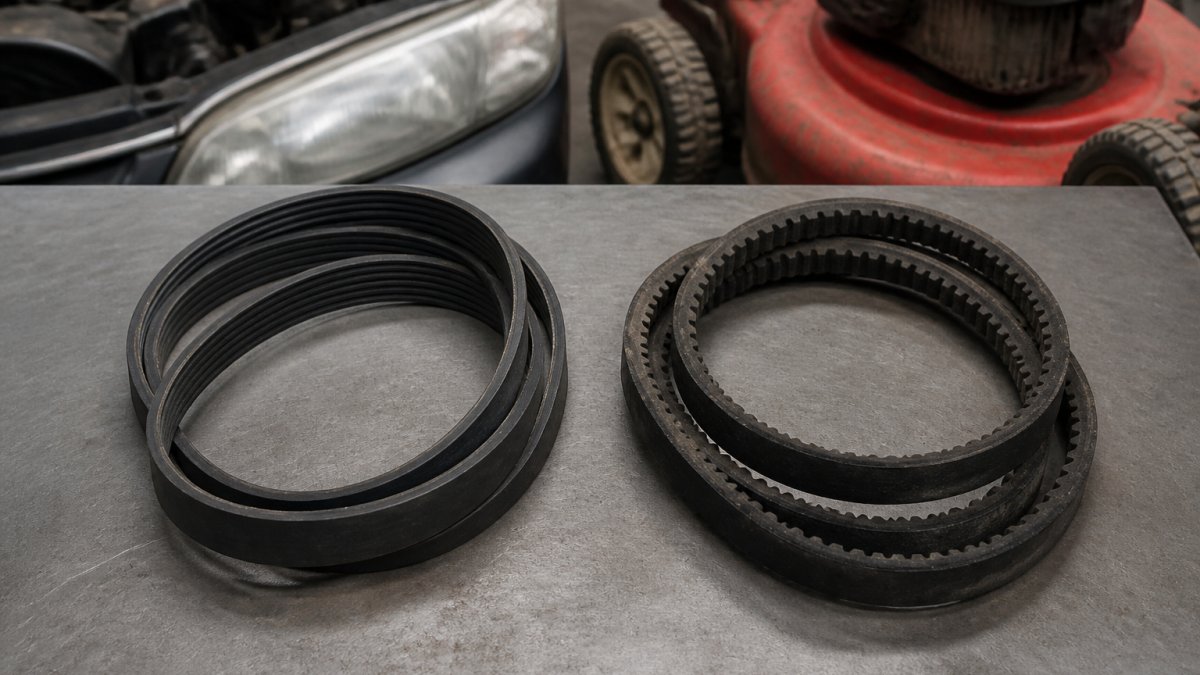
The V-belt profile is the same on both types, a trapezoidal cross-section that grips the sides of a pulley. But lawn mower belts use a raw-edge profile, while many automotive belts use a wrapped edge. The raw-edge design on lawn-and-garden belts allows better cooling and moisture shedding, critical for outdoor equipment that gets wet and muddy.
Automotive belts are often wrapped in fabric that protects against oil and heat inside an engine bay. That same fabric traps moisture on a lawn mower, accelerating deterioration. The pulley arrangement also differs. Automotive powertrains use tight, compact pulley systems with precise alignment. Lawn mower decks and drive systems have more forgiving tolerances, but they also demand belts that handle vibration and shock loads better. A raw-edge lawn-and-garden belt flexes and absorbs impact more effectively than an automotive belt would.
Material Composition and Heat Resistance
Automotive belts are engineered for sustained high temperatures inside an engine compartment, typically 150-200°F. Lawn mower belts face lower peak temperatures but must resist UV exposure, ozone, and moisture degradation. The rubber compound in lawn-and-garden belts includes additives that resist cracking from sunlight and oxidation.
Automotive belts prioritize oil resistance. Lawn mower belts prioritize weather resistance. Use an automotive belt on a mower, and the rubber degrades faster under UV. Use a lawn mower belt on a car engine, and it may absorb engine oil, swell, and slip. The material composition is matched to the environment, not interchangeable.
Pulley Compatibility and Belt Routing
Pulley size and spacing vary dramatically between automotive and lawn mower designs. An automotive belt that fits the pulley diameters on your mower might not follow the correct belt routing path. Incorrect routing means the belt doesn't track properly, leading to slippage and edge wear.
Lawn mower belt routing often includes guide pulleys and idlers positioned to manage the motion of the deck or drive system. An automotive belt, even if the length is close, may not align with these guides. Misalignment causes the belt to ride off-center on the pulley, creating friction and heat that accelerates failure.
Drive Belts vs. Deck Belts: Understanding Mower Belt Types
Riding mowers use two main belt types, and they're not interchangeable. Understanding which one you need is the first step in finding the correct replacement.
Drive belts (also called ground-drive belts or motion drive belts) transfer power from the engine to the wheels, controlling ground speed and forward/reverse motion. They handle continuous load and require high durability. Deck belts (or blade belts) transfer power from the engine to the mower deck, engaging the cutting blades. They experience intermittent engagement and disengagement, with sudden shock loads when the blade clutch engages.
The two types have different tension requirements and failure modes. A worn drive belt causes sluggish ground motion. A worn deck belt causes blade engagement to slip or fail entirely. Installing a drive belt where a deck belt belongs, or vice versa, results in poor clutching, slippage, and potential blade lockup. Check your mower's manual or parts diagram to confirm which type you need.
How to Measure Lawn Mower Belt Size Accurately
Measuring your mower belt correctly is essential for finding the right replacement. An incorrect measurement leads to ordering the wrong size, which won't fit or won't perform properly.
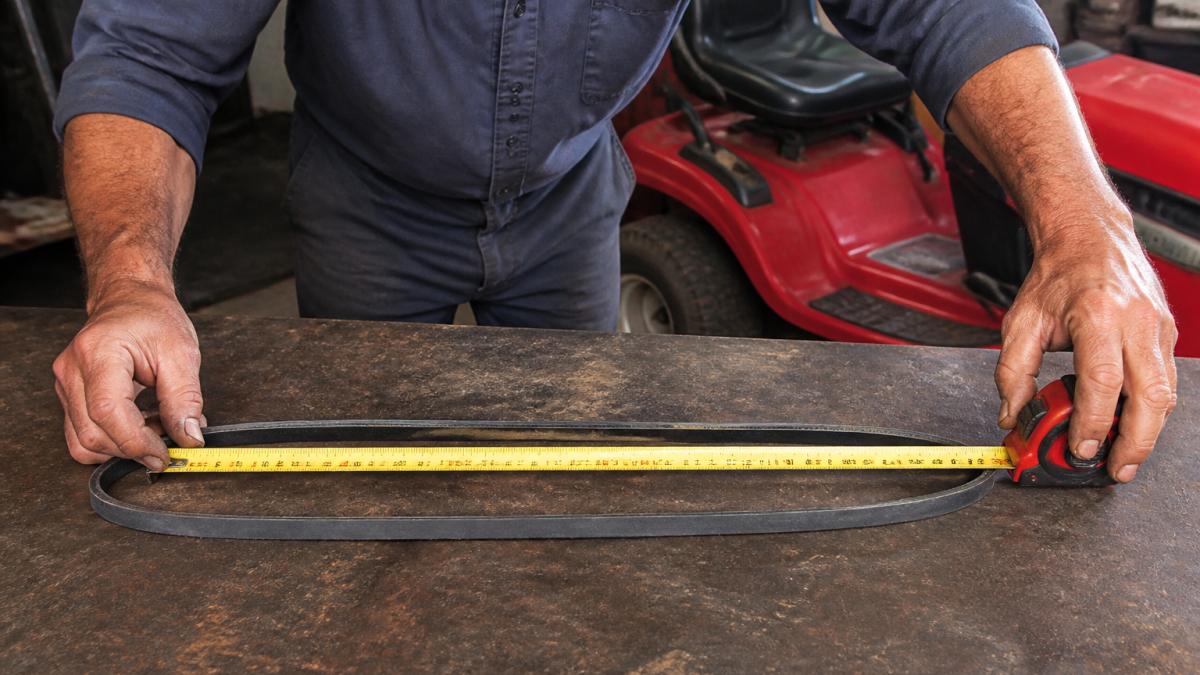
The correct method is to measure the belt's outside circumference, not the inside. Remove the old belt and lay it flat on a workbench. Use a fabric tape measure or a flexible ruler, not a rigid metal tape. Measure the full length around the outside edge of the belt. Record this measurement in inches.
Next, measure the belt width. This is the dimension from one side of the V-groove to the other, measured across the top of the belt. Common widths are 1/2 inch, 5/8 inch, 3/4 inch, and 1 inch. Width affects pulley fit and power transmission efficiency. An undersized width won't grip the pulley properly. An oversized width won't fit the pulley groove at all.
Finally, check the belt profile. Most lawn mower belts are standard V-belts, but some use cogged or banded profiles for better grip and reduced slippage. Cogged belts have teeth on the inside surface and work better in high-load applications. If your original belt is cogged, use a cogged replacement, not a standard V-belt.
Lawn Mower Belt Size Chart and Cross Reference Guide
Once you have the outside circumference and width, use a belt cross-reference chart to find compatible replacements. Many manufacturers use proprietary part numbers, but belts with the same circumference and width from different makers often fit the same mower.
A typical cross-reference works like this: if your original belt is marked 42" circumference by 5/8" width, you'd search for "42 x 5/8" or "42L x 5/8" (the L indicates lawn-and-garden application). The chart will show you multiple options, original equipment manufacturer (OEM) parts and aftermarket equivalents.
OEM parts carry the mower maker's part number (e.g., John Deere GX20072 for a 42-inch deck belt). These are engineered specifically for your mower and tested for fit and performance. Aftermarket replacements must match the same circumference and width to work correctly. A belt that's off by even 1 inch in circumference will either be too tight (causing excessive tension and premature wear) or too loose (causing slippage and blade engagement issues).
For riding mowers, consult your owner's manual for the exact OEM part number. If you've lost the manual, search online for "[Your Mower Make and Model] belt size" or "[Your Mower Make and Model] parts diagram." Many manufacturers post free parts diagrams online. The diagram identifies both the drive belt and deck belt, with part numbers and circumference/width specifications.
Lawn Mower Drive Belt Replacement: Step-by-Step Selection
Selecting the right replacement belt involves more than just measuring. You need to confirm compatibility with your specific mower model and understand how the belt fits into the overall power transmission system.
Identifying Your Mower's OEM Part Number
Start by finding your mower's model number. This is usually stamped on a plate under the seat or on the frame near the engine. Write down the complete model number, including any letter or number suffixes. Then, search the manufacturer's parts website or contact their customer service with the model number.
Provide the parts department with the model number and ask for the replacement belt part number. Specify whether you need the drive belt or the deck belt, the two are different. The parts department will give you the OEM part number and the belt's circumference, width, and profile.
Write down this information. The OEM part number is your primary reference. Even if you choose an aftermarket belt, confirm that its circumference and width match the OEM specification exactly.
Checking Belt Compatibility by Make and Model
Not all belts that fit one mower will fit another, even from the same manufacturer. John Deere 42-inch decks from different model years may use different belt sizes. Cub Cadet mowers from the 2010s may differ from current models.
Cross-reference your belt size against compatibility charts provided by belt manufacturers or retailers. Many online retailers allow you to enter your mower's make, model, and year and will filter compatible belts. This is faster and more accurate than guessing from measurements alone.
Be cautious of "universal" belts marketed as fitting multiple models. A universal belt may fit the pulley diameters but not the belt routing or tensioning system. When in doubt, match the OEM part number or the exact circumference and width specification.
Consequences of Using the Wrong Belt Type
Installing an incorrect belt creates immediate and long-term problems. Short-term, the mower won't operate correctly. Long-term, you risk equipment damage and safety hazards.
A belt that's too long will slip on the pulleys because it can't maintain proper tension. The engine spins the pulleys, but the belt doesn't grip firmly enough to transfer power. Result: the blades engage intermittently or not at all.
A belt that's too short creates excessive tension. The belt stretches to reach the pulleys, straining the belt material and the pulley bearings. Excessive tension causes the belt to crack prematurely.
Using an automotive belt instead of a lawn-and-garden belt introduces different risks. The automotive belt's wrapped edge and oil-resistant rubber don't shed moisture as effectively. Grass clippings stick to the belt, moisture accumulates, and the rubber degrades faster. Slippage increases because the belt loses grip.
An automotive belt may also not fit the belt routing correctly. If it rides off-center on a pulley, edge wear accelerates. The belt tears at the edges, and pieces of rubber break off. This can jam the pulley or damage the belt housing.
Safety is also a concern. A belt that slips unpredictably means the operator can't control blade engagement reliably. The blades might engage suddenly when the operator doesn't expect it, or fail to engage when they should. This creates a hazard for anyone near the mower.
| Issue | Symptom | Root Cause | Prevention |
|---|---|---|---|
| Belt Too Long | Slippage, blades engage inconsistently | Insufficient tension | Measure circumference accurately |
| Belt Too Short | Excessive tension, belt cracking | Overstretching | Match OEM specification exactly |
| Wrong Profile | Reduced grip, premature wear | Design mismatch | Confirm cogged vs. standard V-belt |
| Automotive Belt Used | Moisture damage, slippage, edge wear | Material/design incompatibility | Use lawn-and-garden belt only |
Choosing the correct belt for your lawn mower takes a few minutes of research but saves you from costly repairs and downtime. Measure your current belt's circumference and width, confirm your mower's OEM part number, and match the specification exactly.
When you're ready to order a replacement, V-Belt Nation carries a comprehensive selection of lawn-and-garden belts. We offer competitive prices, with free ground shipping on orders over $175. Our team can help you confirm the correct belt for your mower.
Frequently Asked Questions
Can you use an automotive belt on a lawn mower?
No. Automotive belts are designed for engine compartment temperatures and automotive powertrains, while lawn mower belts handle different pulley configurations, belt routing, and outdoor operating conditions. Using an automotive belt risks slippage, premature failure, and potential safety hazards. Always use a belt engineered for your specific mower model and application.
How do you measure a lawn mower belt?
First, remove the old belt and lay it flat on a work surface. Measure the inside length using a tape measure or ruler, running from the inside edge of one pulley groove to the inside edge of the other. Record the length in inches, then measure the width of the belt. Cross-reference these measurements with your mower's manual or the OEM part number to confirm the correct replacement size.
What is the difference between a drive belt and a deck belt on a lawn mower?
A drive belt (or ground-drive belt) transfers power from the engine to the wheels, controlling forward and reverse motion. A deck belt (or blade belt) transfers power to the mower deck, engaging and disengaging the cutting blades. Both are critical to mower function, but they differ in length, width, pulley arrangement, and replacement procedures. Always identify which belt you need before purchasing a replacement.
Why do lawn mower belts fail prematurely?
Premature belt wear occurs from incorrect belt tension, misaligned pulleys, debris accumulation, exposure to oil or heat, or using an incompatible belt type. Using an automotive belt instead of a lawn-and-garden belt accelerates failure because the belt profile and material composition don't match mower operating conditions. Regular inspection and proper maintenance extend belt life significantly.