 how-to
What Does L Mean in Belt Sizes: A Sizing Guide
Table of Contents
- What Does L Mean in Belt Sizes
- How to Measure Belt Size: Step-by-Step
- Belt Size vs Waist Size: Understanding the Difference
- Belt Size Chart: L and Other Letter Sizes
- What Size Belt for a 32-Inch Waist
- What to Do When You're Between Sizes
- Common Mistakes When Selecting Belt Sizes
- Frequently Asked Questions
Last Updated: October 13, 2026
What Does L Mean in Belt Sizes
The letter L in belt sizing stands for "Large." It's a standardized size designation used across most belt manufacturers, but belt sizes L don't correspond to one fixed waist measurement.
At V-Belt Nation, we work with customers every day who get confused by belt sizing. The confusion stems from one simple fact: a size L from one manufacturer might fit a 34-inch waist, while another brand's L fits a 36-inch waist.
The letter sizing system (XS, S, M, L, XL, XXL) exists alongside numeric sizing (28, 30, 32, 34, etc.). Some retailers use letters exclusively. Others use numbers. A few use both.
Why L Doesn't Equal One Universal Measurement
There is no governing body that sets a universal standard for what "L" means across all belt manufacturers. Each company decides its own size ranges: one brand might define L as fitting waist sizes 34-36 inches, another as 36-38 inches, and a third as 35-37 inches.
This happens because belt sizing depends on several factors:
- The belt's intended use. Casual belts often run looser than formal dress belts. A casual L might accommodate a larger waist than a formal L from the same brand.
- The brand's target market. A manufacturer focused on outdoor work wear might size L differently than one making fashion belts.
- The measurement method. Some brands measure the finished belt length (tip to buckle). Others measure the usable belt strap only. These two methods produce different size ranges.
- The material. Leather stretches slightly over time. Synthetic materials don't. A manufacturer might account for this by adjusting the size range.
The practical takeaway: never assume two L-sized belts from different brands will fit the same waist. Check the actual waist measurement range the manufacturer specifies for that size.
How to Identify L on a Belt Label
Finding the L designation on a belt is straightforward once you know where to look. Most manufacturers place the size marking in one of three locations:
On the back side of the belt strap, near the buckle attachment point. Look for stamped, embossed, or printed text, often alongside the brand name or material type.
Inside the keeper loop (the small loop that holds the belt strap after it wraps around your waist). Flip the keeper back and check the underside.
On a tag or label sewn into the belt, usually found near the buckle area on the underside of the belt.
Some belts use only the letter (L).
If you can't find the size marking on a belt you already own, measuring the belt itself is your backup plan. We'll cover that in the next section.
How to Measure Belt Size: Step-by-Step
Getting an accurate belt measurement takes less than five minutes. The key is using the right technique and knowing what you're measuring: your waist for a new belt, or the belt itself if you're replacing an existing one.
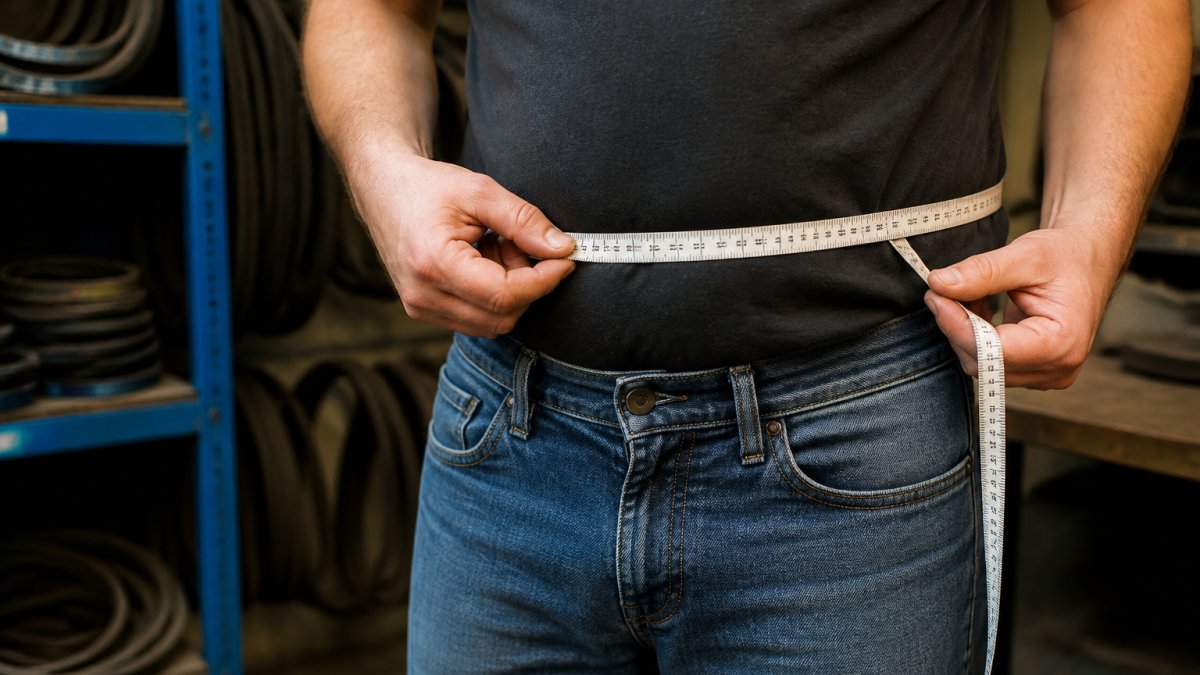
Measuring Your Waist for Belt Sizing
Your waist measurement is the foundation for selecting the right belt size.
Start by finding the smallest part of your waist, typically about an inch above your belly button.
Read the measurement where the tape overlaps. Round to the nearest half-inch if needed. Write this number down.
Here's the important part: this waist measurement is NOT your belt size. Your belt size will be 2-3 inches larger than your waist measurement. We'll explain why in the next section.
Measuring an Existing Belt
If you have a belt that fits you well, measuring it is often faster and more reliable than guessing based on waist size.
Lay the belt flat on a table with the buckle facing up. Straighten it so there are no twists or curves in the strap.
Measure from the center of the buckle to the hole you normally wear.
If you want the full belt length (tip to buckle), measure the entire belt from end to end. This number helps when comparing belts across different brands.
Write down both measurements. When you're shopping for a replacement, look for belts with the same functional length.
Where to Position the Belt When Measuring
Belt fit depends heavily on where you wear it. Wearing a belt too high or too low changes the effective fit and can make it uncomfortable or unstable.
The correct position is at your natural waistline, the smallest part of your waist, typically about an inch above your belly button. Your belt should sit level around your entire body without tilting forward, backward, or to one side.
The hole you use matters too. A well-fitting belt should use a hole near the middle of the available holes. If you're using one of the last holes, the belt is too small.
Belt Size vs Waist Size: Understanding the Difference
This is the core concept that trips up most people shopping for belts. Your waist measurement and your belt size are two different numbers, and understanding why prevents costly mistakes.
Why Belt Length Exceeds Waist Measurement
A belt must be longer than your waist for a simple reason: it wraps around your body and then overlaps itself at the buckle.
When you fasten a belt, the strap comes around your waist and folds back on itself to pass through the buckle.
Here's the math: if your waist measures 32 inches, your belt size will typically be 34-35 inches. The extra 2-3 inches accounts for the overlap at the buckle.
This is why you can't just buy a belt labeled with your waist measurement. A belt marked "32" is actually too small for a 32-inch waist.
Men's vs Women's Belt Sizing
Men's and women's belts use different sizing conventions, which matters if you're shopping across categories.
Men's belts typically use numeric sizing (30, 32, 34, 36, 38, 40, 42, 44, 46) or letter sizing (XS, S, M, L, XL, XXL).
Women's belts often use letter sizing exclusively (XS, S, M, L, XL) with different size ranges than men's belts, a women's L might fit a smaller or larger waist than a men's L, depending on the brand.
The safest approach is to check the manufacturer's size chart for the specific belt you're considering. Never assume a men's L and a women's L are equivalent.
Belt Size Chart: L and Other Letter Sizes
Letter sizing provides a quick reference, but the actual measurements vary by brand. This chart shows typical ranges for standard letter sizes across most manufacturers.
| Letter Size | Typical Waist Range | Typical Belt Length |
|---|---|---|
| XS | 28-30 inches | 30-32 inches |
| S | 30-32 inches | 32-34 inches |
| M | 32-34 inches | 34-36 inches |
| L | 34-36 inches | 36-38 inches |
| XL | 36-38 inches | 38-40 inches |
| XXL | 38-40 inches | 40-42 inches |
These ranges are approximate. Always verify the specific manufacturer's size chart before ordering.
Standard Letter Size Ranges
Belt sizes L typically accommodate waist measurements in the 34-36 inch range, but this varies: some brands position L to fit 35-37 inches, others 33-35 inches, because manufacturers don't follow a universal standard.
When you see an L belt, check the product description or size chart for the exact waist measurement range. This single step eliminates most sizing mistakes.
Converting Inches to Centimeters
International customers or those working with metric measurements need to convert inches to centimeters. One inch equals 2.54 centimeters (Approximate Conversions from U.S. Customary Measures to Metric | NIST).
A 34-inch waist converts to approximately 86 centimeters. A 36-inch waist is about 91 centimeters. An L-sized belt with a 36-38 inch length range is approximately 91-97 centimeters.
Most international manufacturers also provide metric sizing directly on their products, so conversion isn't always necessary. But knowing the conversion helps when comparing belts across different sizing systems.
What Size Belt for a 32-Inch Waist
A 32-inch waist typically requires a belt size of 34 inches or a size L, depending on the brand's sizing system. This accounts for the 2-3 inch allowance needed for the belt to wrap around your body and overlap at the buckle.
The 2-3 Inch Allowance Rule
This rule is fundamental to belt sizing. Add 2-3 inches to your waist measurement to find your belt size.
For a 32-inch waist:
- Add 2 inches = 34-inch belt
- Add 3 inches = 35-inch belt
Most people find a 34-inch belt works well. If you prefer a tighter fit with less overlap, try 34. If you want more overlap and a looser feel, try 35.
The allowance exists because belts must wrap around your body completely and fold back on themselves at the buckle; without this extra length, the belt can't fasten securely or comfortably.
What to Do When You're Between Sizes
Shopping for a belt becomes complicated when your waist measurement falls between standard sizes. A 33-inch waist, for example, sits between the typical S and M sizes.
When you're between sizes, measure an existing belt that fits you well. This real-world measurement is more reliable than guessing based on waist size alone, telling you exactly what size works for your body and preferred fit.
If you don't have a reference belt, try the larger size.
When ordering online, check the return policy. Many retailers allow free returns or exchanges, which makes it easier to try both sizes and keep the one that fits best.
Common Mistakes When Selecting Belt Sizes
Most sizing errors come from predictable mistakes. Knowing these pitfalls helps you avoid them.
Mistake 1: Using your waist measurement as your belt size. A 32-inch waist needs a 34-35 inch belt, not a 32-inch belt.
Mistake 2: Assuming all L sizes are identical. They're not. An L from one brand might not fit the same as an L from another.
Mistake 4: Measuring at the wrong body location. Measure at your smallest waist point, not at your hips or lower abdomen.
Mistake 5: Not checking the size label before buying. If a belt doesn't clearly show its size (letter or number), contact the seller before purchasing.
Mistake 6: Forgetting about material stretch. Leather belts stretch slightly over time; synthetic belts stretch less.
Frequently Asked Questions
What does L mean in belt sizes?
L stands for Large and refers to a category of belt sizes rather than a single fixed measurement. An L belt typically accommodates waist sizes in the 36-40 inch range, though the exact measurement depends on the brand and how the sizing system is structured. Some manufacturers base L on waist circumference, while others use total belt length. Always check the specific brand's size chart to confirm what L means for that product, as standardization across the industry is not universal.
What size belt should I buy for a 32-inch waist?
For a 32-inch waist, select a belt that is 34-35 inches long. Add 2-3 inches to your waist measurement to account for the overlap needed to reach the center hole comfortably. A 32-inch waist typically falls into a Small (S) or Medium (M) belt size depending on the brand. Check the brand's belt size chart to confirm whether a 34-35 inch belt is labeled as S, M, or another designation, then verify the waist range it covers.
Does a 32-inch belt fit a 32-inch waist?
No. A belt labeled 32 inches refers to its total length, not the waist it fits. You need 2-3 inches of overlap to fasten the belt comfortably and securely. A 32-inch belt would only wrap around a 29-30 inch waist at best, leaving insufficient material for proper fit. For a 32-inch waist, purchase a belt that is 34-35 inches in total length to achieve the correct fit.
How do I know if I need an L or M belt size?
Measure your waist circumference at the smallest part of your torso while standing relaxed. Then add 2-3 inches to that measurement to determine the belt length you need. Cross-reference this length with the brand's belt size chart. If your waist is 36-40 inches, you likely need an L (Large). If your waist is 32-36 inches, an M (Medium) is usually appropriate. When between sizes, choose the larger size for comfort and adjustability.
Finding the right belt size doesn't have to be complicated. Understand that L means Large but doesn't correspond to a single universal measurement, measure your waist correctly, and apply the 2-3 inch allowance rule. When you're ready to shop, V-Belt Nation's team can help you find the exact size you need with our extensive inventory and personalized support. Shop Now to browse our selection and get the right fit the first time.