 how-to
How to Calculate Belt Length for Custom Machinery
Table of Contents
- Understanding the Basics of Belt Length Calculation
- How to Measure a Belt for Machinery
- The Belt Length Calculation Formula
- Distance Between Pulleys and Belt Length
- Using a Belt Length Calculator for Accuracy
- Worked Examples: Calculating Belt Length Step-by-Step
- Accounting for Tolerance, Tension, and Adjustment
- Selecting Belt Type and Pitch for Your Custom Design
- Frequently Asked Questions
Last Updated: October 10, 2026
Understanding the Basics of Belt Length Calculation
Getting belt length right is critical: too short won't fit, too long will slip and wear fast. A miscalculation can cost weeks of downtime and hundreds in replacement parts.
Understanding how to calculate belt length accurately saves time and money, whether replacing a worn belt or building new machinery.
Why Belt Length Matters for Custom Machinery
A properly sized belt transfers power smoothly. Wrong length causes tension problems, slipping, premature wear, and failure.
The stakes are high: manufacturing downtime costs thousands per hour, HVAC failures stop entire buildings, and equipment breakdowns halt projects. Correct belt length ensures reliability and avoids emergency orders at premium prices.
Key Measurements You'll Need
Gather these three measurements before calculating:
Pulley diameters: driver and driven pulleys. Distance between pulleys: center-to-center distance from axle to axle. Belt type and pitch: V-belts, timing belts, and cogged belts use different formulas; pitch is tooth spacing or nominal width. A half-inch measurement error compounds through the formula.
How to Measure a Belt for Machinery
Measuring seems simple. In practice, small mistakes happen fast. Here's how to do it right.
Measuring Pulley Diameter
Pulley diameter is the distance across the pulley. For V-belts, measure the pitch diameter (where the belt sits), not the outer edge.
Steps: Stop and lock out machinery. Use a caliper to measure straight across the pulley center. For V-belts, measure where the belt contacts the pulley, not the outer rim. Record in inches or millimeters. Repeat to verify. Common mistake: measuring outer diameter instead of pitch diameter.

Measuring Distance Between Pulleys
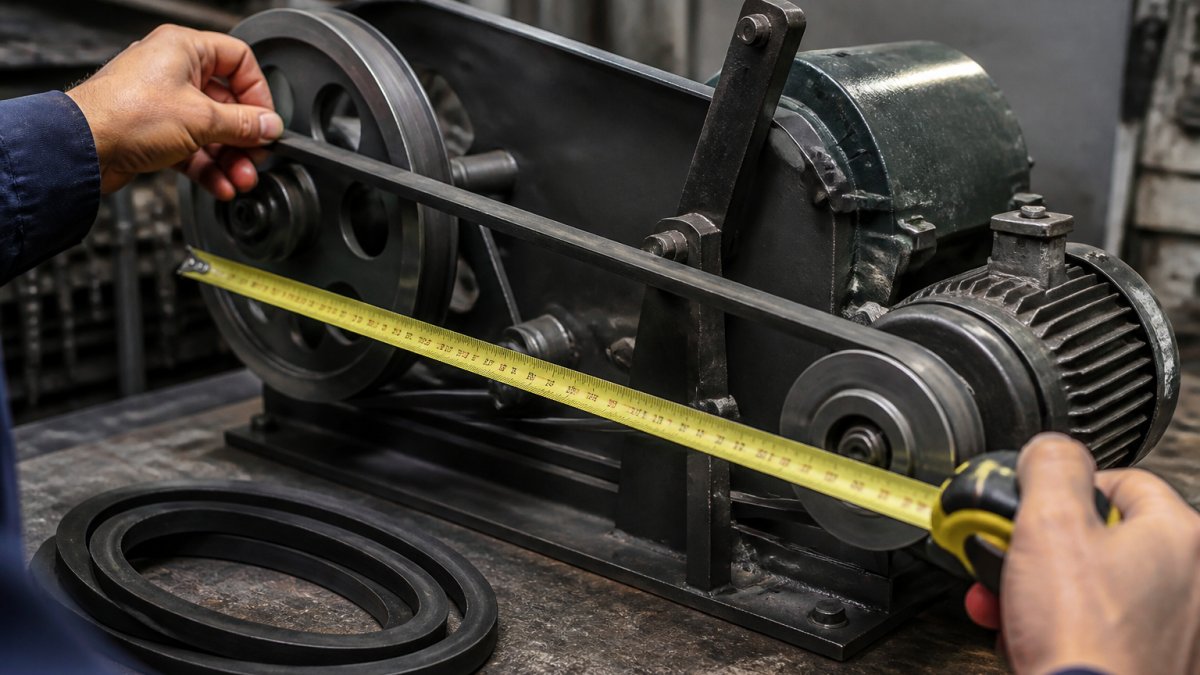
Center-to-center distance is the straight-line measurement from one pulley axle to the other. Use a straightedge or laser level to mark the line, then measure with a tape measure kept tight and level. A 2-inch difference in center distance changes belt length noticeably.
The Belt Length Calculation Formula
This is where the math happens. Don't let it intimidate you. The formula is straightforward once you understand what each part means.
Two-Pulley System Formula
The standard formula for belt length calculation in a two-pulley system is:
Belt Length = π × (D1 + D2) / 2 + 2 × C × sin(θ)
Where:
- D1 = diameter of the larger pulley
- D2 = diameter of the smaller pulley
- C = center-to-center distance
- θ (theta) = half the wrap angle difference
- π = 3.14159
For most practical applications, use this simpler approximation:
Belt Length ≈ π × (D1 + D2) / 2 + 2 × C
This is accurate within 1-2% for standard machinery. It skips wrap angle calculation, which matters most when pulley sizes differ dramatically.
Example calculation:
- Large pulley diameter: 6 inches
- Small pulley diameter: 3 inches
- Center-to-center distance: 15 inches
Belt Length ≈ 3.14159 × (6 + 3) / 2 + 2 × 15 Belt Length ≈ 3.14159 × 4.5 + 30 Belt Length ≈ 14.14 + 30 Belt Length ≈ 44.14 inches
Round up to the nearest standard belt size (usually 44 or 45 inches, depending on what's available).
Understanding Wrap Angle and Its Impact
Wrap angle is the amount of belt contacting each pulley. A belt wraps less on the smaller pulley and more on the larger one. When sizes differ greatly, the wrap angle on the small pulley becomes shallow, reducing grip and requiring higher tension, which accelerates wear. This tells you whether your pulley size difference is practical for your application.
Distance Between Pulleys and Belt Length
Center-to-center distance is critical to your belt length formula. Small changes create noticeable changes in belt length.
How Center-to-Center Distance Affects Your Calculation
A 1-inch change in center distance changes belt length by roughly 2 inches. The relationship is linear for practical machinery, so measure center distance carefully.
Larger center distances reduce wrap angle, lowering tension and bearing stress, but require longer, more expensive belts that take up more space.
Using a Belt Length Calculator for Accuracy
Manual calculations work, but a calculator removes arithmetic errors. Many online tools and spreadsheets can do this for you instantly.
When to Use a Calculator vs. Manual Calculation
Use a calculator when:
- You're designing multiple belt systems and want to compare options quickly
- Your pulleys have unusual sizes or spacing
- You need to account for wrap angle precisely
- You're ordering multiple belts and want to verify each calculation
Manual calculation is fine when:
- You have a simple two-pulley system with standard sizes
- You understand the formula and can verify your work
- You're doing a one-time calculation for a single machine
The advantage of a calculator is speed and consistency. The advantage of manual calculation is understanding. Do both when you're learning.
Many online belt calculators ask for:
- Pulley diameters
- Center distance
- Belt type (V-belt, timing belt, etc.)
- Pitch (for timing belts)
Then they output the belt length instantly. V-Belt Nation's team can help you verify calculations or recommend the right belt size for your specific needs.
Worked Examples: Calculating Belt Length Step-by-Step
Theory is useful. Real examples are better. Here are two scenarios you might face.
Example 1: Standard Two-Pulley Setup
Scenario: You're replacing a belt on a production line. The motor pulley is 4 inches in diameter. The load pulley is 8 inches in diameter. They're spaced 18 inches apart (center to center).
Step 1: Organize your measurements
- D1 (larger pulley) = 8 inches
- D2 (smaller pulley) = 4 inches
- C (center distance) = 18 inches
Step 3: Round to standard size Standard belt sizes come in 1-2 inch increments. Round 54.85 up to 55 inches. When installed, it should have moderate tension. If too loose, try 54 inches; if too tight, try 56 inches.
Example 2: Multiple Pulleys and Complex Routing
Scenario: Custom conveyor with three pulleys: 6-inch drive pulley, two 10-inch load pulleys. Drive pulley is 20 inches from the first load pulley and 25 inches from the second.
Segment 1: Drive pulley to first load pulley
- D1 = 10 inches (load pulley)
- D2 = 6 inches (drive pulley)
- C = 20 inches
Belt Length (segment 1) ≈ 3.14159 × (10 + 6) / 2 + 2 × 20 Belt Length (segment 1) ≈ 25.13 + 40 = 65.13 inches
Segment 2: First load pulley to second load pulley
- D1 = 10 inches
- D2 = 10 inches
- C = 15 inches (assume 15 inches between them)
Belt Length (segment 2) ≈ 3.14159 × (10 + 10) / 2 + 2 × 15 Belt Length (segment 2) ≈ 31.42 + 30 = 61.42 inches
Total belt length = 65.13 + 61.42 = 126.55 inches
Round to 127 inches. This is a custom size. V-Belt Nation stocks standard sizes.
Accounting for Tolerance, Tension, and Adjustment
Getting the math right is half the job. The other half is understanding how belts behave in the real world.
Installation Tension and Take-Up Adjustment Range
Belts stretch when first installed and wear over time, effectively lengthening. Most machinery has a take-up adjustment (1-2 inches on each side) to tighten or loosen the belt. Order a belt that allows for this adjustment: if your calculation gives 54.85 inches, a 55-inch belt is safer than 54 inches. Too short and you can't adjust tight enough; too long and it will slip or overheat.
Measurement Error and Validation
Measurements aren't perfect; small errors add up. After installation, run machinery at low speed for the first hour and check tension every 15 minutes. Listen for squealing (low tension) or grinding (misalignment). Feel the belt, it should be warm but not hot. Recheck tension after 24 hours. If the belt slips or squeals, loosen the take-up adjustment slightly. If it still slips, the belt may be too long or pulleys may be misaligned.
Selecting Belt Type and Pitch for Your Custom Design
Not all belts are the same. The type you choose affects how you calculate belt length and what sizes are available.
V-Belt vs. Timing Belt vs. Cogged Belt
V-belts (classic wedge shape):
- Most common for industrial machinery
- Come in standard sizes (A, B, C, D, E sections)
- Pitch diameter is where the belt sits in the groove
- Good for general power transmission
- Less precise than timing belts but simpler and cheaper
Timing belts (toothed):
- Used when precise speed ratios matter (conveyors, printing equipment)
- Pitch is the tooth spacing (typically 3mm, 5mm, 8mm, 14mm)
- No slipping, tooth engagement is positive
- More expensive than V-belts
- Require precise center distance
Cogged belts (V-belt with teeth):
- Hybrid between V-belts and timing belts
- Better grip than smooth V-belts
- More flexible than timing belts
- Good for HVAC systems and cooling towers
- Pitch matters for cogged belts
For custom machinery, choose based on your accuracy needs and budget. A lawn mower needs a simple V-belt. A production line conveyor might need a timing belt for precision.
Pitch-Specific Calculations and Standard Sizes
Once you know your belt type, you're limited to standard sizes. V-Belt Nation stocks common sizes.
Standard V-belt sizes (examples):
- A-section: 26" to 240" lengths
- B-section: 31" to 390" lengths
- C-section: 51" to 600" lengths
Standard timing belt pitches:
- 3mm pitch: narrow, precise applications
- 5mm pitch: general industrial use
- 8mm pitch: heavy-duty applications
Your calculation might give you 54.85 inches. If that's not a standard size, you have options:
- Use a 55-inch belt (slightly shorter than calculated), may need higher tension
- Use a 56-inch belt (slightly longer than calculated), may have more slack
- Order a custom 54.85-inch belt, costs more, takes longer to arrive
- Adjust your pulley spacing slightly to hit a standard size
Most machinery can accommodate a 1-inch variation without issues. Adjust the take-up mechanism to compensate.
Getting belt length right protects your machinery investment. Measure carefully, use the formula, and account for real-world factors like wear and adjustment range. V-Belt Nation carries a comprehensive selection of V-belts, timing belts, and cogged belts in standard sizes, plus the expertise to help you find exactly what your custom machinery needs. Whether you're ordering a replacement or designing something new, our team is ready to help you get it right the first time. ISO standards for V-belt dimensions and specifications
Frequently Asked Questions
What is the formula for calculating belt length?
The standard formula for two pulleys is: Belt Length = π(D1 + D2)/2 + 2C, where D1 and D2 are the pulley diameters and C is the center-to-center distance. This accounts for the curved sections around each pulley plus the straight runs between them. For more complex systems with multiple pulleys or different belt types, you may need to adjust for wrap angle and pitch diameter.
How do I measure a machinery belt accurately?
Measure pulley diameter at the belt's contact point (pitch diameter for timing belts) using calipers or a measuring tape. For center-to-center distance, measure from the center of one pulley axle to the center of the other using a straight edge or tape measure. Always measure twice to verify accuracy, and account for any wear or alignment issues before calculating belt length for replacement.
How much adjustment should I allow when calculating belt length?
Most belt systems require 0.5 to 1 inch of take-up adjustment range to maintain proper tension during installation and operation. This means your calculated belt length should allow the idler pulley or tensioner to move within this range. Check your machinery's specifications or consult the belt manufacturer for exact adjustment requirements, as different belt types and pulley configurations vary.
How do pulley diameters and center distance affect belt length?
Larger pulley diameters increase the belt length needed because the belt wraps around a bigger circumference. Greater center-to-center distance also increases belt length proportionally. Even small changes in these measurements significantly impact the final belt length, which is why accurate measurement is critical for custom machinery to avoid slippage, tension problems, or premature wear.