 how-to
How to Identify Belt Size: V-Belt & Apparel Guide
Table of Contents
- Two Types of Belt Sizing: Apparel vs. V-Belt
- How to Identify Belt Size for Apparel Belts
- How to Measure V-Belt Length Accurately
- V-Belt Size Chart: Standard Sections and Dimensions
- Belt Cross-Reference Guide: Finding Your Replacement Belt
- Common Belt Measurement Errors and How to Fix Them
- How to Identify Belt Size When the Label Is Worn Off
- Frequently Asked Questions
Last Updated: August 31, 2026
Two Types of Belt Sizing: Apparel vs. V-Belt
Most guides ignore one audience entirely, creating confusion because measurement methods are completely different. Apparel belt sizing is based on waist measurement and trouser size. V-belt sizing is an engineering specification defining cross-sectional profile, pitch length, and circumference within a mechanical drive system.
Core principle: measuring the belt you have is always more reliable than estimating from machine specs.
| Sizing Type | Key Measurement | Primary Method | Common Error |
|---|---|---|---|
| Apparel belt | Waist circumference | Tape measure around waist | Adding too many inches over trouser size |
| V-belt | Pitch length / inner circumference | String or tape wrapped around belt | Measuring outer circumference only |
| V-belt | Section width and height | Calipers on belt cross-section | Ignoring the section constant |
How to Identify Belt Size for Apparel Belts
Apparel belt sizing is more forgiving than V-belt sizing. Key insight: a belt's listed size refers to the distance from the buckle bar to the middle hole, not total belt length.
Measuring Your Waist Size
Wrap a flexible tape measure around your natural waist, above hip bones and below rib cage. Keep the tape snug but not tight, you should slide two fingers underneath. Record the measurement in inches.
For trouser waist measurement, measure where you actually wear your pants, which for many people is slightly lower than natural waist. This forms the basis for belt sizing.
Measuring an Existing Belt
Lay your existing belt flat. Measure from the buckle bar to the hole you actually use. That distance is your functional belt size. The middle hole of a standard five-hole belt is the sizing hole.
Calculating Belt Size from Trouser Size
The standard rule: add 2 inches to your trouser waist size to get your belt size. If your trousers are 34 inches, order a 36-inch belt. Some manufacturers recommend adding 1 inch; others add 2. Size up rather than down when in doubt.
How to Measure V-Belt Length Accurately
V-belt sizing is a precision exercise. Getting it wrong means a belt that slips, runs hot, or fails prematurely. The process has three distinct steps.
According to ANSI/RMA standards for V-belt drives, standard V-belt dimensions follow defined cross-sectional profiles that must be matched precisely for correct fitment in sheave grooves.
Step 1: Identify the V-Belt Section and Width
The belt section defines the cross-sectional shape. Classical V-belt sections run from A through E in increasing size. Narrow/wedge sections use 3V, 5V, and 8V designations. Light-duty fractional horsepower belts use 2L, 3L, 4L, and 5L.
Measure the top width and belt height using calipers, then cross-reference against a standard V-belt section chart:
| Section | Top Width (in) | Height (in) | Typical Application |
|---|---|---|---|
| A | 0.50 | 0.31 | Light industrial, HVAC |
| B | 0.66 | 0.41 | General purpose, compressors |
| C | 0.88 | 0.53 | Heavy industrial, pumps |
| D | 1.25 | 0.75 | Large drives, agricultural |
| 3V | 0.38 | 0.31 | High-speed, precision drives |
| 5V | 0.63 | 0.53 | Heavy-duty wedge drives |
| 4L | 0.50 | 0.31 | Lawn and garden equipment |
If the label is readable, the section letter appears first in the part number (e.g., "B68" means B-section with 68-inch pitch length).
Step 2: Measure Inner Circumference and Outer Circumference
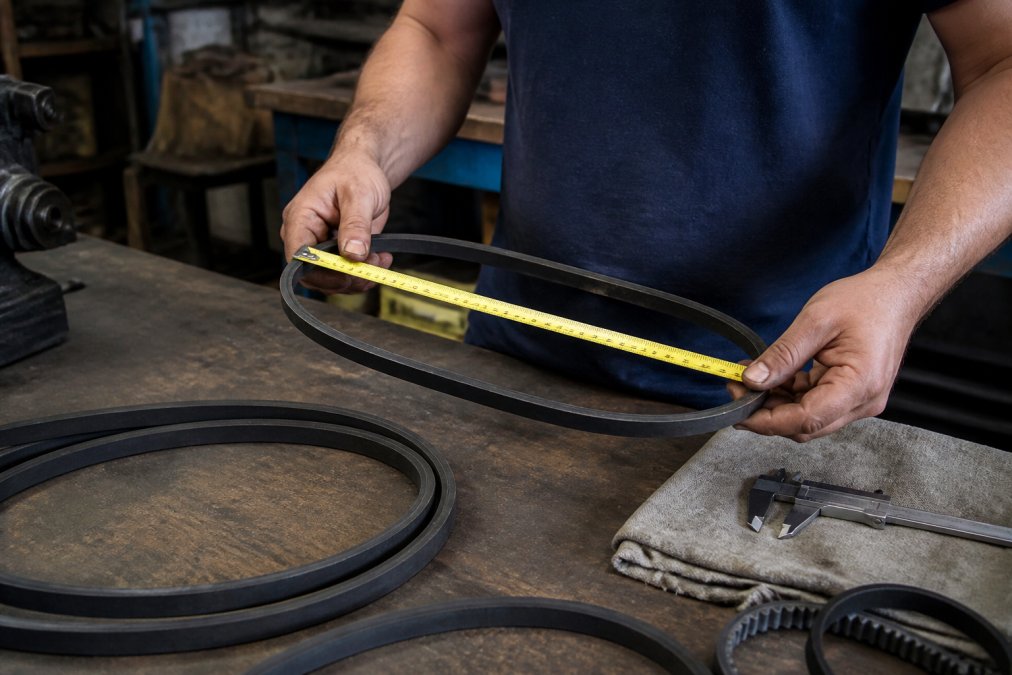
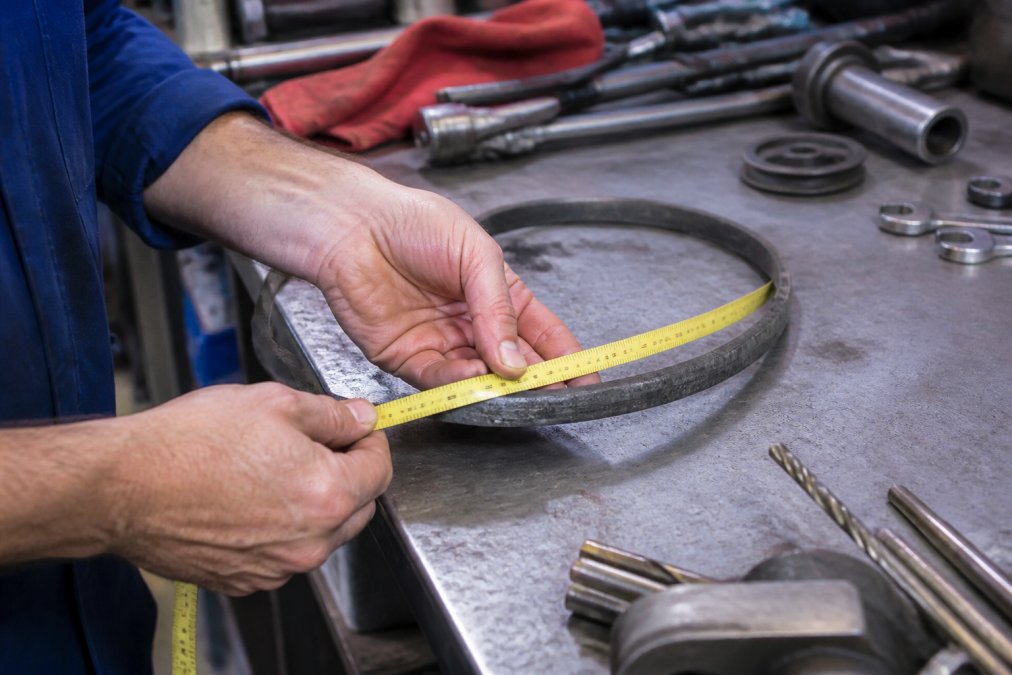
Remove the belt from the drive system. Wrap a flexible steel tape measure around the inside of the belt loop. Keep the tape flat and snug; any slack introduces error.
For belts too stiff to lay flat, use non-stretch string. Wrap it around the inner circumference, mark the overlap point, then measure the string length.
Step 3: Calculate Pitch Length Using the Belt Section Constant
Pitch length represents the circumference at the belt's pitch line, the neutral axis where neither tension nor compression acts.
Pitch Length = Inner Circumference + (Belt Section Constant × 2)
Each belt section has a defined constant:
| Section | Section Constant (in) |
|---|---|
| A / 4L | 0.50 |
| B / 5L | 0.60 |
| C | 0.75 |
| D | 0.90 |
| E | 1.00 |
| 3V | 0.40 |
| 5V | 0.60 |
| 8V | 1.00 |
Example: A B-section belt with inner circumference of 66 inches has a pitch length of 66 + (0.60 × 2) = 67.2 inches.
V-Belt Size Chart: Standard Sections and Dimensions
A V-belt size chart confirms a part number once you have section and pitch length. Standard numbering encodes length directly: a B68 belt is B-section with 68-inch pitch length. A C90 is C-section, 90-inch pitch length.
Narrow section belts follow the same logic: a 5V1180 is 5V section with 118.0-inch pitch length. For lawn and garden equipment, the L-series uses outer circumference: a 4L600 has 4L section and 60.0-inch outer circumference.
As documented in Mechanical Power Transmission Association belt standards, pitch length tolerance bands are defined per section to ensure interchangeability across manufacturers.
When ordering a replacement belt, confirm all three identifiers: section, pitch length (or outer circumference for L-series), and variant type (raw-edge, wrapped, or cogged). Cogged belts run cooler and flex more easily around small-diameter sheaves.
Belt Cross-Reference Guide: Finding Your Replacement Belt
A belt cross-reference guide maps part numbers from one manufacturer to equivalent specifications from another. This matters when you have a worn belt with a readable part number but need a different supplier.
For forward cross-referencing with a known part number:
- Identify the section prefix (A, B, C, 3V, 5V, 4L, etc.)
- Extract the length code
- Note any suffix indicating cogged or other variants
For reverse cross-referencing from measurements:
- Confirm section from top width and height
- Calculate pitch length using the section constant formula
- Match to the nearest standard pitch length in the catalog
Most standard sizing follows RMA (Rubber Manufacturers Association) specifications, meaning belts with the same RMA-standard designation are dimensionally equivalent regardless of brand.
Common Belt Measurement Errors and How to Fix Them
The biggest mistake is measuring outer circumference and ordering on that number alone. Outer circumference is not pitch length. Using it directly produces a belt that's too short, creating excessive tension and premature failure.
The second most common error: measuring a belt under tension while on the drive. Tension stretches the belt, inflating your measurement. Always remove the belt first.
Other errors:
- Wrong section identification: Eyeballing instead of measuring with calipers. A and 3V sections have similar top widths but different heights and are not interchangeable.
- Ignoring belt wear: A worn belt is longer than a new one. If measuring a belt that's been running for years, order to the original part number if readable, not to the measured length.
- Confusing datum length and pitch length: Some catalogs list datum length; others list pitch length. Confirm which reference your supplier uses.

Stretch Allowance and Belt Material Considerations
All elastomeric belts stretch slightly under load over time. A belt that measured correctly at installation will measure longer after months of service. If measuring a used belt to order a replacement, the used belt is likely stretched beyond its original specification. Order to the original part number if readable, not to the measured length.
Different belt constructions handle stretch differently. Polyester tension cord belts have low stretch characteristics. Older cotton-cord belts stretch more. Raw-edge cogged belts flex more easily but maintain dimensional stability better than wrapped belts in high-temperature environments.
According to power transmission engineering guidelines from the American Society of Mechanical Engineers, proper belt tension is as critical as correct sizing. An accurately sized belt installed at wrong tension will fail at the same rate as a wrong-size belt.
How to Identify Belt Size When the Label Is Worn Off
A worn-off label is common in maintenance environments. Here's the systematic approach:
- Remove the belt and let it relax for at least five minutes.
- Measure top width and height with calipers to identify the section.
- Measure inner circumference using flexible tape or non-stretch string.
- Calculate pitch length using the section constant.
- Check the sheave grooves, groove angle and width confirm the section.
- Look for wear patterns, a correctly running belt leaves characteristic wear on sheave sidewalls.
- Cross-reference your measurements against a standard V-belt size chart.
For lawn mowers, garden tractors, or consumer equipment, the equipment's model number often yields the OEM belt specification through the manufacturer's parts lookup.
For HVAC systems and industrial drives, the drive designer's documentation will list the original belt specification. Maintenance logs should capture this at installation.
The V-Belt Nation team can assist with cross-referencing when measurements don't cleanly match a standard part number. Our inventory covers classical, wedge, cogged, banded, and lawn and garden sections, including non-standard metric belt sizes.
For international sizing: metric V-belt designations use millimeter-based top widths (e.g., SPZ, SPA, SPB, SPC for narrow metric sections). If your equipment was manufactured outside the United States, confirm whether the drive uses metric or inch-based standards before ordering. Metric and American sections are not directly interchangeable despite similar dimensions.
Frequently Asked Questions
Q: How do I measure a V-belt if the label is worn off?
A: Wrap a flexible tape measure or a piece of string around the inside of the belt to get the inner circumference. Then measure the top width and height of the belt's cross-section with calipers. Compare those dimensions to a standard V-belt size chart to match the section (A, B, C, 3V, 5V, etc.) and length designation.
Q: What is the difference between inside and outside circumference for belts?
A: Inner circumference is measured along the inside edge of the belt, while outer circumference is measured along the outside edge. For V-belts, neither measurement directly gives you the catalog size. The standard sizing number refers to pitch length, which is calculated by adding a belt section constant to the inner circumference. Using the wrong measurement is one of the most common belt measurement errors, so always confirm which dimension your V-belt size chart or cross-reference guide requires.
Q: What size belt do I need for a 32-inch waist?
A: For apparel belts, the standard rule is to add 2 inches to your trouser waist measurement. A 32-inch trouser waist typically calls for a size 34 belt. This accounts for the buckle bar position and gives you room to use the middle belt hole for the best adjustment range. Leather thickness and the specific brand's sizing guide can shift this by one size, so always verify against the manufacturer's sizing guide when possible.
Q: Will a 38 belt fit a 34 waist?
A: A size 38 belt on a 34-inch waist will likely be too long to fit properly through standard belt loops and will leave several inches of excess past the buckle. The general sizing guideline is to stay within 2-4 inches above your trouser waist. A size 36 is the closest practical fit for a 34-inch waist, landing on the middle belt hole for the best fitment and adjustment range.
Identifying the right belt size is a solvable problem, it just requires the right sequence of measurements and an understanding of which number actually matters for ordering. V-Belt Nation carries an extensive inventory across classical, wedge, cogged, banded, and lawn and garden sections, with a support team ready to help you cross-reference part numbers, confirm specifications, and get the right belt to you fast. Shop Now and keep your machinery running.
This article was written using GrandRanker
Frequently Asked Questions
Q: How do I measure a V-belt if the label is worn off?
A: Wrap a flexible tape measure or a piece of string around the inside of the belt to get the inner circumference. Then measure the top width and height of the belt's cross-section with calipers. Compare those dimensions to a standard V-belt size chart to match the section (A, B, C, 3V, 5V, etc.) and length designation.
Q: What is the difference between inside and outside circumference for belts?
A: Inner circumference is measured along the inside edge of the belt, while outer circumference is measured along the outside edge. For V-belts, neither measurement directly gives you the catalog size. The standard sizing number refers to pitch length, which is calculated by adding a belt section constant to the inner circumference. Using the wrong measurement is one of the most common belt measurement errors, so always confirm which dimension your V-belt size chart or cross-reference guide requires.
Q: What size belt do I need for a 32-inch waist?
A: For apparel belts, the standard rule is to add 2 inches to your trouser waist measurement. A 32-inch trouser waist typically calls for a size 34 belt. This accounts for the buckle bar position and gives you room to use the middle belt hole for the best adjustment range. Leather thickness and the specific brand's sizing guide can shift this by one size, so always verify against the manufacturer's sizing guide when possible.
Q: Will a 38 belt fit a 34 waist?
A: A size 38 belt on a 34-inch waist will likely be too long to fit properly through standard belt loops and will leave several inches of excess past the buckle. The general sizing guideline is to stay within 2-4 inches above your trouser waist. A size 36 is the closest practical fit for a 34-inch waist, landing on the middle belt hole for the best fitment and adjustment range.