 how-to
Identify V-Belt Cross Section by Dimensions
Last Updated: October 22, 2026
Quick Summary
To identify V-belt cross section by dimensions, measure the belt's top width and height at an unworn location using a digital caliper, then compare your measurements to standard profiles. Classical sections (A, B, C, D, E) and metric sections (10X, 13X, 17X) each have fixed dimensions that determine the belt's profile shape and pulley compatibility.
- Measure top width and height at an unworn belt location using a digital caliper accurate to 0.01 inches.
- Classical sections range from A (0.50 in wide, 0.31 in tall) to E (1.60 in wide, 0.95 in tall).
- Metric sections include 10X (0.39 in wide, 0.31 in tall), 13X (0.51 in wide, 0.43 in tall), and 17X (0.67 in wide, 0.55 in tall).
- Read belt markings first, a single letter (A, B, C, D, E) or metric code (10X, 13X, 17X) identifies the cross section directly.
- Never substitute a metric belt for a classical section or vice versa, even if heights are similar, because groove angle and side taper differ.
Table of Contents
- Why Identifying V-Belt Cross Section Matters
- How to Measure a V-Belt: Tools and Technique
- Measuring Belt Top Width and Height
- Classical Sections: A, B, C, D, and E
- A Section vs B Section V-Belt: Key Differences
- Metric Section Designations: 10X, 13X, and 17X
- Reading Belt Markings and Size Codes
- V-Belt Pulley Size and Groove Compatibility
- Frequently Asked Questions
Why Identifying V-Belt Cross Section Matters
Getting the right replacement V-belt starts with the ability to identify V-belt cross section, the belt's profile shape, width and height viewed from the end.
A V-belt cross section is the standardized profile that determines how the belt sits in your pulley groove.
The belt's top width and height are fixed by design standards, telling you whether you need a classical section (A, B, C, D, or E) or a metric section (10X, 13X, 17X).
This guide covers accurate measurement, reading belt markings, and matching dimensions to standard sections.
How to Measure a V-Belt: Tools and Technique
Measuring a V-belt correctly requires the right tools and the right measurement location, most mistakes come from the wrong spot or imprecise tools.
Selecting the Right Measuring Tools
A digital caliper is your best choice, accurate to within 0.01 inches, precise enough for cross-section identification. You'll need a digital caliper (0-6 inch range is standard), a ruler or straightedge, a notepad, and the belt itself (unworn if possible). Avoid tape measures, which flex and lack accuracy.
Finding the Unworn Location
The key mistake is measuring a worn belt, belts stretch and compress over time, so a belt running for months measures smaller than new. Always measure at an unworn location:
- Look for a section that hasn't contacted the pulley
- On an installed belt, measure the back side or the loose span
- On a removed belt, find the least compressed area, usually opposite the wear marks
Measuring Belt Top Width and Height
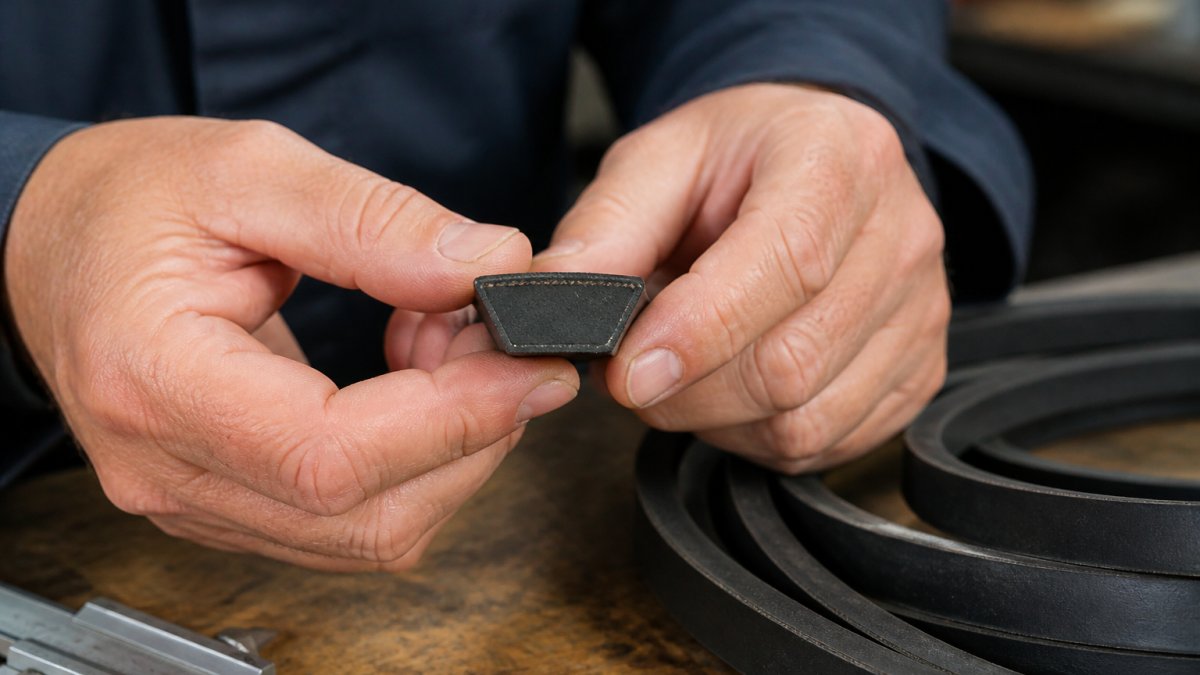
These two measurements define your cross section. Top width is how wide the belt is at the top surface. Height is how thick it is from top to bottom.
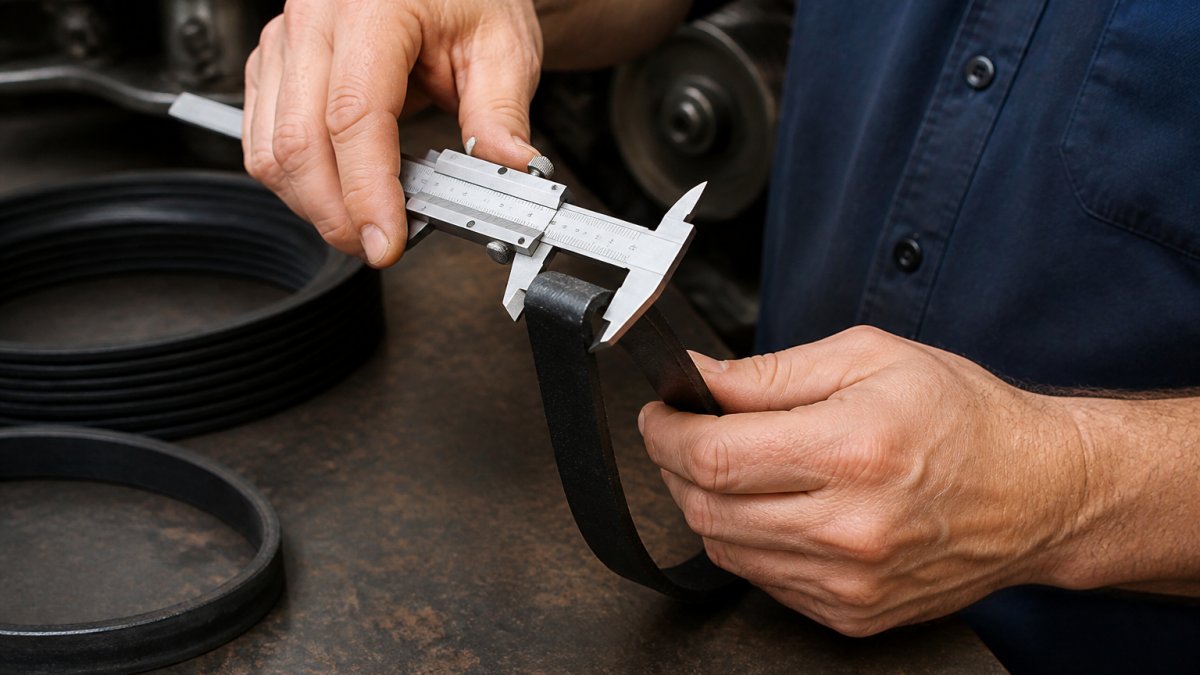
Record both measurements in inches. Round to the nearest 0.05 inch, that's close enough to identify V-belt cross section accurately.
Here's a quick reference for what you'll typically find:
| Classical Section | Top Width (inches) | Height (inches) |
|---|---|---|
| A | 0.50 | 0.31 |
| B | 0.65 | 0.41 |
| C | 0.85 | 0.56 |
| D | 1.25 | 0.75 |
| E | 1.60 | 0.95 |
If your measurements fall between two rows, check the belt markings (covered below) to confirm the exact section.
Classical Sections: A, B, C, D, and E
Classical V-belt sections are the North American standard, named with single letters and used for decades in industrial machinery, HVAC systems, and agricultural equipment. Smaller sections (A) handle light loads on small pulleys; larger sections (D, E) handle heavy loads on bigger pulleys.
- A section: 0.50" wide, 0.31" tall. Used on small motors and fans. Common in lawn equipment and light industrial drives.
- B section: 0.65" wide, 0.41" tall. The most common section. Found on compressors, pumps, and mid-range industrial equipment.
- C section: 0.85" wide, 0.56" tall. Heavy-duty industrial use. Common on larger motors and manufacturing equipment.
When your measurements match one of these rows, you've identified your cross section, your starting point for a replacement.
A Section vs B Section V-Belt: Key Differences
The difference between A and B sections comes down to power capacity and pulley size, many people confuse them because they're close in size.
A section belts are 0.50 inches wide and 0.31 inches tall, fitting smaller pulleys (typically 2-4 inches in diameter) and handling lighter loads, usually under 5 horsepower, lawn mowers, small compressors, garage door openers. B section belts are 0.65 inches wide and 0.41 inches tall, designed for medium-duty work on pulleys 3-8 inches in diameter; most industrial equipment uses B section belts for their balance of power capacity and compatibility.
The practical difference: an A section belt on a B section pulley won't grip properly and will slip; a B section belt forced onto an A section pulley won't fit or will jam. The groove shape differs for each section, it's not just about width and height.
To tell them apart, measure carefully, the 0.15-inch width difference is noticeable side by side, but measurements beat eyeballing.
Metric Section Designations: 10X, 13X, and 17X
Metric V-belts follow a different naming convention and show up constantly on imported equipment, replacement drives, and machinery built to DIN or ISO standards. If your markings are in millimeters or your measurements land near a classical size but not quite on it, you're probably looking at a metric profile. Metric sections are named by nominal top width in millimeters followed by "X." The three most common in North American repair work:
| Metric Section | Nominal Top Width | Nominal Height | Closest Inch Section |
|---|---|---|---|
| 10X | 10 mm (0.39 in) | 8 mm (0.31 in) | A (0.50 in x 0.31 in) |
| 13X | 13 mm (0.51 in) | 11 mm (0.43 in) | B (0.65 in x 0.41 in) |
| 17X | 17 mm (0.67 in) | 14 mm (0.55 in) | C (0.85 in x 0.56 in) |
A few things matter when identifying a belt by dimensions:
- The heights are close, but the widths are not. A 13X belt is about 0.51 inches wide versus 0.65 inches for a B belt, easy to miss with a tape measure, obvious with a caliper.
- The "closest inch section" column is a reference, not a substitute. A 10X is not an A, a 13X is not a B, and a 17X is not a C. Groove angle and side taper differ slightly, so a metric belt in an inch pulley (or the reverse) can sit too high, too low, or slip under load.
- Metric lengths are usually in millimeters. A marking like 13X1500 means a 13X section with a 1,500 mm length, not inches.
How to Tell a Metric Belt from a Classical Belt
If the markings are legible, the code tells you directly: a leading number followed by X (10X, 13X, 17X, and less common sizes like 8X or 22X) is metric; a single letter (A, B, C, D, E) is classical inch; a code like 3L, 4L, or 5L is a fractional-horsepower profile used mostly on light-duty equipment.
If the markings are gone, measure top width and height with a caliper and compare to both tables. A width near 0.51 inches with a height near 0.43 inches points to 13X, not B; a width near 0.65 inches with a height near 0.41 inches points to B, not 13X.
Where Metric Sections Are Common
Metric profiles appear most often on equipment sourced from DIN or ISO regions, imported replacement drives, and some packaging, conveyor, and light industrial machinery. If the nameplate or manual lists dimensions in millimeters, treat the belt as metric and order by the metric code rather than converting to the nearest inch size.
If your numbers fall between a metric and a classical row, don't round to the nearest familiar section. Use the markings first, the pulley groove second, and the equipment specification third, that order resolves almost every metric-versus-inch question.
Reading Belt Markings and Size Codes
The easiest way to identify your cross section is to read what's printed on the belt itself, most have markings stamped or molded into the rubber.
A typical marking looks like B120: the letter (B) is the classical section, the number (120) is the belt length in inches (inside length).
To read your belt's markings:
- Look for printed text on the belt's side or top
- Find the single letter (A, B, C, D, E) or metric code (10X, 13X, 17X)
- That letter or code is your cross section
- The number is the belt length, which confirms the replacement length
If markings are worn or illegible, measure. If markings contradict your measurements, trust the measurements, markings can fade or be obscured by dirt.
V-Belt Pulley Size and Groove Compatibility
A correct cross-section measurement gets you the right belt profile, but not a working drive. The pulley groove must match the belt in three ways, width at the top, depth, and groove angle. Most guides stop at width and height, which is why mismatched replacements still slip, squeal, or fail early.
The Three Groove Dimensions That Matter
- Groove width at the top. The groove opening should accept the belt's top width without the belt sitting proud of the pulley or dropping below the rim. As a working rule, the belt should sit roughly flush with, or slightly above, the pulley's outer diameter.
- Groove depth. The groove must be deep enough that the belt's sides contact the groove flanks, not the bottom. A belt riding on the bottom of the groove is not gripping and will slip.
- Groove angle. Classical V-belt pulleys are commonly cut at 34 to 38 degrees included angle, and the angle is not constant across all pulley diameters. Smaller-diameter pulleys often use a narrower included angle so the belt still wedges properly as it bends around the sheave. This is why a belt that fits one pulley in a drive may not seat correctly in another.
How to Measure a Pulley Groove
Check groove compatibility with the same caliper:
- Measure the groove opening at the pulley's outer diameter.
- Compare it to the belt's measured top width, they should be close; a large mismatch suggests the wrong section.
- Inspect the groove flanks for wear. A worn groove becomes wider and polished, so a new belt sits too deep and slips.
- Check for corrosion, burrs, or a step worn into the groove floor, any of which can damage a new belt.
A worn, corroded, or damaged groove usually needs replacing along with the belt, putting a new belt on a worn pulley is a common reason replacements fail within weeks.
Why Groove Compatibility Changes Your Measurement
Pulley condition also affects belt measurement. A belt running in a worn or misaligned groove wears unevenly, so its top width and height can read smaller than spec, which is why the procedure above calls for an unworn location. If your only belt is heavily worn, measure it for a rough profile, then confirm the section against the pulley groove and equipment specification rather than trusting the worn dimensions.
Matching the Belt to the Whole Drive
Cross-section and groove compatibility are necessary but not sufficient. A complete match also accounts for:
- Belt length and drive center distance. The right section with the wrong length won't tension correctly.
- Number of grooves on the pulley. A multi-groove pulley needs a matched set of belts; mixing worn and new belts causes uneven loading.
- Alignment between driving and driven pulleys. Misalignment accelerates wear and can make a correctly sized belt fail early.
If you're replacing a belt on a drive you didn't build, measure the pulley groove as well as the belt. A matched belt-and-pulley combination runs cooler, lasts longer, and removes guesswork from the next replacement.
Frequently Asked Questions
How do you identify a V-belt cross section?
Measure the belt's top width and height at an unworn location using a digital or analog caliper. Compare your measurements to standard dimension charts for classical sections (A, B, C, D, E) or metric sections (10X, 13X, 17X). Check any printed markings on the belt itself, these often show the size code directly. If markings are worn or missing, your measurements are the most reliable way to identify the cross section and find a replacement.
What's the difference between A section and B section V-belts?
A section and B section V-belts differ in their top width and height. A section belts are narrower and shorter, typically measuring about 0.5 inches wide and 0.31 inches tall. B section belts are larger, usually around 0.625 inches wide and 0.4 inches tall. B section belts handle higher power transmission and work with larger pulleys. Choosing the wrong section will cause poor fit, slipping, or premature wear, so accurate measurement is essential.
How do you measure V-belt length?
V-belt length is measured along the datum line, which runs along the neutral axis of the belt (roughly in the middle of the cross section). Lay the belt flat in a loop and measure the inside perimeter if it's already installed, or measure the circumference if it's removed. Length designations appear on belt markings as numbers (e.g., 40, 60, 100). Accurate length measurement is critical, belts that are too short won't fit around pulleys, and belts that are too long will slip or sag.
Can you identify a V-belt from its pulley dimensions?
Pulley groove dimensions provide a clue, but they're not a reliable standalone identifier because belt wear and pulley wear can distort the fit. Always measure the belt itself first. However, knowing your V-belt pulley size helps confirm compatibility once you've identified the cross section. The pulley groove width should match the belt's top width, and the groove depth should accommodate the belt's height. If measurements and pulley compatibility don't align, the belt or pulley may be damaged or worn.