 listicle
Buy Replacement Lawn Mower Belts: 2026 Guide
Table of Contents
- Best Places to Buy Replacement Lawn Mower Belts
- How We Evaluated Belt Suppliers
- Signs of a Worn Mower Belt: Know When to Replace
- How to Measure Lawn Mower Belt Length Correctly
- Using a Lawn Mower Belt Cross Reference Chart
- Deck Belts vs. Drive Belts: Which Replacement Do You Need?
- Step-by-Step Belt Replacement Guide
- Which Belt Supplier Should You Pick?
- Frequently Asked Questions
Last Updated: September 8, 2026
A worn belt is the most common reason a mower deck stops spinning or a riding mower refuses to move. When you need to buy replacement lawn mower belts, the number of part numbers and cross-reference charts can feel overwhelming. This guide from V-Belt Nation shows you how to identify the right belt, where to source it, and how to install it without a trip to the shop.
The cost of guessing wrong is downtime. A mismatched belt can slip, squeal, or snap within hours. Below, we break down the best suppliers, the critical differences between belt types, and the step-by-step process for a correct replacement.
Best Places to Buy Replacement Lawn Mower Belts
When you need replacement lawn mower belts, you have three main sourcing paths: big-box home improvement stores, dedicated online parts retailers, and specialty industrial suppliers. Each has trade-offs between price, speed, and fitment support.
For most homeowners, the convenience of a national retailer is hard to beat. For commercial operators or anyone with a less common mower model, a specialist supplier with deep inventory and technical support is often the safer bet.
Quick Comparison of Top Belt Retailers
| Retailer | Starting Price | Best For | Key Trade-off |
|---|---|---|---|
| Home Depot | Budget range | DIY owners wanting reviews and local pickup | Regional stock variance |
| Lowe's | Budget range | General residential maintenance | Quality varies by brand |
| Tractor Supply Co. | Mid range | Immediate needs with local pickup | Limited to store inventory |
| The ROP Shop (Walmart) | Budget range | Common John Deere and MTD models | Shorter lifespan than Kevlar belts |
| BlueStars | Mid range | Specific-length replacements | Focused brand compatibility |
| Amazon | Wide range | Comparing brands and prices | Requires careful part number checks |
| V-Belt Nation | Quote-based | Industrial and commercial durability | Best for bulk or specialized needs |
How We Evaluated Belt Suppliers
We ranked suppliers on four criteria: inventory depth, fitment accuracy, delivery speed, and customer support. A low price on the wrong belt is no bargain.
Retailers with verified fitment guides and clear return policies scored higher. So did those offering commercial-grade options, since a Kevlar-reinforced belt can outlast a standard rubber belt several times over in heavy use.
Signs of a Worn Mower Belt: Know When to Replace
Knowing the signs of a worn mower belt is the difference between a 10-minute fix and a damaged pulley system. A failing belt rarely fails silently. But recognizing the symptoms is only half the battle. To avoid a repeat failure, you need to understand the root cause of the wear. A belt that snaps due to a misaligned pulley will snap again if you only replace the belt.
Symptom: Visible Cracking or Fraying
What you see: Small cracks on the inner V-surface or fuzzy, frayed edges.
Root cause: Typically age-related dry rot or UV exposure. If cracking is isolated to one section, it indicates a nicked or burred pulley edge chewing the belt.
Action: Run your finger along the edge of every pulley. If you feel a burr, file it smooth before installing the new belt. If the cracking is uniform, the rubber has simply become brittle.
Symptom: Glazing (Shiny, Polished Surface)
What you see: The sides of the V-belt look hard, shiny, and polished rather than matte.
Root cause: Glazing is caused by heat from slippage. The belt is not gripping the pulley sheave, often due to insufficient tension from a weak idler spring or a stretched belt.
Action: Check the idler arm and spring before replacing the belt. Replace the spring if it feels loose or rusted. If the spring is fine, the belt is simply worn and stretched.
Symptom: Slippage and Squealing on Engagement
What you see: A high-pitched squeal when engaging the blades, often with a delay in reaching full speed.
Root cause: A tension or alignment problem, or oil contamination on the belt or pulley surface.
Action: Inspect pulleys for oil leaks from spindle bearings. Clean any residue with a rag and brake cleaner. If clean, check the routing diagram, a common mistake is routing the belt on the wrong side of a tensioner arm.
Symptom: Belt Dust Accumulation
What you see: Fine, black, rubbery dust near the pulleys or on the deck.
Root cause: Normal over a long service life, but excessive dust indicates severe misalignment, the belt is rubbing against the pulley flange.
Action: Use a straightedge to check pulley alignment across the engine and spindle pulleys. If one pulley is angled, check for a bent spindle or worn pulley mount.
Symptom: Deck Vibration
What you see: Noticeable vibration in the deck when the blades are engaged.
Root cause: Often blade balance, but a worn belt with a broken internal cord will thump as it goes around the pulleys.
Action: Flex the belt along its length. If you find a soft spot or bulge, the tensile cords are broken, often from a sudden shock load like hitting a stump.
By diagnosing why the belt failed, you address the root cause and prevent a repeat failure.
How to Measure Lawn Mower Belt Length Correctly
Measuring a mower belt is straightforward, but the method matters. A common mistake is measuring a stretched, worn belt and ordering a replacement that is too long.
Remove the belt and lay it flat. Use a fabric measuring tape to measure the outside circumference. If the belt is broken, measure the path around the pulleys with a piece of string, then measure that string.
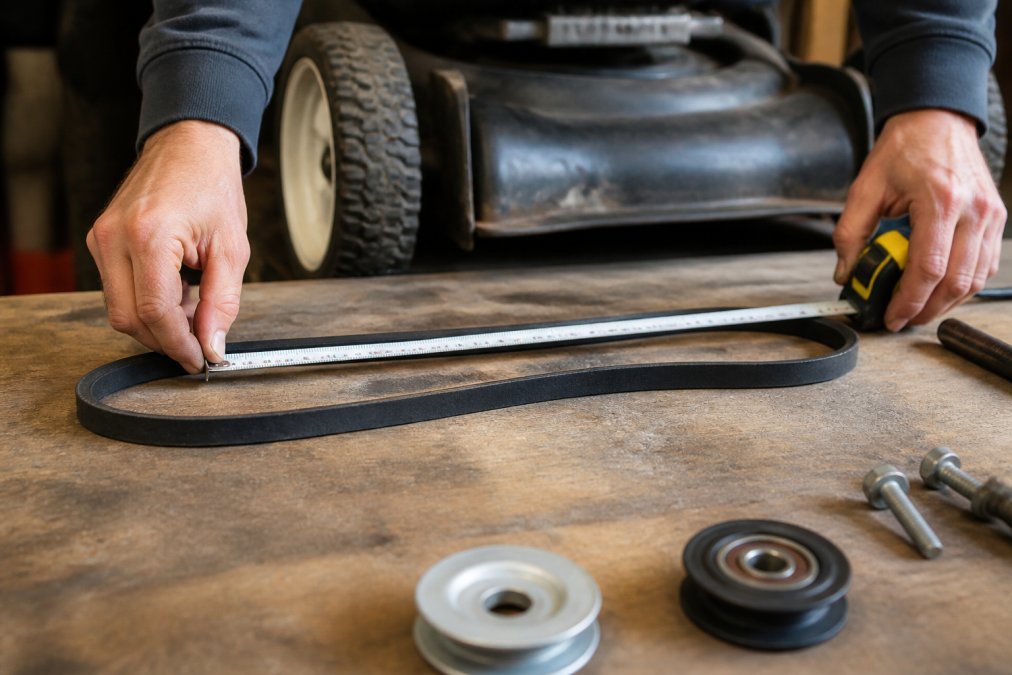
The belt width is equally important. A belt that is the right length but wrong width will sit incorrectly in the pulley groove, causing slippage. Use a caliper for the most accurate width reading.
Using a Lawn Mower Belt Cross Reference Chart
A lawn mower belt cross reference chart translates your OEM part number into compatible aftermarket options. This is where you can save money without sacrificing quality.
Start with the OEM number printed on the belt or in your manual. Enter that number into a reputable cross-reference tool. The chart will return equivalent belts from various manufacturers, often at a lower price.
Cross-referencing requires attention to the belt profile, not just the length. The profile, standard V-belt versus cogged, must match the pulley design. A cogged belt runs cooler and flexes more easily, but it must have the same dimensions as the original.
Deck Belts vs. Drive Belts: Which Replacement Do You Need?
Understanding the difference between deck belts and drive belts is essential before you buy replacement lawn mower belts. But once you know which belt you need, the next decision is what grade to buy. The material composition is the single biggest factor in how long it will last.
A deck belt spins the blades, connecting the engine pulley to the spindle pulleys. A drive belt transfers power to the transmission, moving the mower. Some riding mowers use two separate belts; others use a single belt for both.
| Belt Type | Function | Failure Symptom |
|---|---|---|
| Deck Belt | Spins the blades | Blades won't engage, or engage with a squeal |
| Drive Belt | Moves the mower | Mower won't move forward or reverse |
| PTO Belt | Engages the deck clutch | Deck won't turn on or off cleanly |
The Material Difference: Standard Rubber vs. Kevlar-Wrapped
Most OEM belts use a standard rubber compound with a polyester or fiberglass tensile cord. These are adequate for a residential mower used on a flat, half-acre lot for 30 minutes a week, typically lasting 2-3 seasons.
However, if you are running a zero-turn mower commercially, mowing a steep slope, or operating in wet, heavy grass, a standard rubber belt will overheat and fail prematurely. This is where Kevlar-wrapped belts come into play.
Kevlar-wrapped belts feature an aramid fiber wrap and tensile cords. Aramid fiber is five times stronger than steel on an equal-weight basis (PubMed). This provides two critical advantages:
- Heat Resistance: Standard rubber breaks down above 180°F (peer-reviewed research). A Kevlar-wrapped belt can operate up to 250°F without losing grip (peer-reviewed research).
- Abrasion Resistance: The aramid wrap resists wear from grass clippings and dirt, lasting 2-3 times longer than standard rubber in dusty conditions.
The Trade-Off: Flexibility and Cost
Kevlar-wrapped belts are stiffer than standard rubber. This can be a problem on mowers with small-diameter pulleys (under 3 inches) or complex routing. Most manufacturers recommend Kevlar belts only for pulleys of 3 inches or larger.
The cost difference is significant. A standard OEM-style belt costs between $15 and $25. A Kevlar-wrapped equivalent runs between $35 and $50. For a homeowner mowing a flat yard, the standard belt is the rational choice. For a commercial operator, reduced downtime justifies the higher cost.
When to Upgrade to Kevlar
Consider a Kevlar-wrapped belt if you meet any of these criteria:
- You are replacing a belt that failed in under one season.
- Your mower deck is prone to clogging with wet grass.
- You operate on slopes where the engine generates more heat.
- You are running a zero-turn mower with a 60-inch or larger deck.
Consult your owner's manual to confirm which belt you need. Ordering a deck belt when your drive belt has snapped will leave you with a mower that runs but won't move.
Step-by-Step Belt Replacement Guide
Replacing a belt is a manageable DIY task for most mowers. Here's the process that works across most residential models.
- Disconnect the spark plug wire to prevent accidental starting.
- Remove the mower deck according to your manual's instructions.
- Release belt tension by disconnecting the idler pulley spring.
- Remove the old belt, noting its routing path. Take a photo with your phone for reference.
- Install the new belt by following the routing diagram, leaving the idler pulley for last.
- Reconnect the idler spring to apply tension.
- Reinstall the deck and reconnect the spark plug.
- Test the system by engaging the blades for a few seconds.
The most common installation error is routing the belt on the wrong side of a pulley or tensioner arm. Double-check your work against the diagram.
Which Belt Supplier Should You Pick?
The right supplier depends on your equipment and urgency. For a standard residential mower and a quick fix, a big-box retailer with in-store pickup is hard to beat. For commercial operators, owners of older models, or anyone who values expert support, a dedicated supplier is worth the planning.
Our top pick is V-Belt Nation because of its extensive inventory of V-belt types and sections, including lawn and garden options. The company backs its catalog with a Price Match Guarantee and free ground shipping on all U.S. orders over $175. The personalized support team helps you find specific belts, preventing the costly mistake of installing the wrong part.
For commercial landscapers running zero-turn mowers daily, the durability of a Kevlar-reinforced belt from a specialty supplier justifies the higher upfront cost. For a homeowner with a common model, an aftermarket belt from a reputable retailer will deliver perfectly adequate performance.
Choosing the right replacement belt comes down to accurate measurement, correct identification of the belt type, and sourcing from a supplier that stands behind its products. A mismatched belt fails fast, so take the time to verify the part number and profile before you buy. V-Belt Nation combines a deep inventory of lawn and garden belts with the technical support to confirm your fitment and the delivery reliability to get you mowing again. Get started with V-Belt Nation and find the exact belt your mower needs.
Frequently Asked Questions
How do I know what belt I need for my mower?
Check the part number printed on the old belt, which is the most reliable method. If the numbers are worn off, consult your owner's manual or measure the belt yourself. You need the outside length, width, and belt profile (such as A-section or B-section). A lawn mower belt cross reference chart can then match those specs to the correct replacement part for your model.
Are lawn mower belts universal?
No, lawn mower belts are not universal. They vary in length, width, and profile, and using the wrong size causes slippage, poor cutting performance, or premature failure. While some belts fit multiple models, you must match the specific dimensions and type, such as a deck belt versus a drive belt, to ensure proper fit and safe operation on your machine.
What is the difference between a standard V-belt and a lawn mower belt?
Standard V-belts are designed for industrial power transmission, while lawn mower belts are typically built for the specific demands of mower decks and drive systems. Lawn mower belts often have a narrower profile and are reinforced to handle exposure to grass, debris, and moisture. They also may have a cogged design for flexibility around smaller pulleys, which is less common on standard industrial V-belts.
How do I measure a lawn mower belt if the numbers are worn off?
Use a fabric measuring tape to measure the belt's outside circumference. Mark the belt, then run the tape along the outside edge until you return to the mark. Next, measure the belt's width and thickness at the widest point. Compare these three measurements against a lawn mower belt cross reference chart to identify the correct replacement size.
What causes a lawn mower belt to keep breaking?
Repeated belt breakage usually points to a problem beyond the belt itself. A misaligned pulley system, a seized spindle, or incorrect belt tension are common culprits. Check that all pulleys spin freely and are aligned properly. Verify the belt is routed correctly and the tensioner is working. If those parts are fine, consider upgrading to a heavy-duty belt with Kevlar cord for better durability.