 how-to
Troubleshooting Common V-Belt Slippage Issues
Last Updated: October 29, 2026
Quick Summary
V-belt slippage is the loss of grip between the belt and the pulley groove, usually caused by wrong tension, misalignment, worn sheaves, or too much load. Fix it by re-tensioning to spec with a gauge, aligning the pulleys, and replacing worn sheaves before chasing belt changes.
- Squealing is the most common early sign of v-belt slippage, followed by glazing and a hot rubber smell.
- Never tension, inspect, or adjust a V-belt on a running drive; follow your LOTO procedure first.
- Always re-check tension after the first few hours of running, when new belts seat and lose tension.
- Fix pulley alignment before chasing tension, since a misaligned drive slips even with perfect tension.
- Replace sheaves in sets on multi-groove drives, because one worn sheave keeps slipping.
Table of Contents
- Worn V-Belt Symptoms That Point to Slippage
- What Causes a V-Belt to Slip: From Installation Error to Motor Load
- How to Tension a V-Belt Without Guessing
- V-Belt Pulley Alignment: The Fix Most Techs Skip
- Sheave and Pulley Inspection: Groove Wear, Spin Burn and Shaft Breakage
- How Slippage Damages Bearings, Motors and Drive Efficiency
- Finding the Right V-Belt Replacement Size
- Ordering the Correct Replacement Belt for Your Drive
- Frequently Asked Questions
Worn V-Belt Symptoms That Point to Slippage
V-belt slippage is the loss of grip between the belt and the pulley groove, and it announces itself long before a machine goes down.
Slippage rarely starts as a breakdown. It starts as noise, heat, and dust.
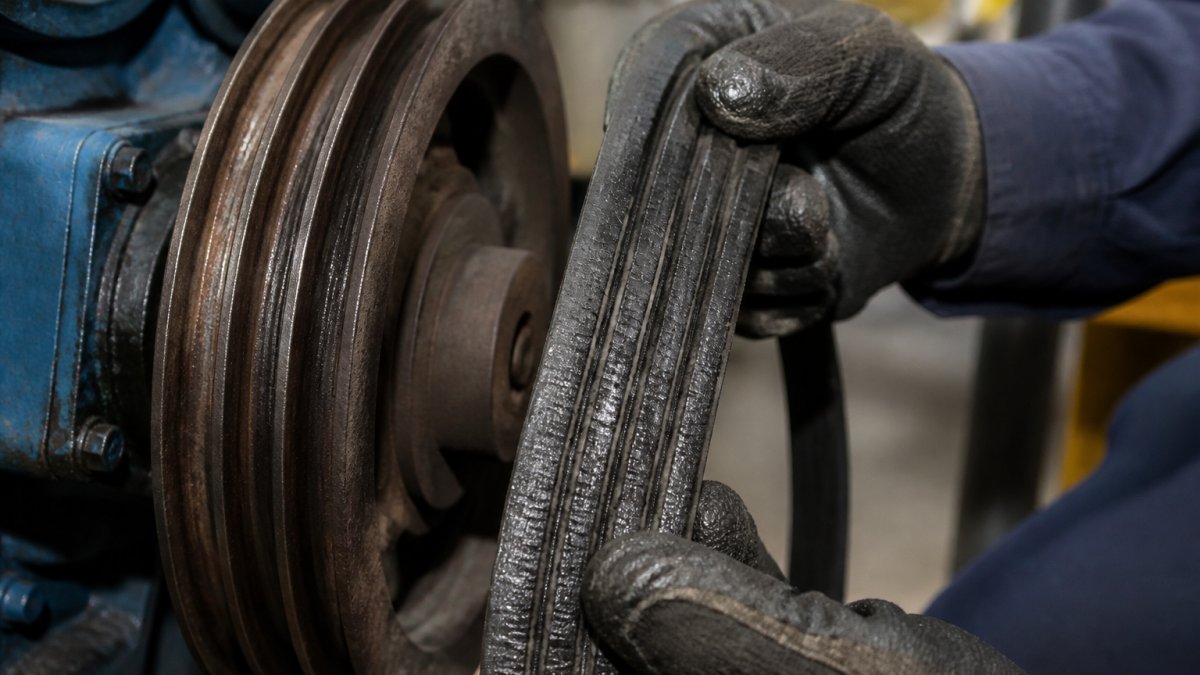
Squealing, Glazing and the Smell of Burning Rubber
Squealing is the most common early sign of v-belt slippage. V-Belt vs Serpentine Belt Squealing: Key Differences The belt is sliding instead of gripping, and that friction vibrates at a pitch you can hear across the plant floor.
Glazing follows. The belt's sidewalls turn shiny and hard, which kills grip even further. You may also catch a hot rubber smell near the drive. That smell means heat buildup is already damaging the belt compound.
Glazing is a wear symptom, not a lubrication problem.
Vibration, Heat Buoyancy and Uneven Wear Patterns
Vibration and heat tell a quieter story than squealing, but they matter just as much. A slipping belt sheds rubber dust, and that dust settles on the guard and sheave.
Pull the belt and inspect it in good light. Look for:
- One sidewall worn deeper than the other
- A band of cracked ribs in a single spot
- Polished, glassy patches on the groove floor
- Belt stretch that leaves the adjuster near its limit
Uneven wear patterns usually point to misalignment, not old age. If the wear is lopsided, replacing the belt alone will just restart the clock.
What Causes a V-Belt to Slip: From Installation Error to Motor Load
Most v-belt slippage traces back to four causes: wrong tension, misalignment, worn sheaves, or too much load. Installation error sits at the top of that list, and it is the easiest to fix.
Here is how the causes sort out in practice:
| Cause | Typical Sign | First Fix |
|---|---|---|
| Loose tension | Squeal at startup, black dust | Re-tension to spec |
| Over-tension | Whining, hot bearings | Back off tension |
| Misalignment | One-sided wear, belt walk | Straight-edge check |
| Worn sheave grooves | Belt sits low, slips hot | Replace sheave |
| Motor overload | Slip under peak load only | Check driven load |
Installation error covers more ground than people expect. A belt forced over a sheave with a screwdriver gets internal cord damage that shows up as stretch weeks later.
Motor load is the cause techs blame last and should check sooner. If a drive only slips during peak demand, the belt may be fine and the driven equipment may be binding.
How to Tension a V-Belt Without Guessing
Correct v-belt tension is the point where the belt grips under load without overloading the bearings. You find it with a measured deflection check, not by feel, and you do it under lockout, not while the drive is live.
Too loose and it slips. Too tight and you cook the bearings.
Follow this sequence:
- Shut down and lock out the drive per your LOTO procedure.
- Remove the guard and inspect the belt and sheaves before adjusting anything.
- Loosen the motor or idler mounting bolts.
- Move the motor to remove slack, keeping sheaves parallel.
- Check deflection at the span midpoint with a gauge or ruler.
- Re-tighten mounts and re-check after a short run-in.
Always re-check tension after the first few hours of running. New belts seat into the grooves and lose tension quickly, which is when most v-belt slippage appears on a fresh install.
Using a Tension Gauge and Checking Belt Deflection
A tension gauge removes the guesswork. Choosing the Right V-Belt Tensioner: What to Know It measures force at a set deflection, so two techs get the same result. The two common styles are the spring-loaded deflection gauge (you press until the belt deflects a set amount and read the force) and the sonic tension meter (you pluck the belt and read its natural frequency against a target for the belt's mass and span).
- Use the gauge spec for your belt section and span length.
- Measure at the midpoint, perpendicular to the belt.
- Record the reading so the next check has a baseline.
- Match both belts on a multi-belt drive within spec.
On matched drives, one loose belt carries less load and slips first. That single slipping belt then drags the whole set toward early failure.
Watch out: over-tensioning to "be safe" is the fastest way to wreck a drive end bearing. More tension is not more grip past the spec.
V-Belt Pulley Alignment: The Fix Most Techs Skip
V-belt pulley alignment is the step that gets skipped when a machine is rushed back into service.
Check alignment with a straight edge across both sheave faces. The edge should touch all four points evenly. On drives with a long span, a laser alignment tool pays for itself in saved belts.
Misalignment comes from a few usual suspects:
- Motor feet shimmed unevenly
- A bent or worn base frame
- Sheaves not fully seated on the shaft
- Couplings or bearings that have shifted
Fix alignment before you chase tension. A perfectly tensioned belt on a misaligned drive will still slip and still wear out early.
Sheave and Pulley Inspection: Groove Wear, Spin Burn and Shaft Breakage
Sheave condition decides whether a new belt grips or slips.
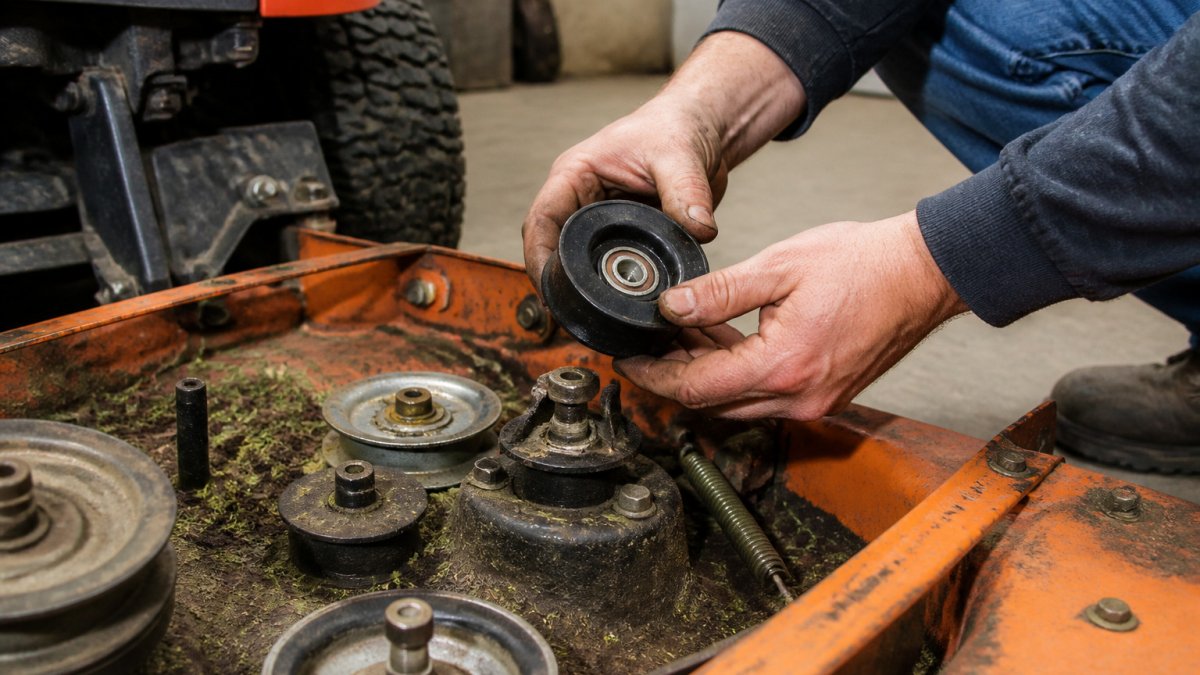
A worn groove lets the belt sink too deep. The belt then rides on the groove floor instead of gripping the sidewalls, and grip drops fast.
Look for spin burn too.
Inspect for:
- Shiny, polished groove floors
- Grooves worn wider at one end
- Cracks radiating from the keyway
- A sheave that rocks on the shaft
Replace sheaves in sets on multi-groove drives. One worn sheave among good ones keeps slipping no matter how many belts you change.
How Slippage Damages Bearings, Motors and Drive Efficiency
Every slipping belt turns power into heat instead of motion. That lost power is drive efficiency walking out the door, and the heat lands on your bearings and motor. The damage is cumulative and mostly invisible until it is expensive.
A slipping belt needs more tension to transmit the same torque, and that extra tension loads the drive end bearing. Over time you get bearing failure, vibration, and eventually shaft damage.
The costs stack up quietly:
- Higher energy draw for the same output
- Shortened bearing and motor life
- More belt changes per year
- Unplanned downtime at the worst moment
Reading the Damage: Bearing, Motor, and Belt Material Clues
You can often tell how long a drive has been slipping by what else is failing.
Belt material changes the failure timeline. Standard rubber-impregnated belts glaze and harden under slip heat, then crack. Aramid-cord belts resist stretch and heat better, so they may slip longer before they show obvious wear, which means the bearing and sheave take the damage instead.
DIY or Call a Pro? A Simple Threshold
Most guides assume you have a millwright on call. If you are a hobbyist, farmer, or small-shop operator, use this threshold:
- Fix it yourself: visual inspection, guard removal, deflection check with a gauge, cleaning dust, replacing a single belt on a small drive under about 5 hp with a standard section.
- Call a pro: any drive over 10 hp, any banded or wedge belt set, any sign of sheave groove wear or spin burn, any bearing noise or motor current change, and any drive where you cannot verify the tension spec. Laser alignment and sheave replacement are also pro jobs on most equipment.
Preventative maintenance beats all of it. A monthly check of tension, alignment, and sheave wear catches v-belt slippage while it is still a cheap fix.
Finding the Right V-Belt Replacement Size
A slipping belt is sometimes just the wrong belt.
Read the old belt's markings before you toss it. If the markings are gone, measure the outside length and match the section to the sheave groove.
Never substitute a different section to "make it fit." A belt that sits wrong in the groove will slip, glaze, and fail early every time.
Ordering the Correct Replacement Belt for Your Drive
Ordering the right belt is where a good diagnosis pays off. Match section, length, and construction to the drive, and buy from a supplier who stocks the odd sizes.
A few rules we stand behind:
- Match the section exactly, not just the length
- Replace multi-belt sets together, never one at a time
- Keep the old belt's markings for the next order
- Confirm cogged versus standard if the drive runs small sheaves
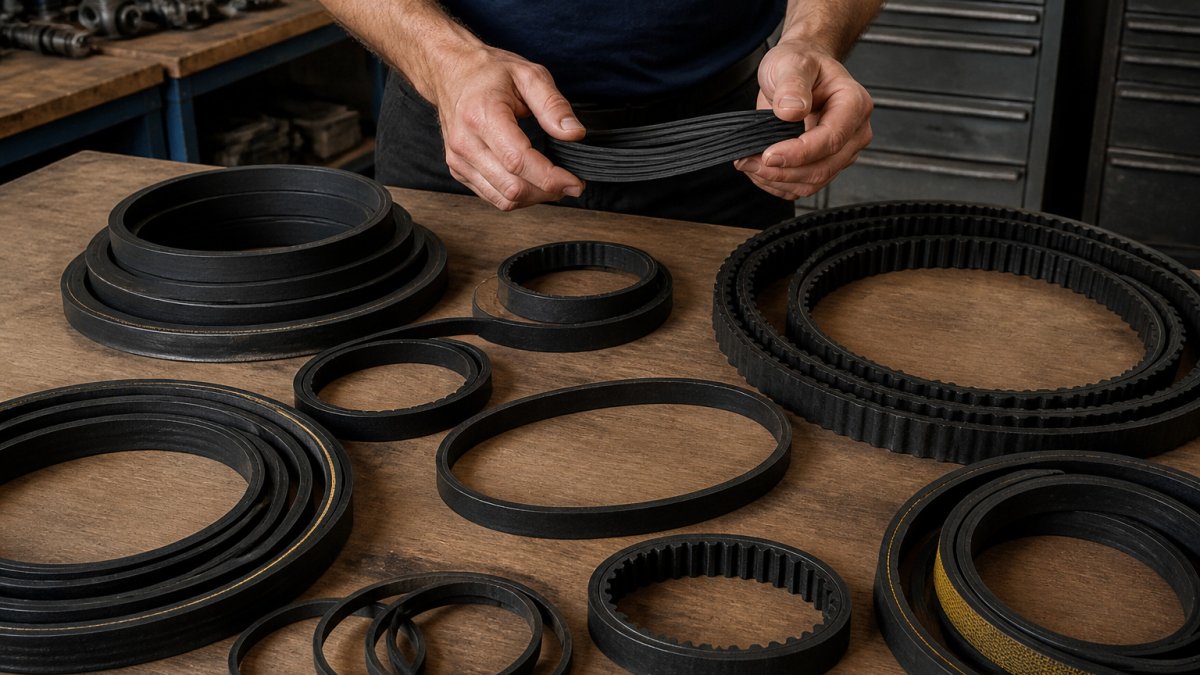
V-Belt Nation offers a comprehensive selection of industrial V-belts, including classic, wedge, cogged, banded, and lawn and garden options. Our team provides personalized support to help you find the specific belt you need. We offer a price match guarantee and free ground shipping on U.S. orders over $175.
Frequently Asked Questions
Why does my V-belt keep slipping after I tension it?
If a freshly tensioned belt still slips, the cause is usually elsewhere in the drive. Check for pulley misalignment, worn sheave grooves that no longer grip the belt sides, or a belt that has stretched past its adjustment range. Oil or grease on the belt and pulley faces will also kill friction. Inspect the sheave for a polished groove floor and spin burn, verify alignment with a straightedge, and replace the belt if it is glazed or cracked rather than overtightening it.
How can I tell if a V-belt is too loose?
A loose belt shows visible deflection when you press midway between the pulleys, and it often squeals on startup or under load. You may also see belt dust collecting around the drive and notice the belt sitting low in the groove. Use a tension gauge to compare against the belt manufacturer's deflection spec instead of judging by feel. A belt that needs constant retensioning is usually worn or the wrong size, not simply loose.
Can misaligned pulleys cause a V-belt to slip?
Yes. V-belt pulley alignment matters because the belt must enter and exit each sheave squarely. Angular or parallel misalignment forces the belt to ride against the groove sidewall, which reduces belt grip, creates uneven wear patterns and causes heat buildup. It also loads the drive end bearing. Check alignment with a straightedge or laser tool across both pulley faces, and shim or reposition the motor before installing a new belt.
Should I use belt dressing on a slipping V-belt?
Belt dressing is a short-term patch, not a repair. It can temporarily restore grip on a glazed belt, but it masks the real problem, attracts dirt and can make the belt slip again once it dries. If a belt is slipping, find the cause: tension, alignment, worn sheave grooves or the wrong V-belt replacement size. A belt that only grips with dressing is ready to be replaced.
Stop losing production hours to a belt that squeals every shift. Get the right belt, the right tension, and the right fit the first time. Get started with V-Belt Nation and keep your drives gripping under load.