 how-to
How Do You Choose the Right Industrial Belt Material?
Quick Summary
To choose industrial belt materials, first define your operating requirements: what is moving, peak load, speed, environment, and temperature range. Then eliminate materials that fail hard limits for temperature, chemical exposure and load before comparing cost and grip.
- Write down operating limits first, including peak load, speed, environment and temperature range.
- Shortlist in four passes: temperature, chemical exposure, load and speed, then abrasion, grip, hygiene and cost.
- Choose rubber for heavy, abrasive bulk and high-friction drives; choose polyurethane for clean lines and sharp-edged parts.
- Check every oil, grease, coolant and cleaning agent against the supplier's resistance chart before ordering.
- Compare belts on cost per operating hour, not purchase price, including downtime and scrap.
Table of Contents
- Start With Your Operating Requirements
- Understanding Industrial Belt Material Types
- Rubber vs Polyurethane Belts: Where Each Performs Best
- Checking Belt Material Chemical Resistance
- A Material-Selection Matrix With Measurable Limits
- V-Belt Material Selection Step by Step
- Lifecycle Cost, Failure Modes and Your Next Order
- Frequently Asked Questions
Start With Your Operating Requirements
Last Updated: October 29, 2026
Choosing the right industrial belt materials starts before you look at a catalog.
If you can't describe your operating conditions in numbers, you're not ready to pick a material.
Start with these questions:
- What is moving? Dry bulk, wet product, sharp-edged parts, hot food or abrasive ore each push the material in a different direction.
- How much load? Peak load matters more than average. Size for the worst moment.
- How fast? Higher speeds build heat and flex fatigue faster.
Write these down as operating limits, the filter you apply to every material you consider.
Don't treat the existing belt as the spec. If the old belt keeps failing, the material was probably wrong, and copying it guarantees the same result.
Understanding Industrial Belt Material Types
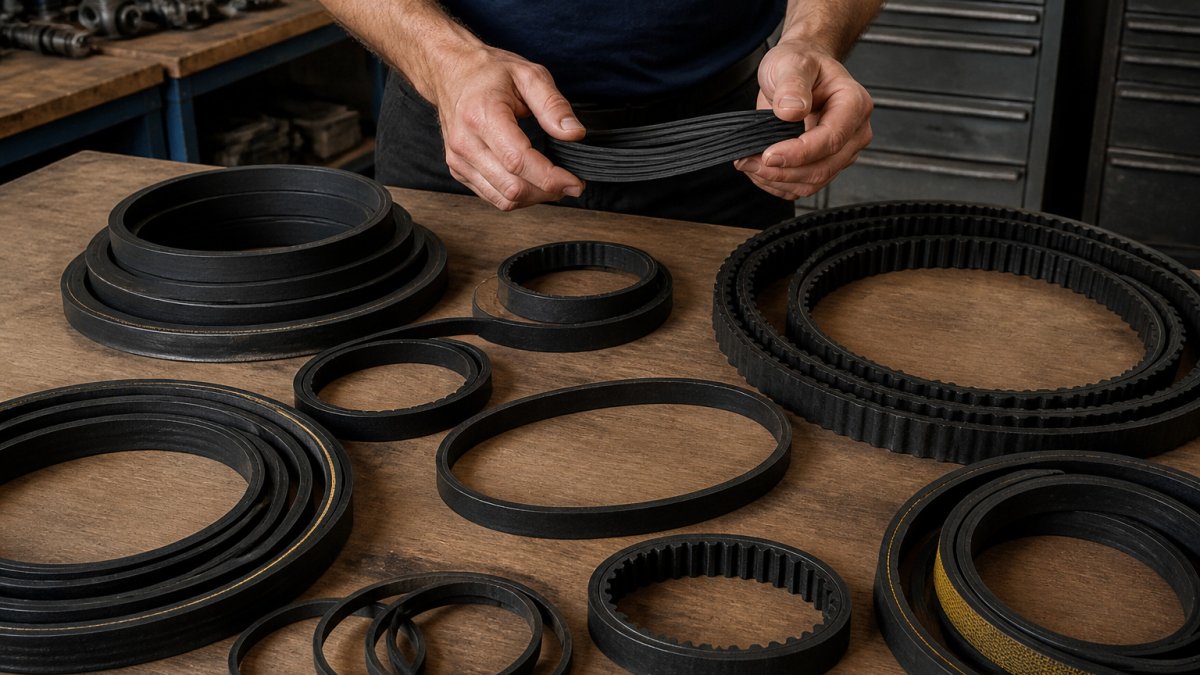
Industrial belt materials are built from a few core families, each trading strengths against weaknesses. Before comparing options, check the quality standards and ratings a belt should meet so you know which constructions qualify.
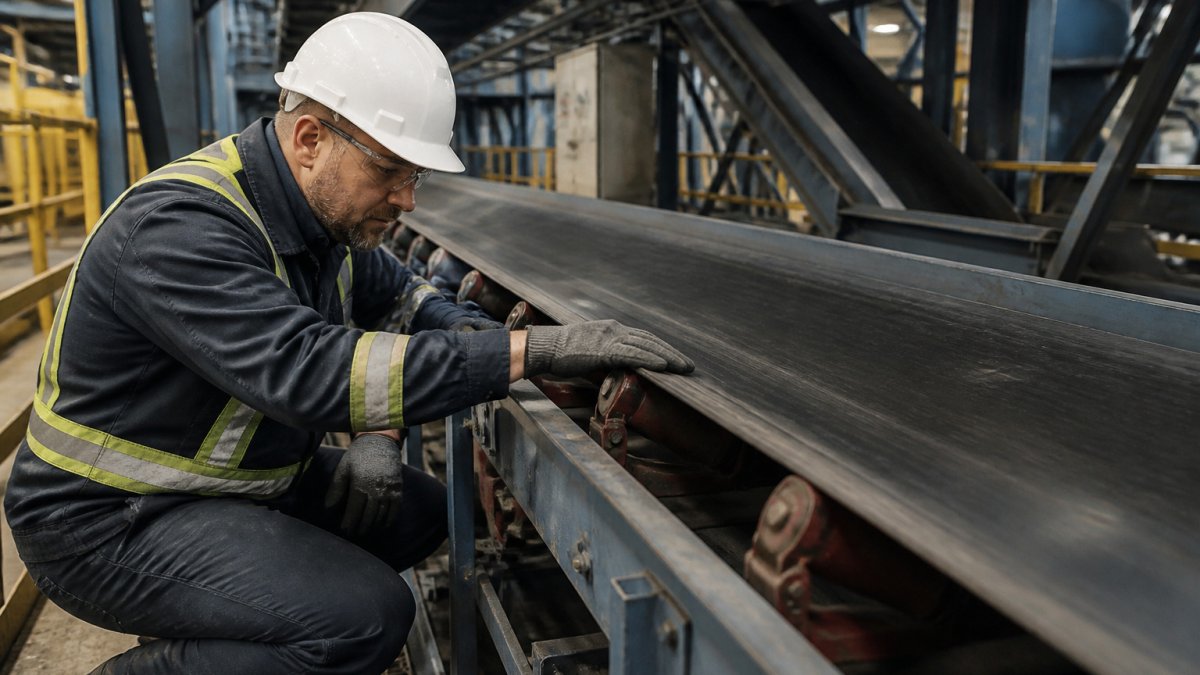
Rubber is the workhorse: good grip, shock absorption and a wide temperature range at reasonable cost. PVC suits light-duty, low-tension conveying.
Reinforcement matters as much as the outer material.
A belt rated for high tension can still fail fast if its cover doesn't match the conveyed product.
Best for: plants that run mixed products and need one belt family to cover several jobs.
Rubber vs Polyurethane Belts: Where Each Performs Best
The rubber versus polyurethane question comes up on almost every quote, and each wins in a different place.
Rubber belts perform best where grip and shock absorption matter most.
- Choose rubber for heavy, abrasive bulk material and high-friction drive needs.
- Choose polyurethane for hygiene-sensitive lines, sharp-edged parts and lighter, faster conveying.
- Check the cost per hour, not just the purchase price. A cheaper belt that wears out twice as fast costs more over its life.
Polyurethane is not automatically better. In heavy, grit-laden service, rubber's grip and cushioning can outlast it.
Skip if: your line is light-duty and hygiene isn't a concern, since the cost premium for polyurethane may not pay back.
Checking Belt Material Chemical Resistance
Chemical exposure is the most overlooked factor in material selection.
List every substance that touches the belt, process oils, greases, coolants, cleaning chemicals and anything the product releases, then check each against the material's resistance chart from your supplier.
Pay special attention to:
- Oils and greases: Neoprene handles many petroleum oils well, while some other rubbers swell in them.
- Cleaning agents: Frequent washdown with strong sanitizers can degrade certain covers faster than expected.
- Moisture: Constant wetness and humidity affect both the cover and the reinforcement over time.
When a chemical is in question, request a sample and run a short test before committing to a full order. A few days of testing costs far less than an unplanned line stop.
A Material-Selection Matrix With Measurable Limits
A selection matrix turns your operating requirements into a clear decision. The version below is built around measurable operating limits rather than adjectives, so you can eliminate materials that fail a hard limit before weighing cost or preference.
| Material | Typical Continuous Service Temperature | Abrasion Resistance | Oil and Grease Resistance | Moisture and Washdown | Relative Load Capacity | Relative Cost | Best Fit |
|---|---|---|---|---|---|---|---|
| General-purpose rubber (NR/SBR) | Roughly -20°F to 180°F | Good | Fair, swells in many petroleum oils | Fair | High | Low | Heavy bulk, high grip, shock loads |
| Nitrile rubber (NBR) | Roughly -20°F to 210°F | Good | Very good | Fair | High | Low to medium | Oily bulk, grain and aggregate with oil mist |
| Neoprene (CR) | Roughly -20°F to 220°F | Good | Very good | Good | Medium to high | Medium | Outdoor service, oily and weather-exposed drives |
| Polyurethane (PU) | Roughly -10°F to 175°F | Very good | Good | Good | Medium | Medium to high | Clean lines, sharp-edged parts, light to medium loads |
| PVC | Roughly 20°F to 140°F | Fair | Fair | Good | Low | Lowest | Light-duty, low-tension conveying |
| Silicone | Roughly -60°F to 400°F | Fair | Fair | Good | Low | High | High-heat and low-temperature extremes |
Treat every number in that table as a starting filter, not a guarantee. Temperature limits shift with belt thickness, cover compound, splice type and how often the belt flexes over small pulleys.
How to shortlist in four passes
- Eliminate on temperature first. Cross out any material whose continuous service range does not cover your peak ambient plus any heat the product or drive adds. Watch cold starts too: a belt that turns brittle at 0°F can crack on the first startup.
- Eliminate on chemical exposure. Check every oil, grease, coolant, cleaning agent and process chemical against the supplier's resistance chart. A material marked 'good' for occasional splash may be unsuitable for continuous immersion or daily washdown.
- Eliminate on load and speed. Match the belt's rated tension and minimum pulley diameter to your drive. A material that passes temperature and chemical checks can still fail if it cannot carry the peak load or flex over your smallest pulley without heat buildup.
- Score the survivors on abrasion, grip, hygiene and cost. Only now compare purchase price and expected life. The cheapest surviving material is not automatically the best once downtime and replacement labor are counted.
Worked example: three materials, one drive
Suppose a drive moves oily metal stampings at a peak ambient of 150°F, with daily washdown and a smallest pulley of 4 inches. General-purpose rubber is eliminated on oil resistance. PVC is eliminated on temperature and load. Nitrile rubber and polyurethane both survive the hard limits; neoprene also survives if outdoor weather exposure is a factor. The final choice then comes down to abrasion severity, grip needs and cost per hour of service, not the lowest sticker price.
That is the point of a measurable matrix: it narrows the field to materials that can actually do the job, then lets you compare the survivors on economics and preference. For current product data and chemical resistance charts, request the manufacturer's material datasheet before you commit to a full order.
V-Belt Material Selection Step by Step
V-belts follow a different path than flat or cogged belts, because the wedge shape and grooved sheave add their own requirements.
- Confirm the belt section and length first. Material choice doesn't fix a wrong fit, so verify the section and pitch length before comparing materials.
- Set the service factor. Apply a service factor based on how hard the drive runs, then size the belt for the adjusted load.
- Check the sheave condition. Worn or misaligned sheaves wear any V-belt material faster, so inspect them before blaming the belt.
- Match the material to the environment. Use standard rubber for general duty, and move to oil-resistant or heat-resistant compounds when the environment calls for it.
- Confirm the operating temperature. High ambient heat shortens belt life, so pick a compound rated above your peak temperature.
- Order a trial set. Run a small batch under real conditions and log wear, noise and slip over the first few weeks.
Compatibility matters here. A V-belt made for one groove profile will not seat properly in another, causing slip and uneven wear that looks like a material problem.
Lifecycle Cost, Failure Modes and Your Next Order
The cheapest belt on the quote rarely produces the lowest lifecycle cost. Count four things: purchase price, installation labor, production lost during downtime, and scrap or rework from slip, tracking problems or breakage. Divide the total by expected service hours to get a cost per operating hour you can compare across materials.
A simple total-cost-of-ownership calculation looks like this:
Cost per operating hour = (belt price + installation labor + downtime cost per replacement × number of replacements + scrap and rework cost) ÷ total operating hours over the comparison period
The formula matters more than any example figures, so use your own belt prices, labor, downtime and scrap costs.
Match the symptom to the material cause
Failure usually has a recognizable cause, and the symptom points to whether the next belt should change material or whether the drive needs fixing first. Review the root causes of premature belt failure to avoid repeating them.
| Symptom | Likely material or drive cause | Corrective direction |
|---|---|---|
| Cracking, hardening, glazing | Compound not rated for operating temperature, or heat from a small pulley or high speed | Move to a higher-temperature compound; check pulley diameter and speed |
| Swelling, softening, tackiness | Chemical attack from oil, solvent or cleaning agent | Switch to an oil- or chemical-resistant cover; verify against the resistance chart |
| Edge fraying, uneven wear | Misalignment, worn sheaves or poor tracking | Fix alignment and sheave condition before changing material |
| Delamination or cover separation | Adhesion failure from heat, moisture or incompatible splice | Review splice method and moisture exposure; confirm cover-to-carcass bond rating |
| Slipping, squealing, low grip | Wrong tension, worn sheaves, or a cover too hard for the drive | Check tension and sheave profile; consider a higher-friction cover |
| Surface abrasion or gouging | Product too sharp or abrasive for the cover | Move to a cut- and abrasion-resistant cover such as polyurethane |
Keep a replacement log that supports the next order
Keep a simple log for each drive: install date, belt material and construction, operating conditions, hours run and reason for replacement. A practical method for spotting cracks before a failure occurs can be added to each inspection entry.
When you request a quote, bring:
- Your operating limits: peak and average load, speed, temperature range, and every chemical the belt contacts
- The failure history from your log, including symptoms and hours to failure
- The sheave profile, minimum pulley diameter and drive dimensions
Pricing depends on quantity, delivery timing and the specific belt construction. For current prices or a quote, check V-Belt Nation's website or contact the team directly.
Common Material Mistakes to Avoid
Most material mistakes are avoidable, and they recur in replacement orders.
- Choosing on price alone. The lowest-cost belt often has the shortest life in tough conditions, and downtime cost dwarfs the price difference.
- Ignoring chemical exposure. A cover that handles dust may fail fast in oil mist or daily washdown.
- Copying the old belt without checking why it failed. Follow correct installation practices so the chosen material performs as intended. Repeating the same material repeats the same failure.
Avoid these and your next material choice will rest on your conditions and lifecycle cost, not guesswork.
Frequently Asked Questions
What materials are industrial belts made from?
Industrial belts are most often made from rubber compounds such as neoprene, EPDM, nitrile and natural rubber, or from polyurethane, PVC and fabric-reinforced synthetic plies. Reinforcement layers of polyester, nylon or aramid cords carry the tensile load. The base compound determines how the belt handles oil, heat, abrasion and moisture, while the reinforcement determines strength and elongation. Your operating conditions, not the material name alone, should drive the final choice. V-Belt Nation can confirm compound options for specific sections and applications when you request a quote.
What is the difference between rubber and polyurethane belts?
Rubber belts offer flexibility, good grip and a lower purchase price in most designs, and they tolerate a wide temperature range in many compounds. Polyurethane belts provide higher abrasion resistance, cleaner operation and better resistance to many oils and greases, and they often suit food-contact or hygiene-sensitive lines. Polyurethane can be less tolerant of heat and some chemicals, so check the specific compound against your conditions. Pricing depends on quantity, dates and delivery, so request a current quote from V-Belt Nation.
Which belt materials resist oil, heat and chemicals?
Nitrile (NBR) and neoprene (CR) compounds are common choices for oil and grease exposure in V-belts. EPDM handles heat, ozone and water well but performs poorly with petroleum oils. Polyurethane resists many oils and abrasion but can degrade with some solvents and high heat. Always match the compound to the specific oil, chemical concentration and maximum temperature in your application, and confirm with the belt supplier's chemical resistance chart before ordering.
How does belt material affect wear and service life?
Abrasion resistance, heat tolerance and resistance to oil or chemical attack determine how quickly a belt wears or hardens. A compound that cracks under heat or swells in oil will fail early even if the reinforcement is strong. Matching material to conditions and checking tension, pulley alignment and sheave condition typically extends service life more than switching brands. Track replacement intervals to measure real performance in your plant.
Choosing the right material comes down to knowing your operating limits, matching the cover and reinforcement to the job, and checking the chemicals and temperatures before you buy. At V-Belt Nation, our team can help you narrow the options and confirm fit for your specific drive. Shop our full range of V-belts and power drive solutions, and reach out if you need help matching a belt to your conditions.